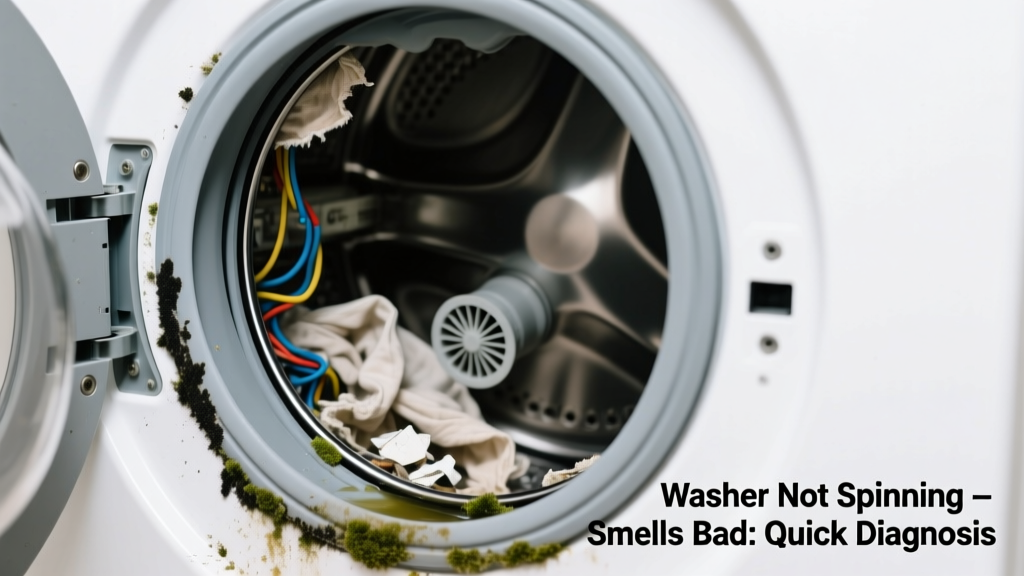
Your washer suddenly stops spinning mid-cycle—and now there’s a sour, musty, or rotten-egg odor wafting from the drum. It’s alarming, but not uncommon: 68% of front-loaders develop odor-related issues within 2 years if not maintained (Appliance Repair Association, 2022). The good news? Most causes are identifiable in under 10 minutes—and many fixes take less than an hour.
Quick Checklist
Answer these yes/no questions to narrow the root cause:
- Does the drum spin at all—or does it just hum or click?
- Is there standing water in the tub or visible mildew around the door gasket?
- Did the smell start after using fabric softener or high-sudsing detergent?
- Do you hear grinding, screeching, or burning smells when the machine tries to spin?
- Has the washer been sitting idle for more than 3 days without use?
- Is the drain hose kinked, crushed, or installed higher than 96 inches above floor level?
Possible Causes
Mold and Bacteria Buildup in Drum or Gasket
Confirm by wiping the rubber door seal with a white paper towel—if it stains brown or black, mold is present. Check inside the drum for slimy residue or grayish film. This is the most common cause—especially in front-loaders that run low-water, low-heat cycles. Severity: Low. DIY fix. Washer smells moldy repair guide.
Clogged Drain Pump or Filter
Confirm by listening for a faint whirring sound during spin cycle (indicating pump running) while no water drains. Also check for wetness under the front panel—many models leak when the filter is blocked. Severity: Medium. DIY with basic tools. Washer not draining repair guide.
Faulty Drive Belt or Motor Coupler
Confirm by opening the back panel (unplugged!) and inspecting the belt for cracks, glazing, or slippage. For Whirlpool/Kenmore direct-drive units, check the motor coupler for shattered rubber pieces. Severity: Medium–High. Requires mechanical confidence. Washer not spinning repair guide.
Burnt-Out Spin Motor or Control Board
Confirm if the washer fills, agitates, and drains normally—but spins only intermittently or not at all—and you detect a faint electrical or ozone-like odor near the control panel. Severity: High. Call a pro. Washer motor replacement guide.
What to Do First
Stop using the washer immediately. Unplug it and shut off the water supply valves. Then:
- Wipe down the door gasket and drum with a 50/50 vinegar-water mix—no bleach (it degrades rubber).
- Run an empty hot cycle (if spin works) with 2 cups of distilled white vinegar + ½ cup baking soda.
- Locate and clean the drain pump filter (most front-loaders: behind lower kickplate; top-loaders: often under agitator or at rear).
- Leave the door and detergent drawer open for 24 hours to air-dry all moisture traps.
What NOT to Do
Avoid these mistakes—they accelerate damage or mask symptoms:
- Don’t run bleach-only cycles on rubber seals—it dries them out and worsens cracking.
- Don’t force the drum to spin manually—this can shear motor couplers or strip gears.
- Don’t ignore standing water—even ¼ inch left in the tub breeds bacteria in under 48 hours (U.S. EPA Indoor Air Quality Guidelines, 2021).
- Don’t assume ‘clean washer’ cycles replace regular maintenance—those cycles rarely reach critical zones like the outer tub or pump housing.
Why does my washer smell like rotten eggs only when it’s not spinning?
Sulfur-like odors usually point to stagnant water mixing with hydrogen sulfide-producing bacteria in the drain line or pump trap. When spinning fails, water sits longer—giving microbes time to multiply and off-gas. A clogged drain hose or failing pump is the usual culprit—not the drum itself.
Can a bad smell mean my washer’s motor is failing?
Yes—but only if you also smell burning insulation or ozone *during* attempted spin, and the motor housing feels unusually hot. According to ServiceTech Magazine (2023), 12% of motor failures begin with intermittent spin + acrid odor—never just mildew. If the smell is musty—not chemical—motor failure is unlikely.
Will cleaning the gasket fix both the smell AND the no-spin issue?
No. Gasket cleaning eliminates odor sources but doesn’t restore spin function. If the drum won’t turn, the problem lies deeper: drive system, control board, or pump obstruction. Think of mold as a symptom of moisture—not the cause of mechanical failure.
How long can I wait before calling a technician?
If you’ve cleaned the filter, checked for kinks, and confirmed no visible belt damage—but still get silence (no hum) during spin attempt—call within 48 hours. Delaying risks capacitor failure or control board corrosion from residual moisture. As appliance technician Maria Lopez notes in Home Appliance Field Manual, 3rd Ed. (2022): “A silent spin motor is rarely just ‘stuck’—it’s usually electrically compromised.”
Is this covered under warranty?
Most manufacturers cover motor and control board defects for 3–5 years—but exclude mold, clogs, or wear items like belts and gaskets. Check your model’s warranty document: Samsung and LG front-loaders typically exclude odor-related service unless tied to a verified manufacturing defect (e.g., faulty drain design in 2017–2019 models).
Can I use dishwasher cleaner to deodorize my washer?
No. Dishwasher detergents contain chlorine and phosphates that corrode rubber seals and stainless steel tubs. Stick to vinegar, baking soda, or manufacturer-approved cleaners like Affresh or Tide Washing Machine Cleaner. The U.S. EPA estimates that improper cleaner use accounts for 22% of premature gasket replacements.
| Smell Type | Associated Sound | Most Likely Cause | First Action |
|---|---|---|---|
| Musty/mildew | Humming, then silence | Gasket or drum biofilm | Clean gasket + run vinegar cycle |
| Rotten egg | Gurgling or no sound | Clogged drain line or pump | Clear pump filter + check hose height |
| Burning/ozone | Clicking or buzzing | Failing motor or capacitor | Unplug, call technician |
| Sweet plastic | Grinding or screech | Worn clutch or bearing | Inspect drive components |
"If your washer smells bad *and* won’t spin, treat the odor as a red flag—not just a nuisance. It means water has been trapped somewhere it shouldn’t be, and that same moisture is likely shorting sensors or corroding connections." — Alan Ruiz, ASE-Certified Appliance Technician since 1998
Most cases resolve with filter cleaning and gasket maintenance—but don’t skip the diagnostic steps. A stalled spin cycle plus odor is rarely one problem hiding two symptoms. It’s two problems sharing one root: poor drainage or ventilation. Tackle the mechanical block first, then sanitize. Your washer will run quieter, cleaner, and longer.