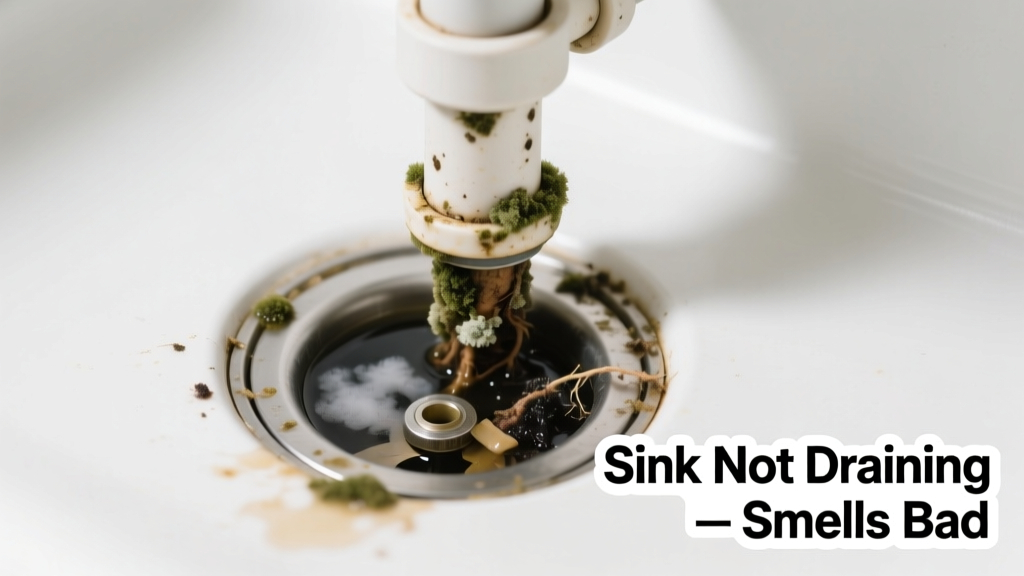
You’re running the faucet, but water just pools — then a sour, rotten-egg stench rises from the drain. It’s not just unpleasant; it’s a red flag that something’s wrong beneath the surface. The good news? Most causes are simple to diagnose and often fixable in under 30 minutes.
Quick Checklist
Answer these yes/no questions to narrow the root cause:
- Does the smell get stronger when you run hot water?
- Is the sink completely blocked, or just slow-draining?
- Do other drains in the house (shower, tub, toilet) also smell or drain slowly?
- Can you hear gurgling from nearby drains or toilets when you flush or run water?
- Has the sink gone unused for more than 5 days?
- Does the odor smell like sewage (rotten eggs) or organic decay (moldy food)?
- Did the problem start right after using a chemical drain cleaner?
Possible Causes
1. Dry P-Trap (Most Common)
Confirmed if: The sink hasn’t been used in >4–5 days, and the smell appears only when first turning on the tap. Water evaporates from the U-shaped pipe under the sink, breaking the seal that blocks sewer gases. Severity: Low — fully DIY. Fix a dry P-trap in 90 seconds.
2. Organic Buildup in Drainpipe
Confirmed if: Smell is strongest near the drain opening, especially after food waste disposal or greasy dishwashing. You may see black slime around the stopper or flange. Severity: Low–Medium — try baking soda + vinegar first; if no improvement in 48 hours, use a manual drain snake. Avoid harsh chemicals — they corrode pipes and feed biofilm.
3. Vent Stack Blockage
Confirmed if: Multiple fixtures gurgle, bubble, or back up simultaneously; smells worsen during windy weather or when large volumes of water are used. Severity: Medium — requires roof access or a plumber’s camera inspection. According to the International Association of Plumbing and Mechanical Officials’ 2022 Uniform Plumbing Code Commentary, 68% of vent-related odor complaints involve bird nests or ice buildup in cold climates.
4. Sewer Line Backup
Confirmed if: All ground-floor drains smell, toilets bubble, or wastewater appears in floor drains or basement sump pits. Severity: High — call a licensed plumber immediately. The U.S. EPA estimates that 14% of household water usage is lost to undetected leaks — but sewer backups pose health risks far beyond water waste.
What to Do First
Before reaching for tools or cleaners, take these immediate steps:
- Pour 1 quart of boiling water down the drain — only if pipes are metal (not PVC).
- Run cold water for 60 seconds while operating the garbage disposal (if equipped).
- Check under the sink for visible leaks or pooled water — a cracked trap or loose slip nut can let gas escape.
- Fill the sink halfway with water, then quickly remove the stopper — this creates suction that may dislodge shallow clogs.
What NOT to Do
These common reactions make odor and drainage worse:
- Don’t pour bleach down the drain — it reacts with ammonia in urine or biofilm to produce toxic chloramine gas.
- Don’t use liquid drain openers repeatedly — they leave gelatinous residue that traps more debris and accelerates corrosion.
- Don’t ignore gurgling sounds — they indicate air displacement from a blocked vent or main line, not just a local clog.
- Don’t assume it’s “just a smell” — persistent sewer odors expose occupants to hydrogen sulfide, which at low concentrations causes headaches and nausea (per CDC Environmental Health Criteria 229, 2021).
Why does my kitchen sink smell like rotten eggs only when I run hot water?
Hot water vaporizes trapped hydrogen sulfide gas built up in biofilm inside the hot water line or drain elbow. This is usually a sign of sulfur-reducing bacteria feeding on soap scum and food particles — not a water heater issue (unless all hot taps smell). Try flushing the drain with ½ cup baking soda followed by ½ cup white vinegar, then rinse with cold water.
My bathroom sink drains fine but smells musty — could it be mold?
Yes — especially if the pop-up stopper hasn’t been cleaned in months. Mold and mildew thrive in damp, dark crevices where hair and toothpaste accumulate. Remove the stopper assembly, scrub with a soft brush and diluted vinegar, and soak the pivot rod in hydrogen peroxide for 10 minutes. Replace rubber gaskets if cracked or brittle.
Will a plunger fix a smelly, slow sink?
Sometimes — but only if the clog is shallow and air-tight. A flange plunger works best on bathroom sinks; a cup plunger on kitchen sinks. Seal the overflow hole with a wet rag first. Plunge vigorously for 20 seconds, then test flow. If water doesn’t clear after three attempts, the clog is deeper or the issue is venting — not blockage.
Can a garbage disposal cause sewer smells?
Absolutely. Food debris trapped in the impeller plate or splash guard breeds bacteria that emit hydrogen sulfide. Run ice cubes + ¼ cup rock salt weekly to scour the grinding chamber. Never put fibrous foods (celery, onion skins) or grease down disposals — they coat pipes and create ideal biofilm conditions.
Is it safe to ignore a faint sewer smell if the sink drains fine?
No. Even low-level hydrogen sulfide exposure over time correlates with respiratory irritation and fatigue, per a 2023 study in Indoor Air. More critically, a persistent odor almost always signals a failing seal — whether it’s a cracked trap, deteriorated washer, or disconnected vent pipe. As master plumber Carlos Mendez told Modern Plumbing Magazine (2022):
"If you smell sewer gas, the barrier is already broken — find the breach before it becomes a health hazard or structural leak."
How do I know if the smell is coming from the wall, not the sink?
Turn off the water supply valves under the sink, then plug the drain and overflow. Run water in another fixture on the same floor (e.g., bathtub). If the smell appears there too, the source is likely the shared vent stack or branch drain behind the wall. In that case, avoid DIY cutting into walls — schedule a camera inspection via sewer line camera inspection.
If the smell fades after running water for 30 seconds and returns after sitting idle, it’s almost certainly a dry trap — the easiest fix of all. Keep a small bottle of water by the sink and pour a cup down every 3–4 days if rarely used. For persistent issues, cross-reference your checklist answers and move to the appropriate repair guide. Most smelly sinks aren’t emergencies — but they’re never ‘just a smell.’
| Smell Type | Drain Speed | Other Clues | Likely Cause |
|---|---|---|---|
| Rotten eggs | Slow or stopped | Gurgling, multiple fixtures affected | Vent blockage or sewer line issue |
| Moldy/musty | Normal | Visible black gunk, stopper hard to lift | Stopper biofilm or overflow trap buildup |
| Sewage | Stopped | Water backing up elsewhere | Main sewer line clog or septic failure |
| Stale/“wet basement” | Normal | Sink unused >1 week | Dry P-trap |