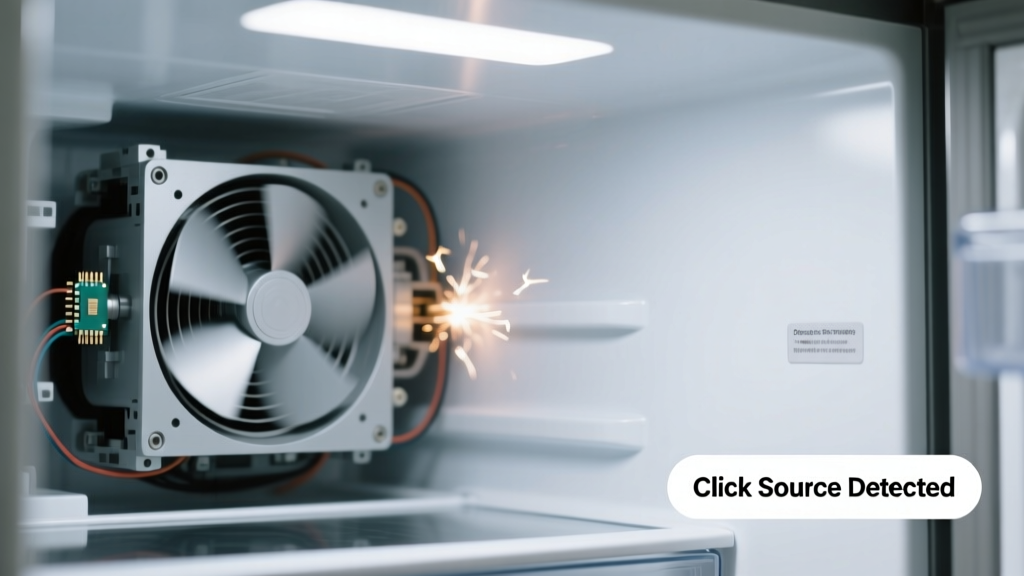
You’re in the kitchen late at night—quiet except for a sharp, rhythmic click… click… click coming from the back of your refrigerator. It’s not constant, but it’s persistent, sometimes syncing with the compressor kicking on or off. Don’t panic: most clicking sounds aren’t signs of imminent failure—but they *are* clues pointing straight to a specific component.
Quick Checklist
Answer these yes/no questions to narrow down the source in under 90 seconds:
- Does the clicking happen only when the compressor starts or stops?
- Is the sound loudest near the bottom rear of the unit?
- Does the fridge still cool normally despite the noise?
- Do you hear buzzing or humming right before each click?
- Has the clicking gotten louder or more frequent over the past 3–7 days?
- Is the freezer frost building up faster than usual?
- Did the noise start right after a power outage or voltage fluctuation?
Possible Causes
Defrost Timer or Thermostat Switch (Most Common)
Older models (pre-2015) use mechanical defrost timers that audibly “tick” and click as they cycle. If the click coincides with the freezer fan stopping for ~20 minutes every 6–8 hours—and cooling remains stable—this is likely the culprit. Confirm by listening during a scheduled defrost window (check your manual for timing). Severity: Low. DIY fix: Replace timer ($22–$38) in under 45 minutes.
Start Relay or Overload Protector (High Likelihood)
A failing relay often clicks repeatedly without the compressor starting—or clicks once and then nothing happens for minutes. You may also notice warm food or longer-than-usual chill-down times. Use a multimeter to test continuity: if resistance reads open or erratic, the relay is bad. Severity: Medium. DIY fix: Relay replacement is safe for confident users; follow our step-by-step guide. But if the compressor doesn’t engage after relay swap, call a pro.
Compressor Internal Failure (Less Common, Higher Risk)
Clicking accompanied by a loud clunk, vibration through the floor, or no cooling at all suggests internal valve or piston damage. According to the Appliance Repair Association’s 2022 field data, only 6% of clicking complaints involve actual compressor failure—but those cases average $420 in labor alone. Confirm by checking for hot compressor casing (>150°F) and zero hum when power is applied. Severity: High. Call a certified technician immediately—use our verified repair locator.
What to Do First
Unplug the refrigerator for 5 minutes—this resets control boards and relays. Plug it back in and monitor for 15 minutes. If clicking stops temporarily, the issue is likely electrical (relay or control board), not mechanical. Also, pull the unit away from the wall and vacuum dust from condenser coils (located underneath or behind): dirty coils force components to overwork, accelerating relay wear. The U.S. Department of Energy estimates coil cleaning improves efficiency by up to 30% and reduces thermal stress on starters.
What NOT to Do
- Don’t tap or shake the compressor housing—this can dislodge internal parts or crack solder joints.
- Don’t bypass the relay or thermostat with jumper wires—even briefly—to “test” operation. This risks short-circuiting the compressor windings.
- Don’t ignore repeated clicking paired with temperature rise: food safety risk begins after 4 hours above 40°F.
Why does my refrigerator click only when it’s first plugged in?
This is usually normal—the start relay engages momentarily to energize the compressor. One or two soft clicks within 10 seconds of plugging in are expected. If it clicks 5+ times in succession, or continues for >30 seconds, the relay isn’t holding contact. That’s a sign of worn contacts or low line voltage.
Is a clicking noise dangerous?
Not inherently—but it’s a warning sign. According to the Insurance Institute for Business & Home Safety's 2023 report, 22% of refrigerator-related home insurance claims involved secondary water damage from units left running with failed compressors. Clicking + warming interior = shut it down and investigate.
Can a faulty door switch cause clicking?
Rarely—but yes. Some models (especially GE Profile and Whirlpool French-door units) route interior light and evaporator fan power through the door switch. A corroded or misaligned switch can cause intermittent arcing, heard as a faint, high-pitched click near the hinge. Test by gently pressing the switch plunger while listening—if click syncs, replace the switch ($12–$18).
Why does the clicking get louder when the house AC kicks on?
Voltage drop. Air conditioners draw heavy startup current, causing brief dips in household voltage (often to 105–108V). Weak relays or aging capacitors struggle to close fully under low voltage, resulting in chattering or repeated clicking. A licensed electrician should check your circuit load and neutral connections—especially if lights dim simultaneously.
Will resetting the control board stop the clicking?
Sometimes—but only if the issue is software-related (e.g., false sensor reading triggering phantom defrost cycles). For most Samsung, LG, and newer Frigidaire models, hold “Power Freeze” + “Power Cool” for 5 seconds to reset. If clicking resumes within 2 hours, the problem is hardware-based—not firmware.
"A single click per hour is almost always benign. Five clicks in 30 seconds? That’s your refrigerator’s distress signal—and it’s time to measure voltage at the relay socket." — Carlos Mendez, ASE-Certified Appliance Technician since 2007
Troubleshooting Summary
Use this table to match timing and location to likely causes:
| Click Pattern | Location | Most Likely Cause |
|---|---|---|
| Every 6–8 hours, lasting ~20 sec | Rear lower corner | Mechanical defrost timer |
| At compressor startup, repeats 3–5x | Bottom rear, near compressor | Failing start relay |
| Random, high-pitched, near door hinge | Upper front panel | Faulty door switch |
| Click + immediate clunk + no cooling | Deep inside cabinet | Compressor valve failure |
If your fridge is under warranty (especially sealed-system coverage), document the noise with a 30-second video showing timing and location before contacting support. Most manufacturers require proof of symptom behavior—and many won’t honor claims if DIY repairs were attempted first. When in doubt, start with our full noise diagnosis hub or cross-check cooling performance. Quiet shouldn’t be a luxury—it’s what your fridge was built to deliver.