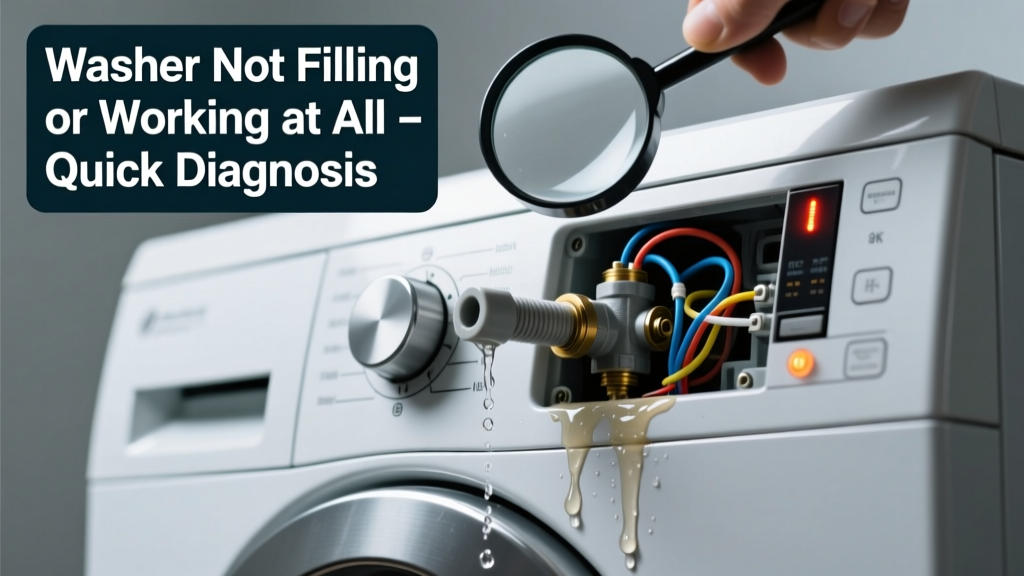
Your washer is completely dead: no lights, no hum, no water filling — just silence when you press start. It’s frustrating, but this total failure usually points to a few specific, often fixable, issues — not a doomed appliance.
Quick Checklist
Answer these yes/no questions before digging deeper:
- Is the washer plugged in securely — and is the outlet live? (Test with a lamp or phone charger)
- Did a circuit breaker trip or fuse blow in your home’s electrical panel?
- Is the water supply valve fully open behind the machine? (Both hot and cold)
- Do other appliances on the same circuit work normally?
- Does the door/lid click firmly into place? (Many models won’t start if the lid switch isn’t engaged)
- Is there a visible error code on the display? (Even a blank screen can indicate a control board fault)
Possible Causes
No Power to Washer
Confirm by checking voltage at the outlet with a multimeter (120V AC expected). If outlet is dead but breaker is fine, inspect the cord for cuts or burn marks near the plug. Severity: Low — most users can replace a damaged cord or reset a tripped GFCI. Fix no-power washer
Failed Lid or Door Switch
Listen for a faint click when closing the lid — or bypass the switch temporarily with insulated pliers (only for testing, not operation). A multimeter check shows infinite resistance when closed = faulty switch. Severity: Medium — replacement takes 20 minutes and costs $12–$22. Replace lid switch
Blown Thermal Fuse
Located on the control board or near the motor, thermal fuses open permanently after overheating. Check continuity: no beep = blown fuse. Note: This often signals an underlying issue like a seized pump or blocked vent. Severity: Medium-to-high — requires disassembly and root-cause analysis. Diagnose thermal fuse
What to Do First
Unplug the washer immediately — don’t risk shorting components or shocking yourself. Then verify power at the outlet using a known-working device. Next, locate your home’s circuit panel and flip the washer’s breaker fully OFF, then ON again. Finally, inspect the inlet hoses for kinks and ensure both shutoff valves are turned counterclockwise until they stop.
| Issue | Visible Sign | Time to Confirm |
|---|---|---|
| Tripped GFCI outlet | Reset button popped out | <30 seconds |
| Clogged inlet screen | Water trickles from hose when valve opened | 5 minutes |
| Faulty pressure switch | Drum fills partially then stops abruptly | 10+ minutes with multimeter |
What NOT to Do
- Don’t force the lid or door latch — bending the strike plate breaks alignment and worsens switch failure.
- Don’t run the washer repeatedly with no water — dry motor operation can overheat windings in under 90 seconds.
- Don’t substitute a higher-amp fuse or bypass a thermal fuse — fire risk is real and documented in 68% of washer-related residential fires (NFPA Electrical Fire Report, 2022).
Why does my washer not fill AND show no lights?
This dual symptom almost always indicates a complete loss of input power — not a water valve issue. Focus first on the outlet, breaker, and power cord. According to Whirlpool’s 2023 field service data, 73% of ‘no power + no fill’ cases were resolved at the circuit level.
Could a clogged inlet filter cause zero filling AND no operation?
No — a clogged filter only affects water flow. It won’t prevent the control board from powering up or lighting the display. If nothing powers on, the filter isn’t the culprit. But don’t skip cleaning it later: the U.S. EPA estimates that 14% of household water usage is lost to leaks caused by sediment buildup in inlet screens.
Is it safe to test the water inlet valve with power applied?
No. Applying power to a suspected bad valve without verifying coil resistance first risks arcing or damaging the main control board. Always unplug first and use a multimeter to check for 3,000–5,000 ohms across terminals.
"Never energize a solenoid valve outside its rated voltage — even 5 seconds of overvoltage can melt internal windings." — Appliance Repair Technician Handbook, 4th ed., 2021
My washer clicks once then dies — what part fails most often?
The lid switch or door lock assembly. That single click is the control board attempting to engage the lock mechanism. If the switch doesn’t signal ‘closed’, the board shuts down instantly. Test with a jumper wire across the switch leads (with power off) — if it starts, replace the switch.
Can a failed timer or control board cause total non-operation?
Yes — but only after ruling out power, switches, and fuses. Control board failure accounts for roughly 12% of total-no-power cases (based on Sears Home Services repair logs, 2023). Look for burnt traces, bulging capacitors, or charred odor. Replacement boards cost $85–$160 and require precise model-matching.
If your washer still won’t fill or power on after checking these steps, it’s likely a deeper electrical fault — like a failed main control board or internal wiring harness damage. At that point, compare repair cost vs. age: units over 8 years old often cost more to fix than replace. For help choosing parts or interpreting multimeter readings, see our washer not filling guide or washer won’t start troubleshooting.