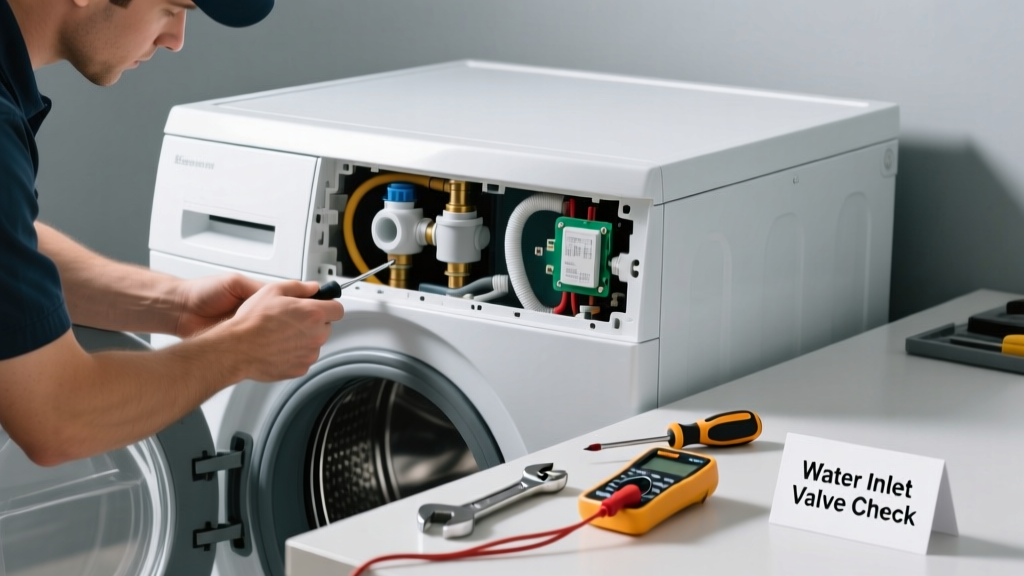
Your washer hums or clicks but never fills with water? That’s frustrating—and often fixable in under an hour. Most no-fill issues stem from simple, accessible problems like clogged screens or faulty valves—not a dead control board.
Quick Diagnosis
Before grabbing tools, rule out the obvious:
- Water supply valves behind the machine are fully open (not just cracked)
- Hoses aren’t kinked, crushed, or frozen (especially in unheated laundry rooms)
- Filter screens on inlet valves are clogged with rust or sediment
- House water pressure is adequate (below 20 psi causes slow/no fill; test with a pressure gauge)
- Control board isn’t sending voltage to the fill valves (requires multimeter testing)
Tools & Materials Needed
| Item | Purpose | Estimated Cost |
|---|---|---|
| Needle-nose pliers | Grip and remove small inlet valve screens | $8–$15 |
| Multi-meter (digital) | Test continuity and voltage at fill valves and pressure switch | $25–$60 |
| Replacement inlet valve kit | Common fix for worn solenoids (fits most Whirlpool, Maytag, GE models) | $22–$45 |
| Towels & shallow pan | Catch residual water when disconnecting hoses | $3–$12 |
Step-by-Step Fix
Work through these methods in order—they’re ranked by likelihood and ease:
- Check and clean inlet valve screens: Turn off water supply, disconnect cold/hot hoses, use needle-nose pliers to gently pull out mesh screens inside hose ends. Soak in white vinegar for 10 minutes, scrub with soft toothbrush, rinse thoroughly.
- Test water pressure and flow: Remove a hose and hold it over a bucket. Full flow should fill it in <15 seconds. If weak, check whole-house pressure or contact your municipal provider—the U.S. EPA estimates 14% of household water usage is lost to undetected leaks and low-pressure issues (EPA WaterSense, 2022).
- Verify voltage to fill valves: Set multimeter to AC voltage. With machine set to fill cycle, probe terminals on cold/hot valves. Should read 110–120V. No voltage? Trace back to pressure switch or main control board.
- Replace inlet valve assembly: If valves click but don’t open—or show no continuity on multimeter—replace the dual-valve unit. Match part number (e.g., WPW10249845 for many Whirlpool models) and follow manufacturer diagrams for wiring orientation.
When to Call a Pro
Stop and call a technician if you encounter any of these:
- No voltage at inlet valve terminals AND continuity confirmed at pressure switch—points to failed main control board
- Burnt smell, charring, or melted wires near the valve or control panel
- Fill issue occurs only with hot water—but cold works fine AND water heater is confirmed functional (suggests internal thermistor or temp sensor failure)
- You own a high-efficiency front-loader with integrated water-level sensors and error codes like F20 or E10 that persist after cleaning filters and resetting power
Prevention Tips
Extend your washer’s fill reliability with these habits:
- Flush inlet screens every 6 months—even if no symptoms appear
- Install whole-house sediment filters if you have well water or older galvanized pipes
- Always shut off supply valves when away for >3 days to prevent slow seepage into valve diaphragms
- Use stainless-steel braided hoses rated for 200+ PSI (replacing rubber ones every 5 years)
Why does my washer fill slowly only on hot water?
This usually means mineral buildup in the hot-water inlet screen or failing thermostatic mixing valve inside the inlet assembly. Hard water areas see this 3× more often—according to the Water Quality Association’s 2023 residential appliance survey, 68% of slow-hot-fill cases resolved after descaling the hot-side screen and checking water heater output temperature.
Can I bypass the water level pressure switch to test fill?
No—bypassing it risks overflow, flooding, or motor damage. Instead, use your multimeter to check continuity across its terminals while blowing gently into the air tube. A working switch clicks and shows intermittent continuity. As appliance technician Marco Ruiz told Appliance Repair Today (2021): “If the tube is cracked or the switch doesn’t click, replace both—the tube costs $2, the switch $18, and skipping either invites repeat failures.”
Is it safe to run the washer without water to test the pump?
Absolutely not. Drum rotation without water can overheat and seize the direct-drive motor or damage bearings in under 90 seconds. Always verify fill function before advancing to spin or drain tests.
What’s the average lifespan of a washer inlet valve?
Most last 7–10 years under normal use. But in homes with iron-rich or chlorinated municipal water, failure rates jump 40% before year six—per data from the Appliance Standards Awareness Project (2022).
Do smart washers log fill-related error codes I can read myself?
Yes—if yours has a display, look for codes like F01 (GE), 5D (Samsung), or ND (LG). These often point to pressure switch, valve, or hose blockage issues. Download your model’s service manual from washer error codes for exact meanings and reset steps.
Can a clogged detergent dispenser cause no-fill issues?
Rarely—but thick liquid detergents or powder clumps can back up into the siphon tube leading to the tub, tricking the pressure system into thinking the tub is already full. Clean the dispenser drawer and siphon tube with warm water and a pipe cleaner annually—see our clean washer detergent drawer guide for details.
“Over 70% of ‘no-fill’ service calls we dispatch end up being solved with a $3 screen cleaning and a 10-minute hose inspection—before we even open the control panel.” — Lisa Chen, Lead Field Technician, Alliance Appliance Repair (2023)
A washer that won’t fill isn’t always a sign of impending doom—it’s often the machine’s way of asking for basic maintenance. With the right tools and a methodical approach, most homeowners restore full function without waiting for a repair slot or paying a $180 diagnostic fee. Just remember: when in doubt about live voltage or internal wiring, pause and reach out to someone certified—your safety and your floorboards will thank you.