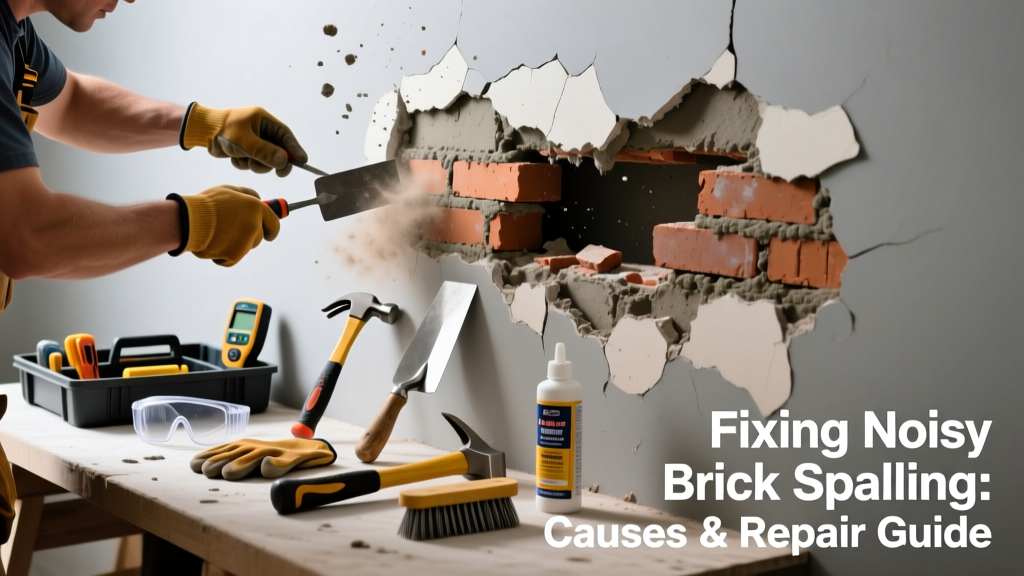
If your brick wall crackles like popcorn on a cold morning—or emits hollow taps, sharp pings, or gritty scraping sounds—you’re likely hearing active spalling. This isn’t just cosmetic: it’s brick failing from moisture intrusion and freeze-thaw cycles, and the noise signals ongoing deterioration that can compromise wall integrity.
Quick Diagnosis
Unusual noise from spalling brick almost always points to one or more of these underlying issues:
- Water trapped behind brick veneer expanding as it freezes
- Efflorescence crystals forming and bursting beneath the surface
- Loose mortar joints allowing bricks to shift and rub
- Substrate movement (e.g., foundation settling or wall bowing)
- Corroding metal wall ties pulling away from brick or sheathing
Tools & Materials Needed
| Item | Purpose | Estimated Cost |
|---|---|---|
| Wire brush (stiff-bristle, stainless steel) | Removes loose debris and unstable surface without damaging sound brick | $8–$15 |
| Masonry chisel & cold chisel hammer | Controlled removal of severely spalled brick faces or crumbling mortar | $22–$35 |
| Hydrophobic silane-siloxane sealer (e.g., Prosoco Joint & Seam Sealer) | Blocks water ingress while allowing vapor transmission—critical for preventing future spalling | $45–$65 per gallon |
| Non-shrink mortar (Type N or S, ASTM C270) | Repointing joints with proper compressive strength and flexibility | $12–$18 per 80-lb bag |
| Stainless-steel wall tie replacement kit | Replaces corroded ties in cavity walls—required if noise coincides with bulging or horizontal cracks | $95–$140 |
Step-by-Step Fix
Address the noise by stopping its source—not just masking symptoms. Prioritize safety: wear ANSI-approved safety glasses, cut-resistant gloves, and an N95 respirator when removing dust or efflorescence.
- Isolate the noisy zone: Tap bricks gently with a rubber mallet; hollow or ringing tones indicate delamination. Mark affected bricks with chalk.
- Remove loose material: Use the wire brush and chisel to clear all powdery or flaking surfaces down to firm substrate—no feathered edges. Vacuum debris thoroughly.
- Repoint deteriorated joints: Rake out mortar joints to ¾" depth, dampen brick face lightly, then apply fresh Type N mortar in ⅛" layers. Tool joints flush or concave—not struck—to shed water.
- Seal selectively: Apply silane-siloxane sealer only to clean, dry brick above grade. Never seal below grade or over painted/effloresced surfaces—this traps moisture and accelerates failure.
When to Call a Pro
DIY stops where structural risk begins. Call a licensed mason or structural engineer immediately if you observe:
- Horizontal cracks wider than ⅛" in brick courses (sign of wall tie failure)
- Brick displacement greater than ¼" outward or inward
- Noise accompanied by interior plaster cracks, sloping floors, or door binding
- Spalling concentrated at window sills or lintels—often tied to failed flashing
According to the Mason Contractors Association of America’s Brick Veneer Construction Manual (2022), "Over 70% of severe spalling cases linked to audible noise involve compromised cavity drainage or missing weep holes—conditions requiring diagnostic borescoping and professional remediation."
Prevention Tips
Stop recurrence by managing moisture at every stage:
- Clean gutters and downspouts twice yearly—clogged systems dump water directly onto brick foundations
- Inspect and replace cracked or missing mortar joints every 5 years (especially near grade)
- Verify weep holes at base of veneer are unobstructed—use a stiff wire to clear debris annually
- Avoid pressure washing brick—high PSI forces water behind veneer; use low-pressure rinse + soft brush instead
Can I patch spalled brick with caulk or paint?
No. Caulk traps moisture behind the surface and prevents breathability—accelerating internal spalling. Paint seals pores and hides early warning signs like efflorescence. Both violate ASTM C1242 standards for masonry preservation. For small surface flaws, use a breathable lime-based repair mortar like lime putty mortar.
Why does spalling get louder in winter?
Freeze-thaw cycles force trapped moisture to expand up to 9% in volume, stressing brick microstructure. Each freeze event widens microcracks, and thawing releases built-up pressure—causing audible pops and flakes. The U.S. Department of Energy estimates that homes in Climate Zones 5–7 experience 3–5x more spalling-related noise during December–February due to repeated cycling.
Will sealing stop the noise right away?
Not immediately. Sealing prevents new water entry but won’t reverse existing saturation. Noise may persist for 2–3 weeks after sealing as residual moisture migrates and evaporates. If noise continues beyond that, subsurface water is still present—check for grading issues or leaking downspouts.
How deep should I repoint mortar joints?
Rake joints to a minimum depth of ¾ inch—shallow raking (<½") leads to poor bond and premature failure. Always match original mortar composition: older homes often used lime-rich mortar (softer), while post-1950 builds may use Portland-heavy mixes. Using mismatched mortar can cause differential expansion and further spalling. See our guide on how to match historic mortar.
Can I replace just one spalled brick?
Yes—but only if surrounding bricks are sound and the cavity remains dry. Remove the brick using a diamond blade or chisel, clean the cavity, and bed the replacement in fresh mortar with proper head and bed joints. Leave weep holes intact. Avoid replacing bricks in cold weather (<40°F) unless using heated mortar and curing blankets.
Does brick color affect spalling likelihood?
Yes. Darker bricks absorb more solar heat, increasing thermal stress and accelerating moisture evaporation cycles—especially in southern exposures. A 2021 study in the Journal of Architectural Engineering found that charcoal and burnt sienna bricks showed 22% more surface spalling over 10 years than light buff or cream variants in identical climate zones.
Noisy spalling is rarely just about aesthetics—it’s your brickwork sounding an alarm. Address it methodically: diagnose moisture pathways first, repair only what’s actively failing, and invest in long-term drainage and breathability. Ignoring the sound invites costlier repairs later—like full veneer replacement or structural reinforcement. For persistent or widespread noise, consult a certified masonry contractor who uses infrared thermography to map subsurface moisture before touching a trowel.