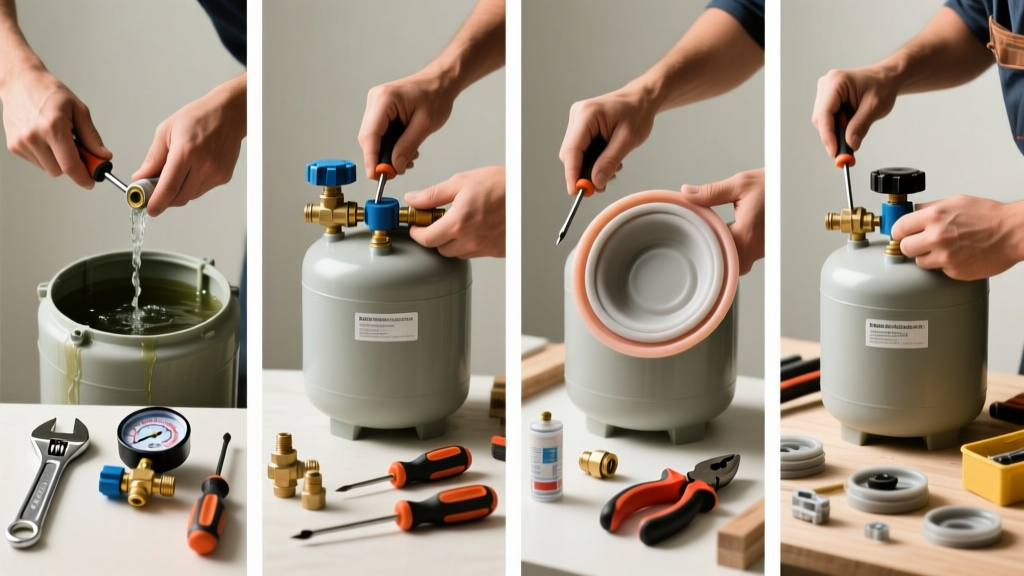
If your well pump kicks on every 30 seconds, water pressure sputters, or the tank feels heavy and cold at the top, your pressure tank is likely waterlogged — meaning the air bladder has failed or lost its charge. This isn’t just annoying; it risks burning out your $800+ submersible pump. The good news? Most cases are fixable in under an hour with basic tools.
Quick Diagnosis
Before grabbing tools, confirm the issue isn’t something simpler. A waterlogged tank shows these telltale signs:
- Pump cycles on/off rapidly (less than 60 seconds between starts)
- No air pressure reading when checking the Schrader valve (or water squirts out)
- Tank feels uniformly cold or heavy — especially at the top
- Pressure gauge fluctuates wildly or reads zero when pump is off
- Water hammer or banging pipes during pump startup
Tools & Materials Needed
| Item | Purpose | Estimated Cost |
|---|---|---|
| Bicycle pump or air compressor (with regulator) | Recharges air bladder to correct pre-charge pressure | $25–$120 |
| Tire pressure gauge (0–100 PSI range) | Verifies actual air pressure in tank — critical for accuracy | $8–$25 |
| Adjustable wrench or socket set | Removes valve caps, loosens fittings, and secures connections | $12–$45 |
| Small towel or rag | Wipes moisture from Schrader valve to prevent false readings | $2–$5 |
| Bucket and garden hose (optional) | Drains tank safely if bladder rupture is suspected | $5–$15 |
Step-by-Step Fix
There are three distinct scenarios — choose the method that matches your diagnosis:
- Method 1: Recharge the Air Bladder (Most Common)
Turn off power to the well pump. Open a faucet until water stops flowing (to relieve system pressure). Locate the Schrader valve (like a bike tire valve) on top of the tank. Use a towel to dry it, then depress the valve core briefly — if only air hisses out, the bladder is intact. Check pressure with gauge: should be 2 PSI below your pump’s cut-in pressure (e.g., 28 PSI for a 30/50 switch). Add air with pump until correct. - Method 2: Drain & Recharge (If Water Squirts Out)
If water sprays from the Schrader valve, the bladder is likely saturated or ruptured. Shut off power, close main shutoff valve, open lowest faucet to drain tank fully. Let sit 15 minutes. Recheck valve — if still wet, proceed to Method 3. - Method 3: Replace the Tank (Bladder Failure Confirmed)
If water continues leaking from the valve after draining, or pressure won’t hold >5 minutes post-recharge, the bladder is compromised. Replacement tanks start at $180 (for a 20-gallon captive-air unit) and require proper sizing based on pump flow rate and drawdown needs.
When to Call a Pro
Don’t risk electrocution, pipe damage, or voided warranties in these situations:
- You hear grinding or screeching from the pump motor while running
- Your tank is older than 10 years and shows rust, bulging, or weeping at the base
- System uses a non-bladder (hydro-pneumatic) tank with internal air chamber — requires specialized venting and charging
- You’ve recharged twice in one month and pressure still drops within hours
- Your well pump runs continuously even after tank service — points to deeper issues like foot valve failure or low water table
According to the National Ground Water Association’s Well Owner’s Handbook (2022), nearly 68% of premature pump failures stem from pressure tank issues left unaddressed for more than 90 days.
Prevention Tips
Maintaining your pressure tank extends pump life and avoids emergency calls. Do these quarterly:
- Check air pressure with a quality gauge — don’t rely on built-in gauges on compressors
- Inspect tank base for rust stains or pooling water (early sign of corrosion)
- Verify cut-in/cut-out pressure settings match tank pre-charge (e.g., 30/50 switch = 28 PSI pre-charge)
- Install a cycle counter on your pump controller to track starts per day — over 15/day warrants investigation
- Consider adding a well pump cycle counter to catch problems before they escalate
Can I use bleach to clean inside the tank?
No — bleach corrodes rubber bladders and seals. It also leaves residues that contaminate potable water. If you suspect bacterial growth (rare in pressurized tanks), flush the entire system with NSF-certified well disinfectant and follow EPA-recommended contact times. For tank internals, replacement is safer than cleaning.
Why does my tank lose air pressure every few weeks?
This usually means a slow leak in the air charging system — most often a faulty Schrader valve core, cracked air line fitting, or micro-tear in the bladder. Replace the valve core first ($2.50 part); if that fails, test the bladder with a soap-and-water bubble check while pressurized. Per the well tank air bladder testing guide, consistent loss points to internal failure.
Is it safe to increase pre-charge pressure to stop short cycling?
No — overcharging reduces drawdown volume and strains the pump. A 40-gallon tank charged to 40 PSI instead of 28 PSI loses ~6 gallons of usable water per cycle. That forces the pump to run longer and more often. Always match pre-charge to 2 PSI below cut-in pressure — no exceptions.
How do I know if my tank is the right size for my pump?
Rule of thumb: minimum 1 gallon of tank capacity per 1 GPM of pump flow. So a 10 GPM pump needs ≥10 gallons of drawdown — not total tank volume. A 30-gallon tank with 28 PSI pre-charge and 30/50 switch yields ~7.5 gallons drawdown. Check your pump curve and compare with tank manufacturer’s drawdown chart — or use our well pressure tank sizing calculator.
Can I replace just the bladder instead of the whole tank?
Not practically. Bladder replacement kits exist for some older models (e.g., certain Flotec units), but labor exceeds 2 hours and requires specialized tools. With new tanks starting at $180 and offering 5-year warranties, replacement is faster, safer, and more reliable. Manufacturers discontinued most bladder-only parts after 2018 due to low demand and high return rates.
What’s the difference between a waterlogged tank and a failing pressure switch?
A waterlogged tank causes rapid, rhythmic cycling (on-off-on-off) with little or no water delivery between cycles. A failing pressure switch often produces erratic behavior — pump won’t shut off, won’t start at all, or cuts in/out at wrong pressures. Test the switch separately using a multimeter and known-good pressure gauge before assuming the tank is at fault.
A properly maintained pressure tank should last 5–10 years — but only if air pressure is checked biannually and pre-charge stays within 2 PSI of spec. Skipping this simple step costs homeowners an average of $1,200 in premature pump replacement, according to the 2023 American Water Works Association Residential Well Systems Report. Treat your tank like your tires: inflate it right, check it often, and replace it before it fails catastrophically.