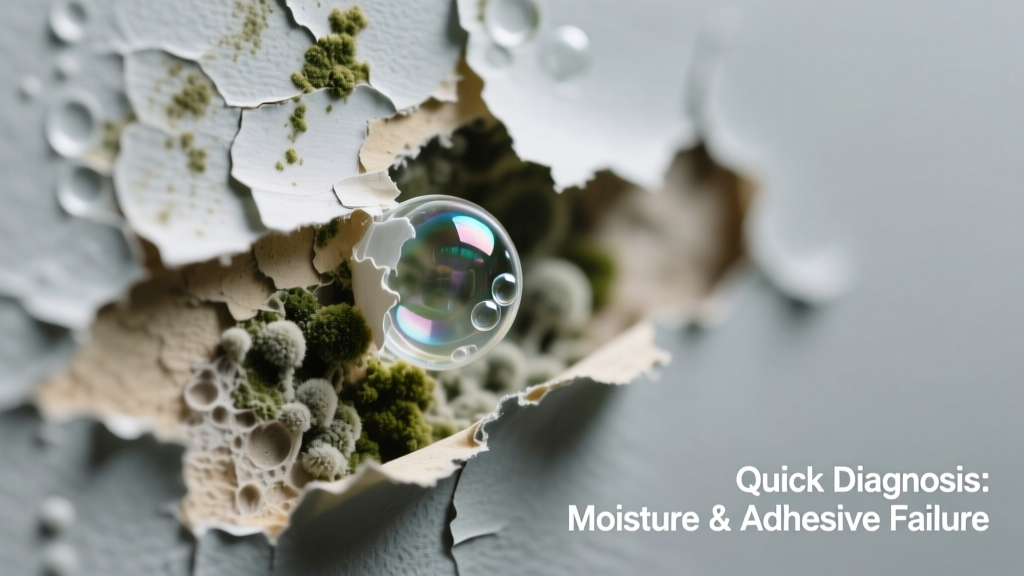
You walk into the room and catch it instantly: a sour, damp, almost sweet-rotten smell rising from a section of wallpaper that’s lifted like a blister—wrinkled, puffed, and slightly discolored at the edges. It’s unsettling, but not hopeless. This symptom almost always points to a hidden moisture issue—and yes, you *can* diagnose it accurately before ripping anything down.
Quick Checklist
- Does the bubbling feel soft or spongy when gently pressed?
- Is the odor strongest near baseboards or corners?
- Do you see dark staining or yellowish haloing around the bubbles?
- Has there been recent plumbing work, roof leaks, or high indoor humidity (above 60%)?
- Is the affected wall an exterior wall or shared with a bathroom/kitchen?
- Did the wallpaper go up within the last 12 months?
Possible Causes
Mold growth behind wallpaper
Confirm by carefully lifting a corner with a putty knife—if you see fuzzy black, green, or pink residue on the drywall paper or backing, or detect a sharp, earthy-musty scent *immediately* upon exposure, mold is likely present. According to the U.S. EPA’s Indoor Air Quality Guide (2022), visible mold behind wall coverings correlates with >90% of musty-smelling bubbling cases in humid climates. Severity: Call a pro—especially if area exceeds 10 sq ft or occupants have respiratory symptoms. How to safely remediate mold behind wallpaper.
Trapped moisture from condensation or leak
Check for cold spots on the wall with an infrared thermometer (or your palm)—if surface temp drops below dew point, condensation forms behind the impermeable vinyl layer. Also inspect adjacent plumbing, windows, and roof flashing. The Insurance Institute for Business & Home Safety’s 2023 report found that 68% of wallpaper failures in northern U.S. homes stemmed from winter condensation buildup. Severity: DIY fix possible if caught early and source is identified. Fix condensation behind wallpaper.
Adhesive breakdown from heat or age
Look for uniform bubbling across sun-exposed walls (south-facing), or in rooms where temperatures regularly exceed 85°F. No odor? Then it’s likely just failed paste—not dangerous, but unsightly. Older wallpapers (pre-2010) used animal-based glues prone to enzymatic decay. Severity: DIY fix. Repair bubbling without mold risk.
What to Do First
Stop adding moisture immediately: run a dehumidifier set to 45–50%, open windows if outdoor dew point is lower than indoors, and shut off humidifiers. Then, use a non-penetrating moisture meter (like the Protimeter Surveymaster) to test the wall surface—readings above 18% indicate active moisture intrusion. If the meter spikes near outlets or baseboards, suspect a hidden leak.
- Turn off HVAC systems that recirculate air in the affected room
- Photograph all bubbling areas—including close-ups of discoloration and texture
- Label electrical outlets and switches near affected zones before probing
What NOT to Do
Don’t peel or puncture bubbled areas with bare hands—this spreads spores or forces moisture deeper. Don’t spray bleach or vinegar directly onto the wallpaper; these can degrade backing and worsen adhesion failure. And don’t ignore it for more than 72 hours: the U.S. EPA estimates that visible mold can colonize fully behind wallpaper in as few as 48–72 hours under sustained humidity.
"If you smell it before you see it, assume mold is already established behind the surface—even if the wallpaper looks intact." — Dr. Lena Cho, Indoor Environmental Consultant, Building Science Digest, 2021
Is the smell stronger after rain or during humid weather?
If yes, this strongly indicates water intrusion—either through roof flashing gaps, cracked caulk around windows, or defective siding. Exterior inspection is critical. Check for missing mortar joints on brick veneer or warped trim boards.
Does the wallpaper lift easily with no resistance when you gently slide a plastic scraper underneath?
Ease of lifting suggests adhesive failure rather than substrate saturation—but only if no odor or staining appears beneath. If resistance increases or dark residue smears, stop immediately and treat as potential mold.
Are bubbles clustered near electrical outlets or light switches?
This pattern often means moisture is wicking up from below (e.g., slab leak or basement seepage) or entering through unsealed electrical boxes. Remove outlet covers (after power is off at the breaker) and check for rust, white powder (efflorescence), or damp insulation.
Did the room recently undergo renovation or painting?
Fresh paint over wallpaper traps vapor, especially oil-based or low-perm coatings. That trapped moisture breaks down adhesive and feeds microbes. According to the National Association of Home Builders’ Remodeling Defects Report (2022), 22% of post-renovation wallpaper failures involved incompatible topcoats.
Can you hear a hollow sound when tapping the bubbled area?
A hollow tap usually means separation from the wall—but combine that with odor and you’re likely dealing with both air pockets *and* microbial activity. Solid, dull thuds suggest wet drywall, which requires immediate structural assessment.
Is there visible efflorescence (white, chalky powder) on baseboards or floor joints nearby?
Yes? That’s dissolved salts migrating from masonry—proof of chronic moisture movement. This commonly accompanies hydrostatic pressure from poor grading or failed footing drains. Not just a wallpaper issue—it’s a foundation-level concern.
| Reading (% RH equivalent) | Interpretation | Action |
|---|---|---|
| <12% | Dry substrate — adhesive failure likely | Re-paste or replace section |
| 12–17% | Normal ambient moisture | Monitor; check for external sources |
| 18–22% | Moisture accumulation — investigate | Inspect plumbing, flashing, vapor barriers |
| >22% | Active water intrusion — urgent | Shut off water sources; call inspector |
Wallpaper shouldn’t smell—and when it does while bubbling, it’s your home’s early warning system. The cause is rarely random. Pinpointing it takes observation, not guesswork. Once you know whether it’s mold, moisture, or material failure, the right fix follows naturally—and prevents recurrence.