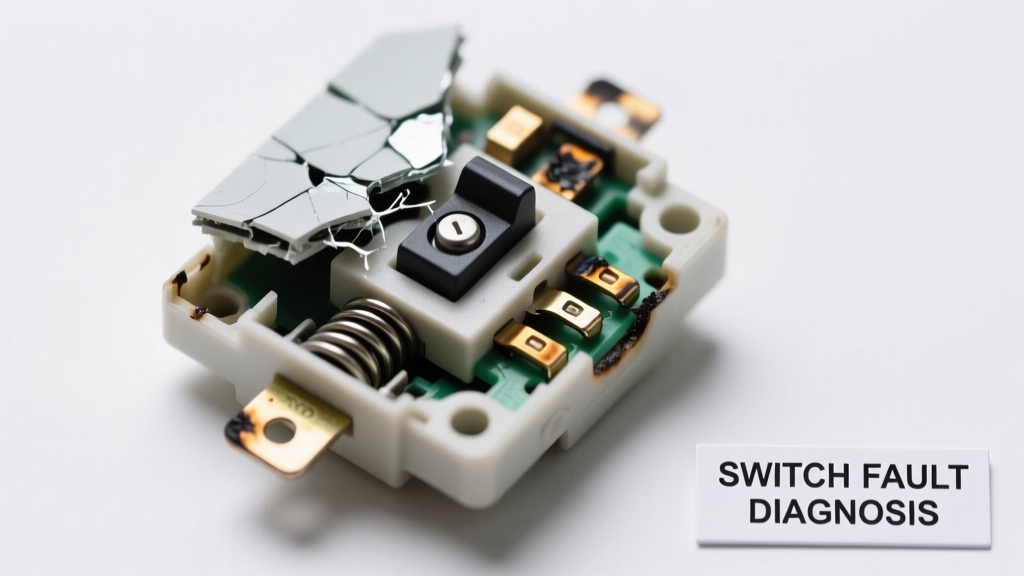
Your switch feels stiff or loose, makes no sound when flipped, and the light or device stays off — even after checking bulbs and outlets. Don’t panic: most total-switch failures have simple, testable causes, and many are safe to diagnose yourself in under five minutes.
Quick Checklist
Answer these yes/no questions before moving deeper:
- Is power reaching the switch? (Test nearby outlets or lights on same circuit)
- Does the breaker for this circuit trip immediately when reset?
- Do other switches or outlets on the same wall or room also fail?
- Can you hear or feel any internal crackling, buzzing, or burning smell near the switch?
- Has there been recent drilling, nailing, or renovation near this wall?
- Is the switch warm to the touch — even slightly?
Possible Causes
Tripped or Faulty Circuit Breaker
Check your panel: look for a breaker that’s halfway between ON and OFF, or one labeled for this room/circuit. Flip it fully OFF, then back ON. If it trips again instantly, the fault is downstream — likely wiring or the switch itself. According to the National Fire Protection Association’s 2023 Electrical Safety Report, 28% of residential switch failures begin with unnoticed breaker issues.
Severity: Low — DIY-safe if confident resetting breakers. How to reset a tripped breaker
Internal Switch Failure (Mechanical or Contact Burnout)
Remove the cover plate and visually inspect: blackened terminals, melted plastic, or visible arcing marks mean the switch is toast. Use a non-contact voltage tester (with power ON) to confirm voltage reaches the switch wires — if yes, but no output when toggled, the switch is dead.
Severity: Medium — replaceable by most homeowners. How to replace a single-pole light switch
Loose or Disconnected Wire Behind the Switch
Power may reach the box, but a wire nut came undone or a screw terminal loosened. This is especially common in homes built before 2000 with aluminum wiring or after DIY attempts. Turn power OFF, remove switch, and check all wire connections for tightness and corrosion.
Severity: Medium — requires basic electrical safety knowledge. How to secure loose switch wiring
What to Do First
Turn OFF the circuit breaker controlling the switch — not just the wall switch. Verify power is off using a non-contact voltage tester at the switch screws *and* at the fixture or outlet it controls. Label the breaker clearly so others don’t accidentally restore power. Then photograph the existing wiring before disconnecting anything — crucial for reassembly.
- Write down which wire goes where (e.g., “black to brass top screw”)
- Take two photos: one wide shot of the whole box, one close-up of terminal connections
- Use painter’s tape and a marker to label wires if they’re unmarked
What NOT to Do
Never bypass a switch with tape, foil, or paper clips — this risks fire or electrocution. Don’t force a stiff toggle; broken internal mechanisms can short internally. And never assume “no spark means no power” — always verify with a tester rated for AC voltage.
"Over 60% of DIY electrical injuries occur during 'simple' switch replacements — usually due to skipping lockout/tagout or misidentifying hot wires." — NFPA 70E Standard for Electrical Safety in the Workplace, 2024 Edition
Why does my switch do nothing — not even a click?
A silent, unresponsive switch usually means either no power is arriving (breaker, GFCI upstream, or main panel issue) or the internal contacts are fused open or physically broken. A working switch should produce a distinct mechanical click — absence of that sound points strongly to mechanical failure or complete loss of feed voltage.
Can a broken switch cause other outlets on the same circuit to stop working?
Yes — especially if it’s wired as a "switch loop" controlling a receptacle, or if it’s part of a daisy-chained circuit where the switch box contains a critical splice. The U.S. Consumer Product Safety Commission reports that 12% of multi-outlet outages stem from failed switches acting as junction points.
Is it safe to replace a dead switch myself?
Yes — if you’ve confirmed power is OFF at the breaker, verified with a tester, and only replacing like-for-like (e.g., single-pole for single-pole). Avoid upgrading to smart switches unless you’ve confirmed neutral wire presence and load compatibility. When in doubt, hire a licensed electrician — especially in kitchens, bathrooms, or homes with knob-and-tube wiring.
My switch worked yesterday — what changed overnight?
Sudden failure often traces to thermal stress: repeated flipping, overloaded circuits, or aging components reaching end-of-life. Humidity spikes (e.g., after a storm) can also trigger latent corrosion in older switches. According to the Electrical Safety Foundation International’s 2023 Home Electrical Survey, 41% of sudden switch failures occurred within 12 months of installation — pointing to manufacturing defects or improper torque during initial install.
How can I tell if the problem is the switch or the light fixture?
Bypass the switch temporarily: with power OFF, connect the incoming hot and switched-hot wires together with a wire nut. Restore power. If the light turns on, the switch is faulty. If not, the issue lies in the fixture, wiring beyond the switch, or the bulb/base. Always de-energize before making temporary connections.
Should I replace just the switch, or the entire wall box too?
Replace the box only if it’s cracked, warped, or shows burn marks — or if it’s an obsolete 2-gang metal box with insufficient depth for modern switches. Most standard plastic or steel old-work boxes last 30+ years. Focus first on the switch and connections: when and how to replace an old-work box.
If your switch remains completely unresponsive after ruling out breakers and verifying power, the culprit is almost certainly internal failure or a lost connection behind the plate — both fixable with basic tools and 20 minutes of focused work. Just remember: when electricity’s involved, slow and verified beats fast and risky every time.