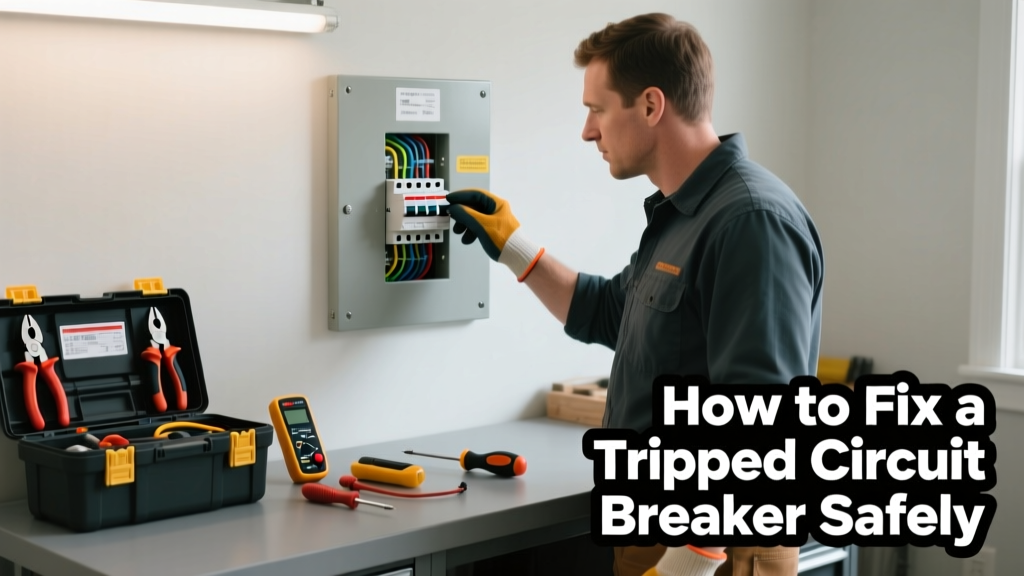
A tripped breaker is one of the most common household electrical issues—and usually the safest kind to handle yourself. But if you ignore the cause or force a reset without diagnosis, you risk overheating wires, damaged appliances, or even fire. Most trips happen for good reasons: overload, short circuit, or ground fault—and each demands a different response.
Quick Diagnosis
Before resetting, identify the likely cause. Check for these red flags first:
- Multiple high-wattage devices running on the same circuit (e.g., space heater + microwave + toaster)
- Burning smell or discoloration near outlets or the panel
- Flickering lights or buzzing from switches or receptacles
- Water exposure near outlets or GFCI-protected circuits (bathrooms, kitchens, basements)
- A breaker that won’t stay in the "on" position after resetting
Tools & Materials Needed
| Item | Purpose | Estimated Cost |
|---|---|---|
| Non-contact voltage tester | Verifies power is off before inspecting outlets or wiring | $15–$30 |
| Insulated screwdriver (VDE-rated) | For safely tightening outlet screws or panel cover removal | $12–$25 |
| Flashlight with hands-free option | Illuminates dark panel enclosures without holding light | $8–$20 |
| Outlet tester (3-light) | Detects open neutral, reversed polarity, or grounding faults | $6–$15 |
Step-by-Step Fix
Follow this sequence—never skip step 1 or 2:
- Turn off all devices and unplug appliances on the affected circuit. Start with high-draw items like microwaves, hair dryers, and space heaters.
- Locate the tripped breaker: Look for the switch handle in the middle position (not fully “on” or “off”) or slightly offset toward “off.” Some panels have orange or red indicators.
- Reset firmly: Push the handle fully to “off,” then back to “on” with deliberate pressure. A soft click means it engaged; no click or immediate trip means deeper trouble.
- Test gradually: Turn on devices one at a time. If the breaker trips again within seconds, stop—there’s likely a short or ground fault.
- Check GFCI outlets upstream: A tripped GFCI (often in bathrooms or garages) can cut power to downstream outlets—even if the breaker appears fine.
When to Call a Pro
Don’t attempt DIY if you encounter any of these:
- The breaker trips immediately upon reset—even with everything unplugged
- You smell burning plastic or see scorch marks inside the panel or on outlets
- Breaker feels hot to the touch or makes buzzing/humming noises
- You’re dealing with aluminum wiring (common in homes built 1965–1973), which requires special connectors and training
- Your home has a Federal Pacific Electric (FPE) or Zinsco panel—both recalled due to failure-to-trip risks (per Federal Pacific breaker panel safety advisories)
According to the Electrical Safety Foundation International’s 2022 report, nearly 40% of home electrical fires start at outlets or switches—often preceded by repeated breaker trips that were ignored or misdiagnosed.
Prevention Tips
Reduce future trips with these practical habits:
- Map your circuits: Label each breaker with what it powers (use our circuit mapping guide for help)
- Spread high-load appliances across different circuits—never plug a 1500W heater and 1200W toaster into the same 15A circuit
- Replace old or worn outlets—loose contacts increase resistance and heat buildup
- Install AFCI breakers in bedrooms and living areas (required by NEC 2017+ for new installations) to catch arc faults before they ignite
- Test GFCIs monthly using their “test” button—failure here causes phantom trips on shared circuits
Why does my breaker keep tripping after I reset it?
If the breaker trips again within seconds—even with nothing plugged in—the issue is likely a hardwired fault: damaged cable behind walls, failing light fixture wiring, or a compromised junction box. This isn’t a load issue—it’s a safety hazard requiring thermal imaging or megohmmeter testing only licensed electricians perform.
Can I replace a 15-amp breaker with a 20-amp one to stop tripping?
No—this is extremely dangerous and violates NEC code. A 20-amp breaker on 14-gauge wire (standard for 15A circuits) allows unsafe current levels that can overheat and ignite insulation. Always match breaker amperage to wire gauge: 14 AWG = 15A, 12 AWG = 20A. Upgrading requires rewiring the entire circuit.
Is it normal for a breaker to feel warm?
A slight warmth is typical under heavy load—but if it’s too hot to hold your finger on for 3 seconds, or if adjacent breakers are warm, that indicates loose terminals, corrosion, or internal arcing. Shut off the circuit and contact an electrician immediately.
What’s the difference between a tripped breaker and a blown fuse?
Breakers are reusable electromagnetic or thermal-magnetic switches; fuses contain a metal strip that melts permanently under overcurrent. Modern homes use breakers; older ones (pre-1960) may still have fuse boxes. Never replace a fuse with higher amperage—same danger as oversized breakers.
Do LED bulbs cause breakers to trip?
Rarely—but low-quality LED drivers can introduce harmonic distortion or inrush current spikes, especially when dozens are switched on simultaneously. Use UL-listed LEDs and consider staggered switching in large installations. More often, LED-related trips point to failing dimmer switches incompatible with LED loads.
How long should a circuit breaker last?
Most last 30–40 years under normal conditions, but frequent tripping, moisture exposure, or panel corrosion shortens lifespan. The U.S. Consumer Product Safety Commission recommends replacing panels older than 40 years—or sooner if breakers feel stiff, don’t snap decisively, or show visible pitting.
Tripped breakers are rarely emergencies—but they’re always warnings. Treat each trip as diagnostic data, not just a nuisance to reset. When you understand the pattern—timing, load, location—you’ll spot real trouble before it sparks. And remember: your panel isn’t just a switchbox. It’s the nervous system of your home’s electricity—and sometimes, the quietest symptoms demand the most attention.