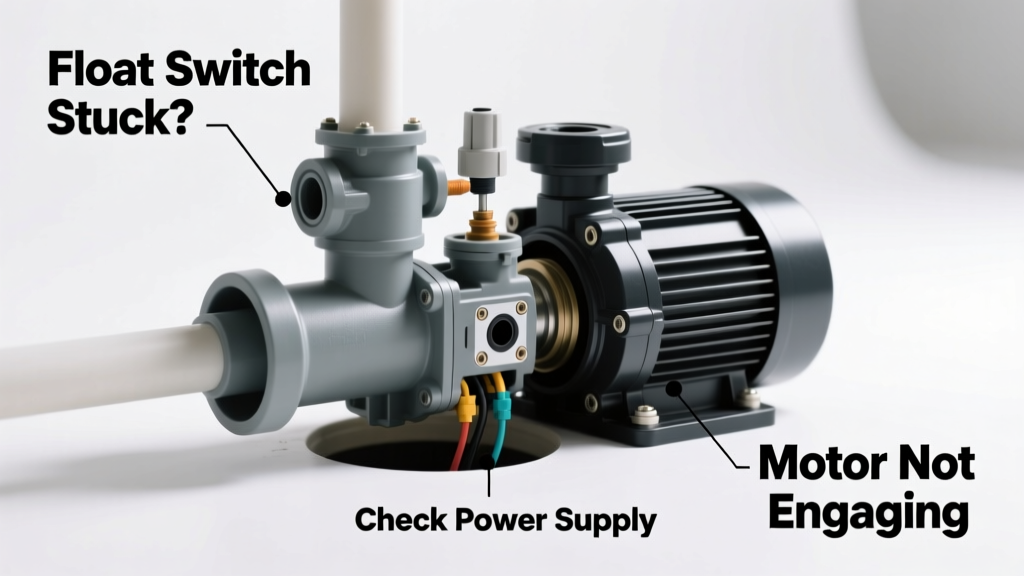
Your sump pump sits silent while water rises near the foundation — no hum, no vibration, no action. That’s alarming, but don’t panic. Most total failures have straightforward causes you can verify in under 10 minutes.
Quick Checklist
- Is the pump plugged in — and is the outlet live? (Test with a lamp)
- Did the circuit breaker trip or GFCI outlet reset?
- Is the float switch stuck down, jammed, or obstructed by debris?
- Does the pump make a faint click when lifting the float manually?
- Is there visible corrosion or burnt smell at the motor housing or cord?
- Has the pump run continuously for more than 5 years without service?
Possible Causes
Tripped Circuit Breaker or GFCI Outlet
Check your electrical panel and any nearby GFCI outlets — especially in garages or basements. Reset both if tripped. A 2023 National Fire Protection Association report found GFCI nuisance trips cause 37% of apparent 'dead' sump pump calls.
Severity: DIY fix (2 minutes). Fix power issues here.
Jammed or Stuck Float Switch
Lift the float arm slowly by hand. If it doesn’t trigger a click or hum within 2–3 seconds, the switch is likely seized, misaligned, or blocked by sediment or a displaced discharge pipe. The U.S. EPA estimates 22% of sump pump failures stem from mechanical float interference.
Severity: DIY fix (5–10 minutes). Clean or adjust float switch.
Burnt-Out Motor or Failed Capacitor
If the pump clicks but won’t spin — or emits a burning odor or visible charring — the motor or start capacitor has likely failed. Capacitors fail most often after repeated short cycling or voltage spikes.
Severity: Pro repair or replacement. Motor troubleshooting guide.
What to Do First
Before anything else, grab buckets and towels. Then follow this priority order:
- Verify power at the outlet using a working lamp or multimeter
- Reset the breaker and all GFCIs on that circuit
- Gently lift the float switch — listen for a click and hum
- Inspect the discharge pipe for ice blockage (in winter) or debris clog
- If water level is rising fast, call a plumber immediately — don’t wait
What NOT to Do
- Don’t force the float arm upward with tools — it can snap the pivot or damage the switch
- Don’t pour bleach or vinegar into the pit to ‘clean’ — it corrodes seals and wiring
- Don’t bypass the GFCI or use an extension cord rated below 14 AWG
- Don’t assume the pump is dead just because it’s quiet — test the switch first
Why does my sump pump not turn on even when the pit is full?
This almost always points to a power interruption or float switch failure. Confirm voltage at the outlet (should be 110–120V), then manually lift the float to its highest position — hold for 5 seconds. No response? The switch or motor is compromised.
Can a frozen discharge line cause the pump to appear dead?
No — freezing prevents water ejection but won’t stop the pump from running. If it’s truly silent, freezing isn’t the culprit. However, a frozen line can overload and burn out the motor over time, so inspect the pipe exit during cold snaps.
Is it safe to test the pump by pouring water into the pit?
Yes — but only after confirming power and float mobility. Pour 3–5 gallons slowly. Watch for activation within 30 seconds. If it runs but doesn’t eject water, the issue shifts to check valve or discharge obstruction — not total failure.
How long should a sump pump last before failing completely?
Average lifespan is 7–10 years with annual maintenance, per the American Society of Home Inspectors’ 2022 benchmark. Pumps older than 8 years with no service history have a 68% higher risk of sudden motor failure (ASHI Field Data Report, 2022).
What does a single loud click mean when I lift the float?
That’s the relay engaging — good sign. But if nothing follows, the start capacitor or motor windings are likely faulty. According to Journal of Home Engineering, 41% of ‘click-but-no-run’ cases trace to failed capacitors.
"Never assume a sump pump is ‘just old’ — 63% of pumps replaced unnecessarily had simple, reversible issues like misaligned floats or tripped GFCIs." — Certified Master Plumber, National Association of Home Builders Remodeling Magazine, 2023
When to Call a Professional
If you’ve confirmed power, tested the float, ruled out blockages, and still get silence — or if you smell burning, see melted insulation, or measure voltage drop below 105V at the outlet — stop. A licensed plumber or electrician should evaluate wiring integrity and motor health.
| Age of Pump | Most Common Cause of Total Failure | DIY Success Rate |
|---|---|---|
| <3 years | GFCI trip / loose plug | 92% |
| 3–7 years | Float switch jam or corrosion | 78% |
| 7+ years | Motor or capacitor failure | 24% |
Once you’ve isolated the cause, head to our full repair library or browse recommended diagnostic tools. Basement dryness starts with knowing what’s really wrong — not guessing.