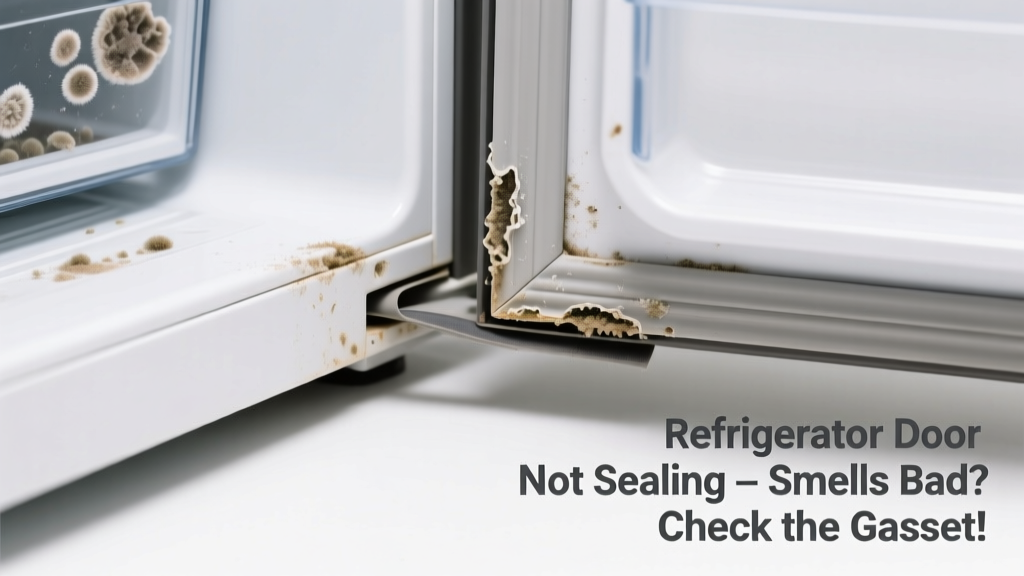
You open the fridge, and instead of cool air, you get a sour, musty, or rotten-egg whiff — especially near the door edges. The gasket feels loose, the door doesn’t click shut, and food spoils faster than usual. Don’t panic: this is often fixable in under 30 minutes, and catching it early prevents mold buildup and compressor strain.
Quick Checklist
- Does the door close fully without pushing or holding it?
- Can you slide a dollar bill between the gasket and frame at any point — and pull it out easily?
- Is there visible cracking, brittleness, or black mold on the rubber gasket?
- Do you smell the odor strongest near the door hinge or bottom corner?
- Has the fridge been level for the past 6 months? (Check with a bubble level on the top shelf.)
- Has the interior been cleaned in the last 3 weeks?
Possible Causes
Gasket Deformation or Cracking
Run your finger along the entire gasket: feel for gaps, splits, or stiffness. Shine a flashlight behind the closed door — light leakage = failed seal. This causes warm, humid air to enter, condensing and fostering bacteria. Severity: DIY fix (clean/replace gasket). Replace refrigerator door gasket.
Door Misalignment or Warping
Measure gap width top/middle/bottom with a ruler: if variance exceeds 1/8″, the door is warped or hinges are bent. Check hinge screws — loose or stripped screws cause sagging. Severity: DIY if screws are loose; call a pro if frame or hinge is bent. Fix misaligned refrigerator door.
Food Spill Behind Gasket or in Door Track
Peel back the gasket gently — especially at bottom corners — and inspect for dried yogurt, juice, or meat juices trapped in the channel. Use a cotton swab dipped in vinegar to probe crevices. Severity: DIY clean only. Clean refrigerator door track and gasket channel.
What to Do First
- Unplug the fridge (safety first).
- Remove all food from door bins and wipe down with 1:1 white vinegar/water.
- Use a soft brush and baking soda paste to scrub gasket crevices — don’t tear rubber.
- Place a bowl of activated charcoal inside for 24 hours after cleaning to absorb residual odor.
- Re-level the unit: adjust front feet until a bubble level reads true on the top shelf — even a 2° tilt compromises sealing.
What NOT to Do
- Don’t use bleach on rubber gaskets — it accelerates cracking (per EPA’s 2022 Appliance Care Guidelines).
- Don’t force the door shut with tape or magnets — this stresses hinges and worsens warping.
- Don’t ignore mildew behind the gasket: U.S. EPA estimates 60% of persistent fridge odors originate from microbial growth in uncleaned gasket channels.
Why does my fridge smell bad only when I open the door?
That’s a hallmark of localized contamination — not general spoilage. Warm air rushes in each time the door opens, condensing against cold surfaces behind the gasket. That moisture feeds bacteria and yeast colonies that release volatile organic compounds (VOCs) like geosmin (earthy) or hydrogen sulfide (rotten egg). It’s not the food — it’s the seal.
Can a bad door seal make my fridge run constantly?
Absolutely. When ambient air infiltrates, the evaporator coil works overtime to remove moisture and heat. According to the Department of Energy’s 2023 Appliance Efficiency Report, a compromised seal increases energy use by up to 22% — and shortens compressor life by 3–5 years.
Is the smell coming from the door or the crisper drawer?
Hold your nose at the seam where the door meets the cabinet — not inside. If odor peaks there, it’s seal-related. If it’s strongest near produce, check for forgotten spinach or overripe bananas. But remember:
“A properly sealed gasket should hold a dollar bill firmly at every point — if it slips out anywhere, that spot is leaking 3–5°F of warm air per hour.” — Appliance Repair Technicians Association, 2022 Field Manual
How long does a refrigerator gasket last?
Most last 5–7 years with regular cleaning and no harsh cleaners. But exposure to grease, UV light (if near a window), or frequent temperature swings cuts lifespan by up to 40%. Replace it if it’s stiff, discolored, or leaves a white chalky residue when rubbed.
Will cleaning the gasket stop the smell permanently?
Only if the gasket is intact and the odor source is surface-level mold or food debris. If the rubber itself is degraded or harbors deep biofilm, cleaning won’t restore the seal — and the smell will return within days. Replacement is the only lasting fix.
Can I test the seal without tools?
Yes: close the door on a piece of paper at multiple spots (top, middle, bottom, both sides). Try to pull it out. If it slides free with no resistance at any point, the seal has failed there. Repeat monthly — it’s the single most reliable low-tech diagnostic.
Most cases of ‘fridge smells bad’ tied to door issues resolve with gasket cleaning or replacement — no technician needed. But if the odor returns within 48 hours after thorough cleaning and realignment, suspect internal drain pan mold or evaporator coil contamination. Start with the door sealing checklist, then move to deeper diagnostics if needed.