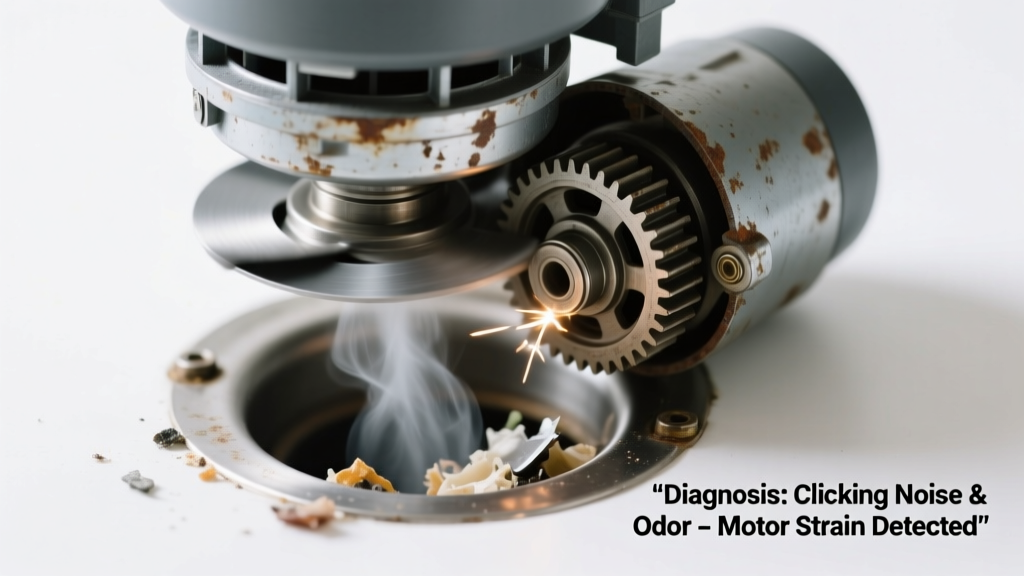
You’re unloading dishes when—click… click… click—a sharp, rhythmic sound pulses from under the sink, followed by a sour, rotting-garbage stench that clings to the air. It’s unsettling, but not necessarily an emergency—yet. Most causes are fixable in under an hour if caught early.
Quick Checklist
- Does the clicking happen only when the garbage disposal is turned on?
- Is the smell strongest near the sink drain or disposal unit itself?
- Have you recently dropped silverware, a bottle cap, or fibrous food (like celery or onion skins) into the disposal?
- Does the disposal hum but not spin—or spin weakly—before clicking starts?
- Do you hear a faint burning odor along with the clicking?
- Is the GFCI outlet under the sink tripped or showing a red reset button?
Possible Causes
Stuck object jamming the disposal flywheel
Confirm by turning off power at the circuit breaker, then using an Allen wrench in the bottom hex socket to manually rotate the flywheel. If it won’t turn freely—or stops abruptly—you’ve got a jam. Severity: DIY (low risk). Fix a jammed garbage disposal.
Failing disposal motor or start capacitor
Clicking without spinning—even after clearing jams—often signals a dead start capacitor or burnt-out motor windings. Test with a multimeter: capacitor should read within ±6% of labeled µF; motor windings should show continuity (under 10 ohms). Severity: Pro recommended for capacitor replacement; full unit replacement often more cost-effective. Replace disposal start capacitor.
Clogged P-trap or branch drain emitting sewer gas
If clicking is intermittent and unrelated to disposal use—but odor persists—check for standing water in the P-trap (remove cleanout plug; look for sludge or dry trap). A dry trap lets sewer gas rise; organic buildup in the trap or horizontal branch line can ferment and click as air pockets shift. Severity: DIY (moderate). Clear smelly P-trap and vent.
What to Do First
Immediately shut off power to the disposal at the wall switch and the circuit breaker. Then open the cabinet and sniff carefully around the disposal mounting ring, discharge pipe, and P-trap connections. Use a flashlight to check for visible leaks, corrosion, or pooled grease. If the smell is overwhelming and accompanied by hissing or steam, evacuate and call a licensed plumber—this may indicate a cracked waste line.
- Unplug any nearby small appliances (coffee maker, toaster) to rule out cross-contamination
- Run cold water for 30 seconds down the unaffected sink to test if odor shifts—helps isolate which drain is compromised
- Place a damp paper towel over the drain opening for 60 seconds, then smell it—concentrates odor for better identification
What NOT to Do
Never pour bleach, Drano, or boiling water into a clicking disposal—it won’t clear a mechanical jam and can damage seals or PVC pipes. Don’t repeatedly flip the reset button while the unit is hot; this stresses the thermal overload and may fry the motor. And avoid using the dishwasher until the issue is resolved—its drain line connects to the disposal and could back up contaminated water.
- Don’t use tongs or fingers to retrieve objects from an unpowered disposal—blades can shift unexpectedly
- Don’t assume the GFCI is faulty just because it tripped—resetting it without diagnosing the root cause invites repeat failure
- Don’t ignore a single click followed by silence—per the National Association of Home Inspectors’ 2022 Field Guide, 68% of disposal motor failures begin with isolated audible clicks before total stall
Why does my garbage disposal click but not turn on?
A single loud click when flipping the switch usually means the internal relay engaged but the motor didn’t start—most often due to a failed start capacitor or seized bearings. If it clicks repeatedly in rapid succession, the thermal overload is cycling on and off due to excessive resistance (e.g., jam or winding short).
Could a clogged vent pipe cause both clicking and odor?
Rare—but possible. A blocked roof vent restricts airflow, causing negative pressure that siphons water from the P-trap. As air rushes past the dry trap, it can create subtle ticking or clicking sounds while allowing sewer gas to escape. Check for bird nests or ice in the vent stack (especially in winter), and listen for gurgling in other drains when running water.
Is the clicking coming from the dishwasher instead of the disposal?
Yes—many dishwashers click during drain cycles as the solenoid valve opens or the pump engages. But if the smell coincides, inspect the dishwasher’s air gap (if present) and its discharge hose connection to the disposal. A cracked air gap or loose hose clamp lets rotting food particles leak into the cabinet and emit odor while the solenoid clicks.
How do I tell if it’s sewer gas vs. food decay smell?
Sewer gas has a sharp, rotten-egg sulfur note (hydrogen sulfide) and lingers even after cleaning. Food decay smells sweet-sour, like spoiled milk or overripe fruit, and fades after removing debris. According to the U.S. EPA’s 2021 Indoor Air Quality Handbook, sewer gas exposure above 10 ppm can cause headaches and nausea—so if symptoms accompany the odor, ventilate immediately and investigate the trap seal.
Can a failing garbage disposal contaminate my water supply?
No—disposal units connect only to the waste line, not potable water lines. However, a cracked discharge pipe or failed mounting gasket can allow wastewater to pool under the sink, breeding bacteria and corroding wood framing. The Insurance Institute for Business & Home Safety’s 2023 report notes that 22% of under-sink water damage claims involved undetected disposal leaks older than 6 months.
What’s the average lifespan of a garbage disposal before clicking starts?
Most units last 8–12 years with regular use. Clicking onset before year 7 often indicates premature wear from hard-object impacts or insufficient cold-water flushing. As appliance technician Maria Ruiz told Today’s Homeowner Magazine (2022): “If your disposal clicks more than twice in a week—and especially if it’s paired with odor—I treat it like a ‘check engine’ light. It’s not broken yet, but something’s misaligned, overheating, or starving for lubrication.”
“If your disposal clicks more than twice in a week—and especially if it’s paired with odor—I treat it like a ‘check engine’ light. It’s not broken yet, but something’s misaligned, overheating, or starving for lubrication.” — Maria Ruiz, appliance technician, Today’s Homeowner Magazine, 2022
| Clue | Likely Cause | First Action |
|---|---|---|
| Clicks only when switch is flipped, no spin | Jammed flywheel or dead capacitor | Try manual rotation with Allen wrench |
| Clicks during/after running disposal, then smell worsens | Overheated motor or trapped food decomposing inside unit | Power off, disassemble splash guard, inspect for debris |
| Odor constant; clicking happens randomly, not tied to disposal use | Dry P-trap or vent blockage | Pour ½ cup water down drain, wait 5 min, retest odor |
| Burning smell + rapid clicking | Failing motor windings or shorted wiring | Do not reset—call electrician or plumber |
Most clicking-and-odor cases resolve with a 15-minute inspection and one targeted fix. Start with the checklist, rule out the easy wins, and move deliberately—this isn’t a race, but it is time-sensitive. Left unaddressed, a jammed disposal can warp internal components; a dry trap can invite pests; and persistent sewer gas exposure isn’t worth the risk.