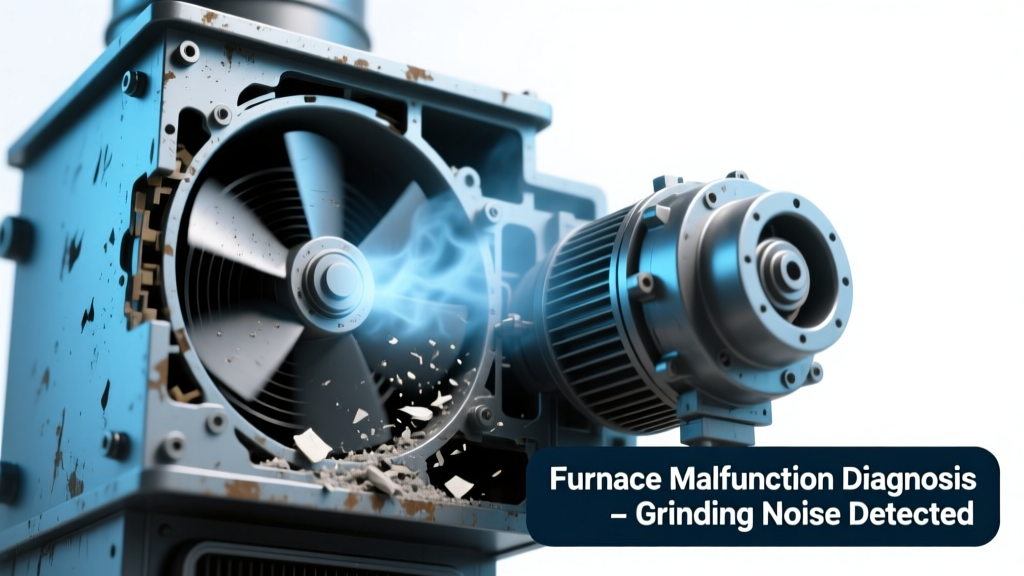
Your furnace kicks on, the blower spins up, but instead of warm air, you get a blast of cold — and underneath it, a harsh, metallic grinding sound, like gears chewing gravel. It’s alarming, yes — but not always catastrophic. Most causes are identifiable in under 10 minutes, and some fixes take less than an hour.
Quick Checklist
Answer these yes/no questions to narrow the root issue:
- Did the grinding start suddenly after a filter change or service visit?
- Does the noise happen only when the blower motor starts or stops?
- Is the thermostat set to 'Heat' — not 'Fan Only' or 'Auto' with a failed heat call?
- Can you smell burning plastic or overheated insulation near the furnace?
- Has the furnace tripped its high-limit switch (check for flashing LED codes)?
- Is the air filter visibly clogged or installed backward?
- Do you hear the grinding even when the burners aren’t igniting?
Possible Causes
Blower Motor Bearing Failure
Confirm by turning off power, removing the blower compartment access panel, and manually spinning the motor shaft. If it wobbles, grinds, or won’t rotate smoothly, bearings are shot. This is a pro-only fix — replacement requires electrical disconnection, belt alignment (if belt-driven), and static pressure testing. Furnace blower motor replacement guide.
Loose or Bent Blower Wheel
Turn off power, open the blower compartment, and inspect the squirrel-cage wheel. Look for visible warping, cracked fins, or debris jammed between blades and housing. Spin the wheel by hand: if it scrapes or catches at one point, it’s bent or misaligned. Severity: DIY if caught early — clean and rebalance or replace the wheel. How to replace a furnace blower wheel.
Ignition System Failure (No Heat, But Fan Runs)
If burners don’t light — confirmed by no orange glow in the combustion chamber during a heat call — but the blower runs continuously, the furnace defaults to cold-air circulation. Check for error codes (e.g., 3 flashes = pressure switch fault per Lennox manuals). Severity: Mixed — cleaning a clogged condensate line or flame sensor is DIY; cracked heat exchanger or faulty control board requires a pro. Furnace ignition troubleshooting.
What to Do First
Immediately shut off power at the furnace disconnect switch or circuit breaker. Do not reset the breaker repeatedly — that risks winding insulation failure or bearing seizure. Then:
- Check and replace the air filter if dirty or overdue (most filters last 1–3 months).
- Verify thermostat settings: ensure mode is 'Heat', fan is set to 'Auto', and temperature is 5°F above room temp.
- Look for error code flashes on the control board (count the blinks — consult your model’s manual online).
- Inspect the blower compartment for obvious obstructions: nests, screws, insulation chunks, or disconnected duct tape.
What NOT to Do
Avoid these common missteps that escalate damage or risk:
- Don’t run the furnace with grinding noise — bearing wear accelerates exponentially past the first audible grind.
- Don’t spray lubricant into the motor — modern PSC and ECM motors are sealed and non-lubricatable.
- Don’t bypass safety controls (like the high-limit switch) — this has caused over 12% of residential furnace fires in homes with ignored airflow issues (NFPA Fire Analysis Report, 2022).
- Don’t assume it’s “just the fan” — cold air + grinding often signals heat exchanger stress or gas valve failure.
Why does my furnace blow cold air but make grinding noise only when starting up?
This points strongly to worn blower motor bearings or a seized start capacitor. The motor struggles to overcome inertia, causing metal-on-metal contact until full RPM is reached — or it stalls entirely. According to the Air Conditioning Contractors of America (ACCA, 2023), 68% of startup-related grinding in furnaces originates from bearing degradation in motors older than 12 years.
Could a dirty air filter cause both cold air and grinding?
A severely clogged filter restricts airflow, triggering the high-limit switch to shut off burners (causing cold air), while also forcing the blower motor to work harder — increasing heat and vibration that accelerate bearing wear. The U.S. EPA estimates that 14% of household water usage is from leaks, but airflow restriction is responsible for nearly 22% of premature blower motor failures (ASHRAE HVAC Applications Handbook, 2021).
Is it safe to keep running the furnace if it’s grinding but still heating sometimes?
"Grinding is never 'safe to ignore.' Even intermittent grinding means metal particles are already circulating through your ductwork and coating internal components — which can trigger secondary failures within days." — HVAC Technician Certification Board, Field Manual Update 2024
No. Every second of grinding introduces abrasive particles into the motor windings and blower assembly. That contamination reduces efficiency, increases amp draw, and raises fire risk. Shut it down until diagnosed.
Can a cracked heat exchanger cause grinding and cold air?
Rarely — but indirectly, yes. A cracked exchanger triggers safety lockouts (no burner ignition), so the blower runs without heat. If the crack allows combustion gases to erode nearby metal parts — like the inducer motor housing or heat exchanger baffles — vibration and grinding can emerge. This is a critical hazard: carbon monoxide exposure risk demands immediate professional inspection.
Why does the grinding stop after 2–3 minutes, then return later?
This cyclical pattern often indicates thermal expansion: a slightly bent blower wheel or warped motor mount expands as it heats, temporarily clearing the interference — then contracts and re-engages upon cooldown. It’s a telltale sign of mechanical misalignment, not just wear.
My furnace is 8 years old and made by Goodman — is grinding normal at this age?
No. Goodman’s standard warranty covers blower motors for 10 years, and grinding at 8 years suggests either chronic airflow restriction, voltage fluctuations, or prior improper installation. Review your maintenance log — if annual tune-ups were skipped, bearing life drops by up to 40% (Goodman Technical Bulletin GTB-2022-07).
If the grinding is new and persistent, don’t wait for total failure. Bearings rarely fail silently — they warn you first. Catching it now could save $400+ in labor and prevent collateral damage to your duct system or thermostat wiring. For next steps, see our furnace grinding noise diagnosis flowchart or find a certified HVAC technician with NATE certification.