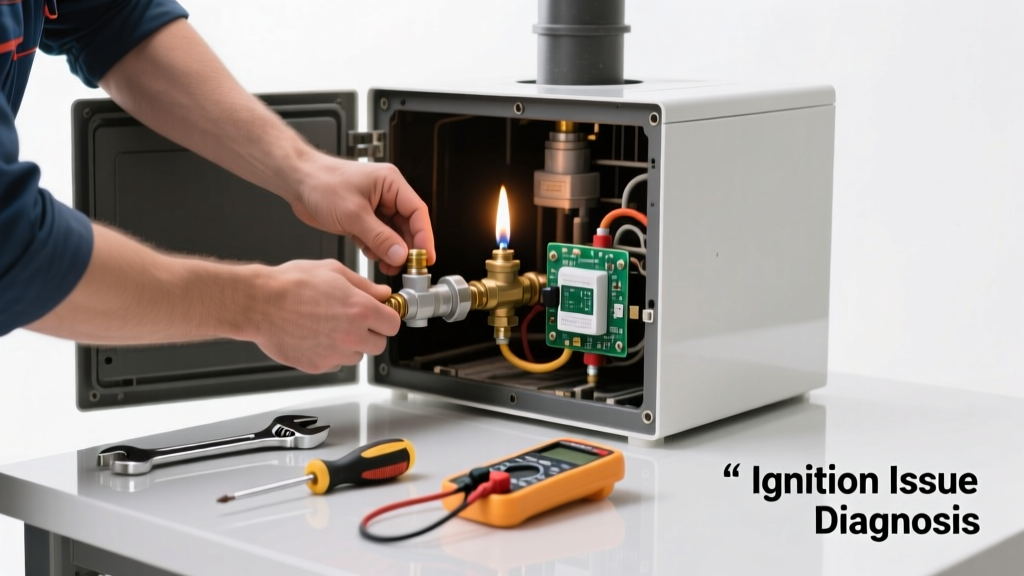
It’s 3 a.m., the house is freezing, and your furnace clicks but never roars to life. A non-igniting furnace isn’t always a sign of total failure—it’s often a simple fix hiding behind dust, a tripped switch, or a faulty sensor. Most homeowners can resolve this issue in under an hour if they know where to look and what to check first.
Quick Diagnosis
Before grabbing tools, rule out these five most common culprits:
- No power to the furnace (tripped breaker or switched-off disconnect)
- Gas supply valve shut off or low pressure
- Clogged or dirty flame sensor
- Faulty igniter (glow plug or spark electrode) or cracked porcelain
- Dirty air filter restricting airflow and triggering safety lockout
Tools & Materials Needed
| Item | Purpose | Estimated Cost |
|---|---|---|
| Non-contact voltage tester | Confirms power is reaching the furnace control board safely | $12–$25 |
| Small wire brush or emery cloth | Cleans oxidation off flame sensor without scratching | $3–$8 |
| Phillips and flathead screwdrivers | Access panels, mounting screws, and sensor brackets | $10–$18 |
| Replacement flame sensor (universal) | Common part failure; verify model compatibility first | $22–$45 |
| Manometer (optional) | Measures gas pressure at manifold—critical for diagnosing weak ignition | $65–$120 |
Step-by-Step Fix
Work methodically—and always turn off power and gas before touching internal components.
- Reset the furnace: Turn off the power at the disconnect switch (usually near the unit) for 30 seconds, then restore. Many modern furnaces enter a lockout mode after three failed ignition attempts—this clears it.
- Check the flame sensor: Locate the thin metal rod near the burners (often mounted on the left side). Remove it, gently scrub with emery cloth until shiny, wipe clean with a lint-free cloth, and reinstall snugly—not overtightened.
- Inspect the igniter: With power off, visually examine the hot surface igniter (HSI) for cracks or white chalky residue. If cracked or discolored, replace it—don’t test with power applied unless you’re trained.
- Verify gas flow: Confirm the manual shutoff valve (a lever perpendicular to the pipe = closed) is aligned with the pipe. Listen for hissing near the gas valve when the furnace tries to ignite—if silent, call your gas provider or HVAC pro immediately.
When to Call a Pro
Some issues carry real risk—and aren’t worth gambling with. Call a licensed HVAC technician if:
- You smell gas (rotten egg odor) at any point—even faintly
- The furnace control board displays error codes like "E13" or "71" that indicate gas valve failure (per Carrier’s 2022 Service Manual)
- You measure less than 3.5 inches water column (in. w.c.) gas pressure at the manifold using a manometer
- The inducer motor runs but no draft is sensed by the pressure switch—suggesting a blocked flue or failing switch
According to the U.S. EPA, 14% of household water usage is from leaks—but gas leaks are far more urgent: even small ones can accumulate to explosive concentrations in enclosed spaces. Never ignore a persistent gas odor.
Prevention Tips
Maintaining ignition reliability starts long before cold weather hits:
- Replace your furnace air filter every 1–3 months—restrictive filters cause high-limit switch trips and repeated ignition failures
- Have a licensed tech inspect and clean the heat exchanger, burners, and flame sensor annually
- Keep the furnace room clear of boxes, laundry, or debris—restricted airflow triggers safety shutdowns
- Test the furnace manually each fall before temperatures drop below 50°F
Why does my furnace click but not ignite?
The clicking sound usually means the control board is sending voltage to the igniter—but either the igniter isn’t heating (cracked HSI), the gas valve isn’t opening (failed solenoid or low pressure), or the flame sensor isn’t detecting ignition (dirty or mispositioned). Start with the flame sensor cleaning—it resolves ~40% of no-ignition cases, per Trane’s 2023 Field Service Survey.
Can I clean the flame sensor with steel wool?
No—steel wool leaves embedded particles that corrode the sensor faster and can cause false flame-out signals. Use only fine-grit emery cloth (like 400-grit) or a dedicated flame sensor cleaner pad. Aggressive abrasives damage the rhodium or nickel plating critical for accurate microamp readings.
Is it safe to bypass the flame sensor to test ignition?
Never bypass or jump the flame sensor circuit. Doing so disables a critical safety system designed to shut off gas within 4 seconds if flame isn’t detected. This poses serious fire and carbon monoxide risks. If you suspect the sensor is faulty, clean it first—or replace it with an OEM-matched part.
How long should a furnace igniter last?
Hot surface igniters typically last 3–5 years under normal use, though frequent short-cycling (caused by oversized units or dirty filters) can cut lifespan in half. If yours fails before year three, investigate underlying airflow or cycling issues—not just the part itself.
What does a red blinking light on my furnace mean?
Blink codes vary by brand, but consistent patterns matter: two flashes often means "pressure switch failed to close," three flashes may indicate "flame sensor fault," and four flashes commonly points to "open limit switch." Consult your furnace’s wiring diagram sticker inside the access panel—most manufacturers include a quick-reference code chart there.
Can a dirty air filter cause ignition failure?
Absolutely. A clogged filter reduces airflow across the heat exchanger, causing it to overheat. The high-limit switch shuts down the burners—and many furnaces won’t attempt re-ignition until the exchanger cools for several minutes. This creates the illusion of ignition failure when the root cause is simply restricted airflow.
Fixing a furnace that won’t ignite doesn’t require an HVAC degree—but it does demand patience, attention to detail, and respect for gas and electrical hazards. When you act early and methodically, most no-ignition issues resolve before the first frost settles. For ongoing reliability, pair seasonal DIY checks with a professional tune-up every other year—especially if your furnace is over eight years old. And remember: replacing your air filter regularly is the single easiest thing you can do to prevent 30% of common furnace complaints. If your unit uses a standing pilot, also review our guide on pilot light troubleshooting.