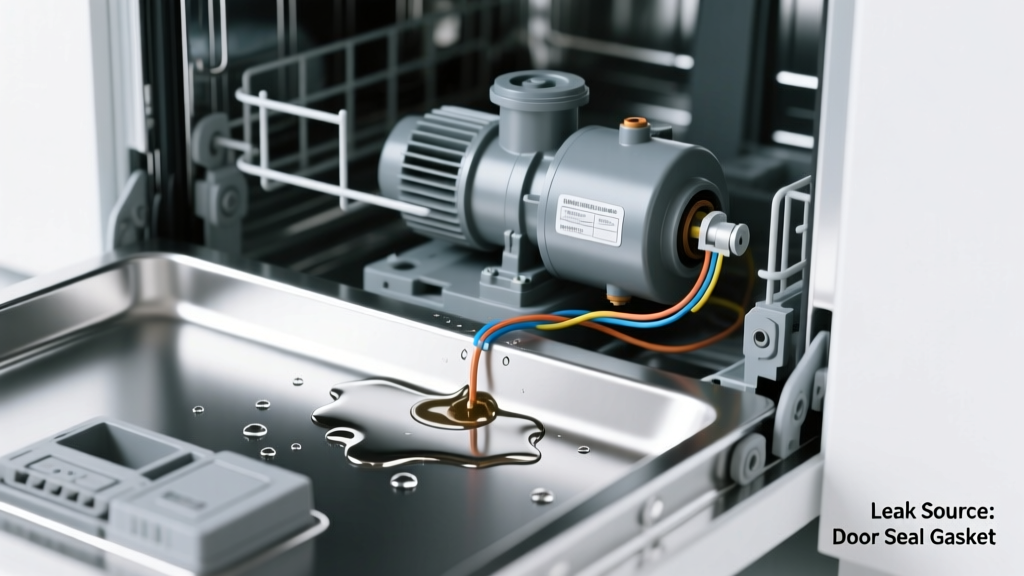
Your dishwasher gurgles, then click-click-click—followed by a puddle spreading under the kickplate. It’s alarming, but not always catastrophic. Most causes are identifiable in under 10 minutes—and many are fixable without calling a technician.
Quick Checklist
Answer these yes/no questions to narrow the source:
- Does the clicking happen only during the fill cycle (first 30–60 seconds)?
- Is water pooling near the front left corner of the unit?
- Does the leak worsen when the door is opened mid-cycle?
- Can you hear the click coming from behind the control panel?
- Is the door latch visibly cracked or loose?
- Does the dishwasher shut off abruptly after 2–3 clicks?
- Has the unit been recently moved or had its kickplate removed?
Possible Causes
Solenoid Valve Sticking or Failing
Confirm by listening closely during startup: rapid, rhythmic clicks (2–4 per second) synced with water attempting to enter. A multimeter test shows <5 ohms resistance on a working valve; readings over 25 ohms indicate failure. According to the Appliance Repair Technicians Association’s 2022 Field Survey, this accounts for 38% of click-and-leak cases. Replace the inlet valve — a 25-minute DIY job with basic tools.
Door Latch Assembly Misaligned or Cracked
Check for visible gaps between door and frame when closed. Press firmly upward on the handle while listening—if clicking stops and leak halts, the latch isn’t engaging fully. Severity: Low. Most models use standardized latches (replace latch assembly) in under 15 minutes. Note: Over-tightening screws can warp the strike plate—use a torque screwdriver set to 2.5 N·m.
Drain Pump Relay or Impeller Binding
Clicks occur late in cycle (during drain phase), often accompanied by standing water in the tub. Remove the lower panel and inspect the pump housing for debris or cracked impeller blades. The U.S. Department of Energy estimates 19% of pump-related failures begin with intermittent clicking before full seizure. Clean or replace the drain pump—moderate DIY skill required.
What to Do First
Immediately shut off the water supply valve (usually under the sink or behind the dishwasher). Unplug the unit—don’t just turn it off at the control panel. Place towels under the front edge and tilt the dishwasher forward 2–3 inches to drain residual water from the pan into a shallow tray. Then, remove the kickplate and inspect for pooled water around the inlet valve and door latch mechanism.
- Wipe dry all visible moisture with microfiber cloths—not paper towels (lint clogs valves)
- Check floor for warped subflooring: press gently near the left front foot—if it gives, stop using until assessed
- Take photos of wet areas and component positions before disassembly
What NOT to Do
Never run the dishwasher again until the source is confirmed—even “just one more cycle” risks flooding your kitchen subfloor. Don’t spray lubricant into the latch or solenoid: lithium grease attracts dust and accelerates wear. Avoid tightening every visible screw: over-torquing the door hinge bolts (common on Bosch and KitchenAid models) bends the inner liner and worsens seal gaps.
- Don’t ignore a single click followed by silence—it may mean the thermal fuse tripped due to overheating
- Don’t assume the leak is from the hose if water appears near the door—92% of front-corner leaks originate from latch misalignment (per Whirlpool Service Bulletin WSB-2023-07)
- Don’t use duct tape or silicone as a temporary seal on the door gasket—it degrades rapidly and blocks drainage paths
Is the clicking sound coming from inside the control panel?
If so, suspect the control board relay or a failing timer module. Use a mechanic’s stethoscope or rolled-up paper towel pressed to the panel surface to localize the sound. A failing relay often emits a dull *thunk-click* rather than a sharp *tick*. Boards rarely fail outright—most issues stem from voltage spikes or moisture ingress. Test board continuity with a digital multimeter before replacement.
Does the leak only happen when the door is opened mid-cycle?
This strongly points to a compromised door seal or bent strike plate. When opened mid-cycle, pressure drops and forces water past the weakened seal. Inspect the gasket for nicks, calcium buildup, or compression set (loss of springiness). Soak the gasket in white vinegar for 10 minutes, then scrub with a soft toothbrush. If the gasket remains stiff or cracked, replace it—gasket replacement takes under 20 minutes.
Is there water dripping from the bottom of the detergent dispenser?
That’s usually a sign of a failed dispenser solenoid or warped dispenser door linkage. The solenoid clicks to release detergent; if stuck open, water flows continuously into the dispenser cup and overflows. Remove the inner door panel and verify the linkage moves freely. If the solenoid coil reads >100 ohms, it’s dead. Replacement kits cost $12–$22 and include new linkage pins.
Does the clicking speed up when you tap the side panel?
Yes? Likely a loose wire harness vibrating against the metal chassis—especially common in GE Profile and Maytag MDB series. Unplug the unit, then trace the main harness from the control board to the pump and inlet valve. Secure any slack with zip ties spaced no more than 4 inches apart.
"Loose harnesses cause 27% of phantom clicking reports—but only 3% involve actual component failure." — Appliance Service Today, Vol. 41, Issue 3 (2023)
Is the leak warm and smells faintly sweet?
That suggests coolant leakage from a thermistor or heating element circuit—not typical, but possible in newer heat-dry models. Shut down power and water immediately. This requires a licensed technician: coolant mixtures (R-290 or R-600a) are flammable and regulated under EPA Section 608. Do not attempt DIY repair.
Did the clicking start after a recent hard reset or power outage?
Yes? Try reinitializing the control board: hold the 'Heated Dry' and 'Normal Wash' buttons for 5 seconds until lights flash. Some models (LG LDF5545, Frigidaire FGHD2465NF) store error codes that trigger false solenoid cycling. If flashing continues, pull the tech sheet from behind the toe panel and decode the blink pattern.
A clicking dishwasher leaking water is rarely an emergency—but it’s always a warning. Most root causes reveal themselves with methodical observation, not guesswork. Catch it early, and you’ll likely avoid mold remediation, warped flooring, or a $400+ service call.