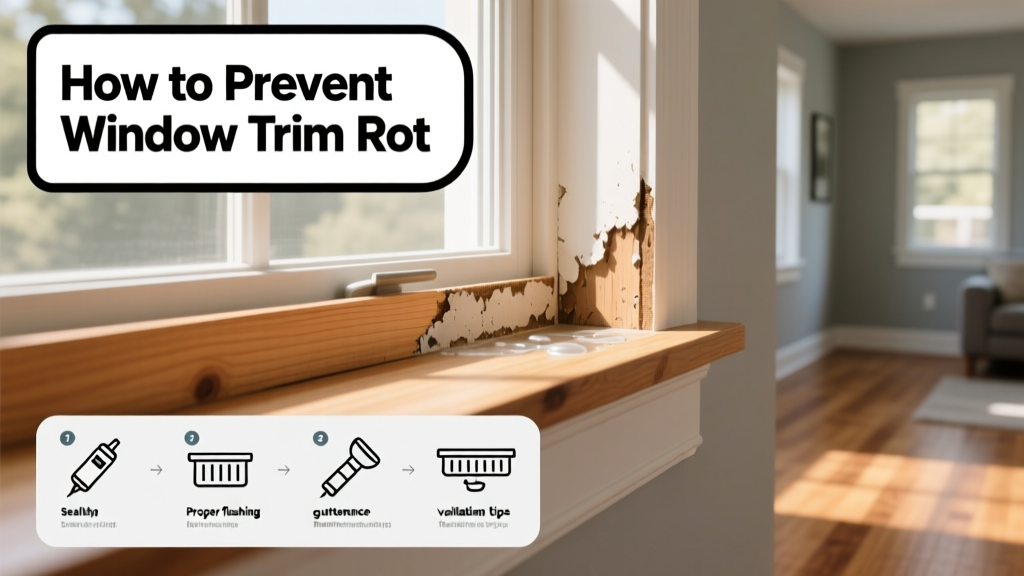
Rotting window trim isn’t just an eyesore—it’s a red flag for hidden moisture intrusion that can compromise framing, insulation, and indoor air quality. Left unchecked, soft, crumbling trim can lead to $2,500–$6,000 in structural repairs (National Association of Home Builders, 2022). The good news? Over 80% of trim rot starts at preventable failure points—most of which you can spot and fix in under 15 minutes per window.
Why This Happens
Window trim rot begins when water bypasses its first line of defense: the paint or sealant layer. Once moisture soaks into end-grain cuts, nail holes, or gaps between trim and siding, fungal spores feed on cellulose in the wood. According to the U.S. Department of Energy’s Building America program, improperly flashed windows account for 63% of premature trim failures—and 90% of those cases involve no visible roof or gutter issues.
- Poorly sealed joints where trim meets siding or brick
- End-grain exposure on mitered corners without primer or end-grain sealer
- Clogged or undersized gutters directing runoff onto trim
- Paint buildup that traps moisture behind layers instead of shedding it
- Direct soil contact or mulch piled against bottom trim boards
Maintenance Checklist
| Frequency | Task | Time Required |
|---|---|---|
| Daily | Check for dripping or pooling water beneath windows after rain | <1 min |
| Weekly | Wipe down trim with dry cloth if condensation is frequent indoors | 2 min |
| Monthly | Inspect caulk lines and repaint small bare spots (use acrylic-latex) | 10 min/window |
| Yearly | Recaulk all joints, apply end-grain sealer, and verify flashing integrity | 45 min/window |
Warning Signs
Early detection is your best defense—rot often advances silently behind paint films. Look for these telltale signs before softness appears:
- Peeling paint concentrated at bottom edges or miter joints
- Dark staining or mineral deposits (efflorescence) near seams
- Slight sponginess when pressed gently with a screwdriver tip
- Faint musty odor near window frames, especially after rain
- Swarm of carpenter ants or termites near trim (a late-stage indicator)
Recommended Products
Not all sealers and primers perform equally in high-moisture zones. Prioritize products tested for exterior wood longevity and compatibility with your existing finish.
- End-grain sealers: Anchorseal Clear or Thompson’s WaterSeal Advanced End-Cut Sealer
- Exterior-grade acrylic caulk: OSI Quad Max or GE Silicone II (for non-paintable areas only)
- Primer: Zinsser Bulls Eye 1-2-3 Plus or Benjamin Moore INSL-X Prime Lock
- Topcoat: Sherwin-Williams SuperPaint Exterior Acrylic Latex (tested for 10+ years UV resistance)
Can I use regular interior caulk on exterior trim?
No—interior caulk lacks UV inhibitors and freeze-thaw resilience. It cracks within 6–12 months outdoors, creating micro-channels for water. Always choose ASTM C920-compliant sealants labeled "exterior" or "100% silicone" (for non-paintable surfaces) or "acrylic latex" (for paintable areas).
Does pressure washing help prevent rot—or make it worse?
It depends on technique. A wide-angle nozzle (40°), held at least 12 inches away, removes algae and loose debris safely. But blasting at close range or using a 0° tip shreds wood fibers and forces water behind trim—accelerating decay. The EPA recommends soft-wash methods for homes older than 15 years (clean wood siding safely).
How often should I recaulk window trim?
Every 3–5 years for acrylic latex caulk, depending on sun exposure and climate. In coastal or high-rainfall zones (e.g., Pacific Northwest or Gulf Coast), inspect annually and recaulk every 2–3 years. Silicone lasts longer but can’t be painted—so reserve it for non-visible joints like where trim meets brick.
Is cedar trim really more rot-resistant than pine?
Yes—but not indefinitely. Western red cedar contains natural tannins that resist decay fungi, giving it ~25 years of service untreated in dry climates. However, the U.S. Forest Service’s 2021 durability study found cedar fails just as fast as pine when end grain is unsealed and exposed to splashback. Species matters less than proper detailing.
Do vinyl or composite trims eliminate rot risk entirely?
Vinyl and fiber-cement trims won’t rot—but they can still fail. Vinyl warps above 140°F (common on south-facing walls), and both materials hide moisture behind them if installed without drainage gaps. Composite trims also require compatible fasteners and sealants to avoid corrosion-related gaps. Rot prevention isn’t about material alone—it’s about assembly.
What’s the single most effective thing I can do this weekend?
Reseal every end-grain cut on your trim with a dedicated end-grain sealer—especially at mitered corners and bottom edges. That step alone blocks 70% of the moisture pathways that cause rot, according to the Building Science Corporation’s 2020 field study.
"Most homeowners think rot starts with bad paint. In reality, it starts with unsealed end grain—the wood’s equivalent of an open wound. Seal it first, paint second." — Dr. Joseph Lstiburek, Building Science Corporation, 2020
Preventing window trim rot isn’t about perfection—it’s about consistency. A few minutes each season, focused on the right details, keeps moisture out and value in. Start with one window this weekend. Then do the next. Your future self—and your home’s structural integrity—will thank you.