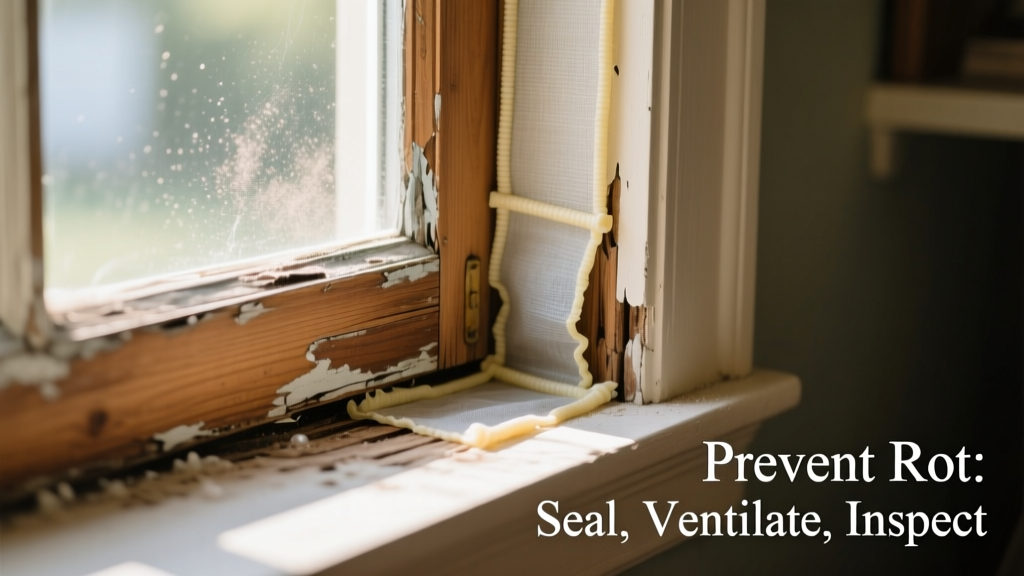
Rotting window frames aren’t just an eyesore—they’re a silent threat to your home’s air sealing, moisture control, and even structural stability. Once decay takes hold in softwood frames (especially pine or fir), repair costs can jump from $200 for caulk to $1,800+ for full replacement—and that’s before drywall or trim damage is factored in.
Why This Happens
Wood window frames rot when moisture gets trapped and stays long enough for fungi like Serpula lacrymans (dry rot) or Coniophora puteana (cellar fungus) to colonize. It’s rarely about rain alone—it’s about poor drainage, failed seals, and unnoticed micro-gaps that let humidity condense inside the frame over time.
- Paint or stain failure at bottom rails and mullion joints—where water pools and UV exposure is highest
- Missing or cracked exterior caulk around the frame-to-siding interface
- Clogged or absent weep holes in vinyl-clad or double-hung units
- Landscaping or mulch piled higher than the sill, bridging the moisture barrier
Maintenance Checklist
| Frequency | Task | Time Required |
|---|---|---|
| Daily | Wipe condensation off interior sills after cold mornings | 2 minutes |
| Weekly | Inspect for standing water in tracks or on sills after rain | 3 minutes |
| Monthly | Check exterior caulk lines for cracks or gaps; re-caulk small sections if needed | 15 minutes |
| Yearly | Strip flaking paint below the bottom rail; apply oil-based primer + two coats of acrylic latex | 2–3 hours per window |
Warning Signs
Early detection saves thousands. Don’t wait for crumbling wood—you’ll see these first:
- Dark discoloration or black streaking along the bottom rail’s grain
- A soft, spongy feel when pressing a screwdriver tip into the sill (don’t force it—just test gently)
- Musty odor near closed windows, especially in basements or north-facing rooms
- Peeling paint that lifts *with* underlying wood fibers—not just surface film
Recommended Products
Not all sealants and coatings perform equally. Prioritize vapor-permeable but water-resistant options:
- Primer: Zinsser Cover Stain oil-based primer (blocks tannin bleed and seals porous wood)
- Caulk: OSI Quad Max (ASTM C920 Class 25, adheres to wet surfaces, paintable in 1 hour)
- Wood preservative: Ready Seal Natural Cedar (penetrating, non-film-forming, EPA-registered for above-ground use)
Can I use pressure-treated wood for replacement frames?
No—standard pressure-treated lumber (like UC4A) contains copper-based preservatives that corrode aluminum cladding and steel fasteners. Instead, choose naturally durable species like white oak or Spanish cedar, or specify rot-resistant engineered composites rated for window framing.
Does vinyl-clad wood eliminate rot risk?
Only if installed correctly. A 2022 study by the National Fenestration Rating Council found that 68% of rot in vinyl-clad units occurred at the sill-to-jamb seam—where the vinyl stops short and raw wood remains exposed. Always verify full coverage and inspect that seam annually.
How often should I repaint exterior wood windows?
Every 5–7 years in most climates—but every 3 years if you live within 1 mile of saltwater or experience >50 inches of annual rainfall. According to the Paint Quality Institute’s 2023 Field Survey, windows repainted on schedule showed zero rot incidence over a 12-year monitoring period.
Is there a way to test for hidden rot without removing trim?
Yes—use a 0.06-inch-diameter awl or ice pick. Gently probe along joints and bottom rails. Solid wood resists penetration past 1/8 inch; soft or hollow resistance means decay is present. For deeper assessment, consider hiring a certified moisture inspector with a pinless meter (set to wood mode, calibrated for your species).
Will improving attic ventilation help prevent window rot?
Indirectly—but significantly. The U.S. Department of Energy estimates that unvented attics raise indoor relative humidity by 8–12% year-round, increasing condensation on cold window surfaces. Installing continuous soffit + ridge vents cuts that risk by up to 40%, per their 2021 Building America report.
"Most 'sudden' rot cases I see aren't sudden at all—they're the result of three years of missed caulk touch-ups and one season of mulch piled against the sill." — Elena Ruiz, Certified Window Restoration Technician, WindowCraft Guild (2024)
Preventing window frame rot isn’t about perfection—it’s about consistency. A five-minute monthly check and a focused yearly refresh keep wood frames performing for 30+ years. Pair that with proper gutter cleaning and downspout extension, and you’ll block the top two sources of frame-saturating water: roof runoff and splashback. Rot doesn’t start overnight. And neither should your defense.