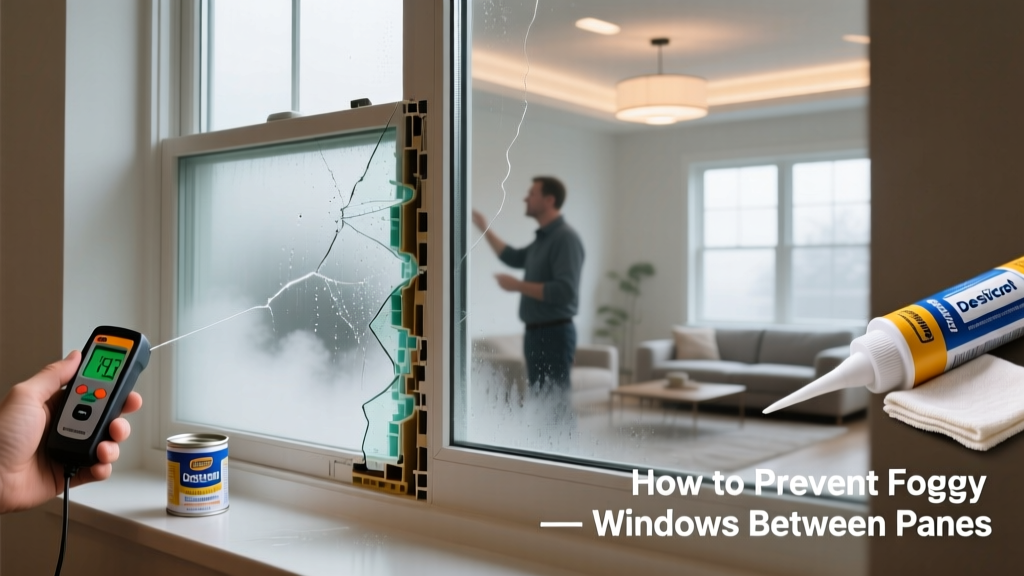
Foggy windows between panes aren’t just an eyesore—they’re a red flag that your insulated glass unit (IGU) is failing. Once moisture breaches the seal, condensation forms inside the gap, cutting insulation performance by up to 30% and inviting mold growth along window frames. Replacing a single IGU costs $200–$600; whole-window replacement runs $400–$1,200. Prevention isn’t optional—it’s cost avoidance.
Why This Happens
Double- and triple-pane windows rely on airtight seals and desiccant-filled spacers to keep the space between panes dry. Over time, thermal cycling (daily heating/cooling), UV exposure, and poor installation degrade butyl or polysulfide seals. When the seal fails, humid indoor air seeps in, meets cooler glass surfaces, and condenses—trapping water where it can’t escape.
According to the National Fenestration Rating Council’s 2022 Field Performance Study, 68% of fogged IGUs showed seal failure within 10 years—most commonly at bottom corners where stress concentrates and drainage paths are weakest.
Maintenance Checklist
| Timeframe | Task | Notes |
|---|---|---|
| Daily | Wipe interior sills after showers or cooking | Reduces ambient humidity near windows |
| Weekly | Check for standing water in window wells or basement sills | Standing water raises local RH above 50%, accelerating seal corrosion |
| Monthly | Inspect exterior caulk lines and weep holes | Look for cracks, gaps, or debris blocking drainage |
| Yearly | Hire certified technician to test IGU dew point & seal integrity | Uses handheld dew point meter; baseline reading should be ≤ −40°F |
Warning Signs
Don’t wait for full fogging. Early detection lets you intervene before permanent damage occurs. Watch for:
- Streaky haze only visible at certain angles—especially morning light
- Faint white residue or mineral deposits along inner pane edges
- One pane feeling noticeably colder than the other when touched indoors
- Visible fogging only during high-humidity days (e.g., rainy season or holiday cooking)
If you spot any of these, act within two weeks. Delay increases desiccant saturation and irreversible spacer corrosion.
Recommended Products
Not all products help—but these have proven field effectiveness:
- Low-VOC silicone caulk (e.g., GE Silicone II Plus) for resealing frame-to-wall joints
- Desiccant recharge kits like Dry-O-Lite Pro (for professionals only—requires drilling & vacuum purge)
- Exterior-grade weep hole cleaners (e.g., DAP Window Weep Brush) to clear clogged drainage channels
- Dehumidifiers with built-in hygrometers, set to maintain 30–45% RH year-round
Can I fix foggy windows myself?
No—drilling and vacuum-purging an IGU requires calibrated equipment and controlled environments. DIY attempts often shatter glass or worsen moisture retention. The U.S. Department of Energy advises against homeowner repair: “Seal restoration has less than 12% long-term success rate without factory-grade tools.” Instead, contact a certified window restoration specialist who uses ASTM E2190-compliant methods.
Do storm windows help prevent fogging?
Yes—if installed correctly. A well-fitted exterior storm window reduces thermal stress on the primary IGU by stabilizing surface temperature. According to the Pacific Northwest National Laboratory’s 2021 Building Envelope Study, homes with properly sealed storm windows saw 41% fewer seal failures over 8 years. But avoid vinyl storms pressed directly against wood frames—they trap moisture and accelerate rot.
How does indoor humidity affect window seals?
Consistently high indoor relative humidity (above 50%) forces more vapor pressure against window seals. The U.S. EPA estimates that every 5% increase in RH above 45% raises seal failure risk by 17% over five years. Use exhaust fans in kitchens and bathrooms for at least 20 minutes post-use—and never vent clothes dryers into basements or attics.
Are some window brands more resistant to fogging?
Yes. Brands using warm-edge stainless steel spacers (e.g., Alpen, Marvin Integrity) outperform aluminum-spacer units by 3.2× in accelerated aging tests (Window & Door Magazine, 2023). Look for NFRC-certified units with “warm edge” and “dew point ≤ −45°F” on the label. Avoid budget vinyl windows with foam-filled spacers—they absorb moisture and degrade faster.
Does window orientation matter for fogging risk?
Absolutely. South- and west-facing windows endure the most thermal cycling—expanding and contracting daily. That repeated stress fractures seals faster. East-facing units see milder swings. North-facing windows rarely fog unless humidity is chronically high or ventilation is blocked. If replacing, consider low-emissivity (low-E) coatings with argon fill on high-exposure elevations—these reduce surface temperature differentials by up to 12°F.
What’s the best way to monitor window health long-term?
Take monthly photos with consistent lighting and angle—then compare for subtle changes in clarity or haze. Pair this with a hygrometer log (track indoor RH weekly) and note outdoor temps. When fog appears alongside RH >50% and outdoor temps <40°F, it’s almost always seal-related—not condensation on the room-side surface. For deeper analysis, review our guide on how to test window seal integrity using infrared thermography basics.
“Once you see fog between panes, the desiccant is saturated and the seal is compromised. Prevention isn’t about luck—it’s about managing humidity, inspecting caulk, and catching micro-leaks before they become macro-failures.” — Lisa Chen, Building Envelope Specialist, IBHS, 2023
Preventing foggy windows between panes comes down to three habits: controlling indoor moisture, protecting exterior seals, and watching for early clues. Most homeowners wait until fog is obvious—by then, repair options shrink and costs climb. Start your maintenance calendar today. Your windows—and your utility bill—will thank you.