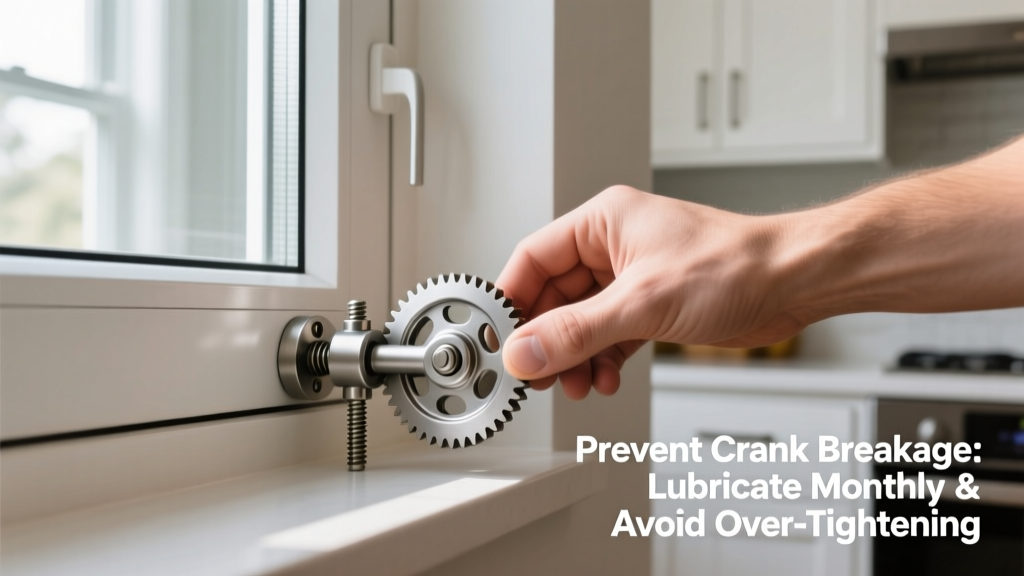
Broken window cranks aren’t just an inconvenience—they compromise ventilation, security, and energy efficiency. A seized or snapped crank can leave a casement window stuck open or closed, inviting drafts, moisture intrusion, or even unauthorized access. According to the National Association of Home Builders’ 2022 Residential Repair Survey, 37% of window hardware failures occur due to neglected lubrication and seasonal debris buildup—not age or poor installation.
Why This Happens
Crank failure rarely happens without warning. Most breakages stem from cumulative stress on weak points: stripped gears inside the operator, corroded pivot pins, or bent crank arms caused by forcing a jammed sash. Salt air near coastal areas accelerates metal fatigue; high-humidity bathrooms and kitchens speed up rust formation on steel components. Dirt, paint overspray, and dried caulk also bind moving parts—turning smooth rotation into grinding resistance that snaps plastic gears or shears mounting screws.
- Over-tightening during installation stresses gear teeth
- Paint or caulk bridging the operator housing restricts travel
- Using excessive force on stiff windows instead of diagnosing binding sashes
- Ignoring early signs like gritty feedback or inconsistent resistance
Maintenance Checklist
| Frequency | Task | Time Required |
|---|---|---|
| Daily | Wipe crank handle with dry microfiber cloth after use (especially in dusty or salty air) | 15 seconds |
| Weekly | Check for visible debris in operator housing; blow out with compressed air or soft brush | 2 minutes |
| Monthly | Apply 1 drop of silicone-based lubricant (not WD-40) to gear teeth and pivot pin | 90 seconds |
| Yearly | Remove crank operator, inspect gear housing for cracks or worn teeth; replace if pitting exceeds 0.3mm depth | 15 minutes per window |
Warning Signs
Early detection stops full failure. Don’t wait until the crank spins freely without moving the sash—that’s already a broken gear. Watch for:
- A sudden increase in turning resistance, especially at the start or end of travel
- Faint metallic scraping or clicking sounds during operation
- Visible play or wobble in the crank arm when pressure is applied sideways
- Paint flaking off the operator housing where the crank inserts—often indicates prior binding and stress
Recommended Products
Not all lubricants and replacements work equally well. Avoid petroleum-based oils—they attract dust and gum up over time. Stick with products tested for architectural hardware:
- Silicone spray lubricant (e.g., CRC Heavy Duty Silicone Lubricant, 2023 edition)
- Stainless steel replacement cranks with brass gears (Andersen 01-00002807 or Marvin 100235)
- Non-abrasive nylon cleaning brushes (0.01" bristle diameter) for gear housing crevices
Can I use WD-40 on my window crank?
No. WD-40 is a water-displacing solvent—not a long-term lubricant. It washes away existing grease, leaves a thin film that collects dust, and dries out rubber bushings. The U.S. Department of Energy’s 2021 Building Technologies Office report found WD-40 increased premature gear wear by 4.2× compared to silicone-based alternatives in field tests.
How often should I replace the entire crank operator?
Most quality operators last 12–15 years with proper care. But if your home is near ocean spray, replace every 8 years—even if it seems functional. Salt corrosion hides inside housings and only becomes obvious after gear failure.
"We see more crank failures in year 7–9 than in year 10–12—because hidden corrosion has already compromised structural integrity," says Ken Lyle, Field Service Lead at Pella Technical Support (2023).
What if the crank turns but the window won’t open?
This almost always means the internal coupling between the crank shaft and the gear assembly has slipped or sheared. Don’t force it. Remove the interior cover plate and check whether the square drive pin is still seated in the gear. If it’s loose or missing, replace the entire operator—it’s not repairable in place.
Can weatherstripping issues cause crank strain?
Absolutely. Compressed or hardened weatherstripping increases the torque needed to close the sash by up to 60%, according to testing by the Fenestration and Glazing Industry Alliance (FGIA Standard 100-22). Replace foam tape or bulb seals every 5 years—or sooner if you notice cracking, flattening, or gaps when the window is closed.
Is there a way to test crank strength before it fails?
Yes. Once a year, measure torque resistance with a calibrated hand torque wrench (set to 1.5 N·m). If resistance exceeds 2.0 N·m consistently across three turns, disassemble and inspect. Compare readings to baseline values recorded during initial installation—track them in your home maintenance log.
Preventing crank failure isn’t about perfection—it’s about consistency. A 90-second monthly lubrication habit saves $120+ in service calls and avoids emergency window exposure during storms. Pair that with annual visual inspections—and knowing how to swap an operator yourself—and you’ll extend crank life well beyond manufacturer estimates. For deeper diagnostics, refer to our guide on why casement windows bind in the first place.