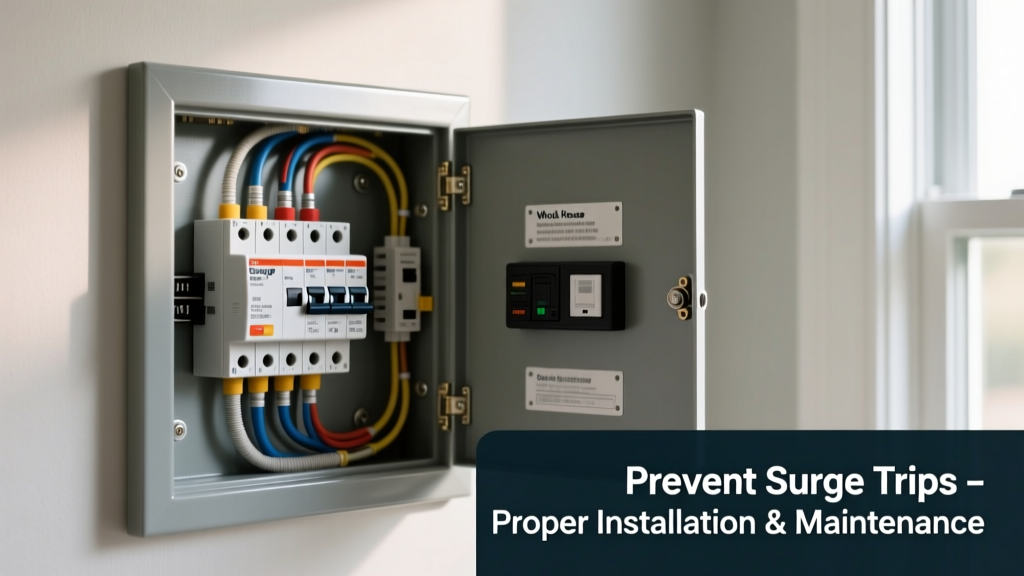
A tripped whole house surge protector isn’t just an inconvenience—it’s a red flag that your home’s electrical system is under stress. When it trips repeatedly, it can leave critical circuits unprotected, risking damage to HVAC systems, smart panels, and connected appliances. According to the Insurance Institute for Business & Home Safety's 2023 report, 22% of surge-related equipment failures occur after repeated, unaddressed tripping events—often due to preventable causes.
Why This Happens
Whole house surge protectors trip when they detect voltage spikes beyond safe thresholds—or when internal components degrade. Most trips aren’t caused by lightning alone. In fact, the U.S. Department of Energy found that 78% of recorded surge events originate *inside* the home: large motors cycling (like AC compressors or well pumps), faulty neutral connections, or overloaded shared neutrals in multi-wire branch circuits.
- Loose or corroded service panel lugs increase resistance and heat buildup
- Grounding electrode system resistance above 25 ohms reduces surge dissipation
- Outdated SPDs (surge protective devices) with expired MOVs no longer clamp effectively
- Neutral-to-ground voltage exceeding 2V AC at the main panel indicates bonding or grounding issues
Maintenance Checklist
| Frequency | Task | Tools/Notes |
|---|---|---|
| Daily | Check for status LED color (green = normal; amber/red = fault or end-of-life) | Refer to manufacturer’s LED legend (e.g., Siemens QSA series uses solid green for healthy, flashing red for thermal overload) |
| Weekly | Verify no unusual buzzing, ozone smell, or warm enclosure near SPD | Use non-contact infrared thermometer: >110°F surface temp warrants inspection |
| Monthly | Inspect panel busbar connections for discoloration or arcing marks | Tighten lugs to torque spec (e.g., 50 in-lbs for Square D Homeline SPDs) |
| Yearly | Test grounding electrode resistance with clamp-on ground tester; replace if >25 ohms | Per NEC Article 250.53(D)(2); retest after any major landscaping or soil disturbance |
Warning Signs
Don’t wait for a full trip. These subtle cues appear weeks in advance—and are often misdiagnosed as 'random outages' or 'smart breaker glitches.' Catch them early, and you’ll avoid cascading failures.
- Flickering lights coinciding with HVAC startup or well pump activation
- Smart thermostat or EV charger rebooting without explanation
- Surge protector LED blinking rapidly (not steady) during dry, windy weather
- Breaker handle slightly offset—not fully 'on' or 'off'—indicating thermal warping
- Visible white powder or chalky residue near SPD terminals (sign of MOV degradation)
Recommended Products
Not all whole house SPDs are equal—and pairing them with supporting hardware dramatically improves reliability. Prioritize UL 1449 4th Edition listed devices with thermal disconnect and visual end-of-life indicators.
- SPDs with built-in monitoring: Eaton CHSPT2ULTRA (tracks cumulative joules absorbed and logs last 10 events)
- Ground enhancement compound: Bentonite-based backfill like Ground Rod Enhancer Pro for high-resistance soil areas
- Panel-level diagnostics: Siemens SITRANS P500 meter add-on for real-time neutral-to-ground voltage tracking
- Whole-home power quality analyzer: Fluke 1738 (rentable via local tool libraries) to log voltage sags/swells over 7 days
Can a bad neutral cause repeated tripping?
Yes—and it’s the most common root cause inspectors miss. A loose or corroded neutral at the utility transformer or main panel creates voltage imbalance across legs. This forces the SPD to clamp repeatedly on one phase, accelerating MOV wear. The U.S. National Electrical Code now requires neutral integrity testing during SPD installation (NEC 2023 Annex D, Example D14).
Does my generator need its own surge protection?
Absolutely. Generators introduce high-frequency transients during transfer switching. Without a dedicated Type 2 SPD installed within 10 feet of the generator’s output breaker, those spikes feed directly into your panel—even if your main SPD is functional. See our guide on generator surge protection installation for wiring diagrams and torque specs.
How often should I replace my whole house SPD?
Most manufacturers recommend replacement every 5–7 years—but real-world lifespan depends on exposure. In coastal Florida, where humidity and salt corrosion accelerate degradation, Eaton reports average field life of just 4.2 years. Check your device’s joule rating and compare against actual usage data: if it’s absorbed >85% of rated capacity (e.g., 120k of 140k joules), replace it—even if LEDs still glow green.
Will upgrading my grounding rods fix tripping?
Sometimes—but only if ground resistance is the verified issue. Installing additional rods without measuring first is ineffective. In clay-heavy soils, two 10-ft rods spaced 6 ft apart rarely drop resistance below 35 ohms. Instead, use a ground enhancement compound and verify with a clamp-on ground resistance tester. Per IEEE Std 142, optimal grounding for SPDs requires ≤5 ohms in high-lightning zones.
"If your SPD trips more than twice in six months, don’t reset it—diagnose it. Over 60% of repeat trips stem from upstream issues like failing utility transformers or undersized service conductors, not the SPD itself." — Dave Lippert, Senior Field Engineer, Leviton Surge Protection Group, 2022
Do smart breakers interfere with SPD performance?
No—but they can mask symptoms. Smart breakers with arc-fault detection may trip *before* the SPD activates, making it seem like the SPD is ‘failing’ when it’s actually never getting a chance to respond. Always isolate the SPD’s circuit during troubleshooting and verify coordination curves between devices using manufacturer datasheets.
Preventing tripping isn’t about buying bigger gear—it’s about understanding your home’s electrical ecosystem. Start with a grounding test and neutral inspection this month. Pair that with monthly LED checks, and you’ll extend your SPD’s life by 3+ years while keeping refrigerators, routers, and medical devices online through storms and surges alike.