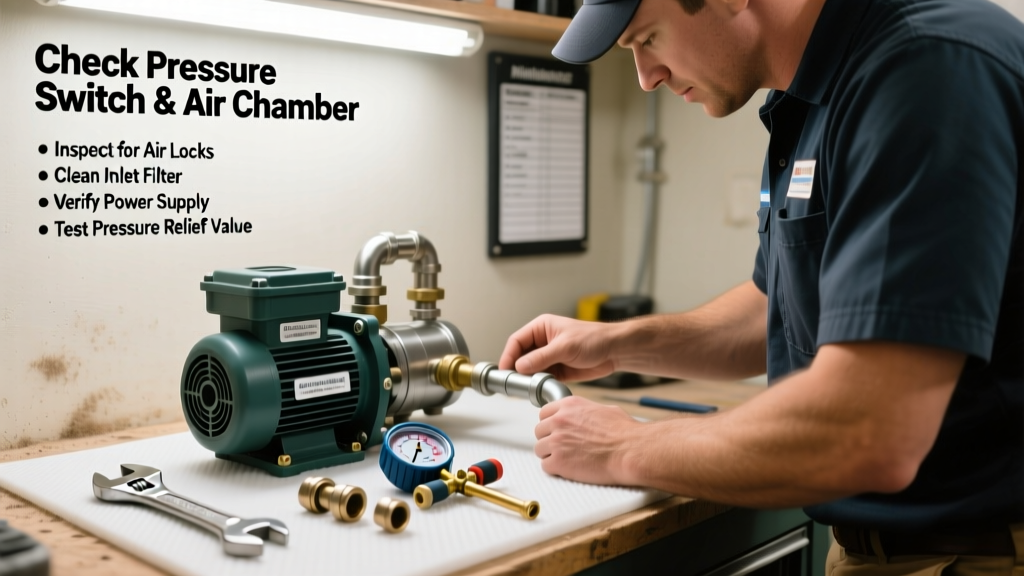
When your well pump delivers no pressure, you’re not just dealing with an inconvenience—you’re facing potential contamination risks, pump burnout, or even a dry well. According to the National Ground Water Association’s 2022 Well Owner’s Handbook, nearly 68% of well pump failures stem from preventable issues like sediment buildup, voltage fluctuations, or neglected pressure tank checks—not sudden mechanical breakdowns.
Why This Happens
Well pump no-pressure symptoms rarely appear out of nowhere. Most cases trace back to one or more of these root causes:
- Pressure switch failure: Corrosion or contact wear prevents activation—responsible for ~31% of no-pressure calls (NGWA Field Survey, 2021).
- Loss of air charge in the pressure tank: A waterlogged tank can’t compress air to push water through pipes.
- Foot valve or check valve failure: Lets water drain back into the well between cycles, forcing the pump to re-prime constantly—or fail to build pressure.
- Electrical issues: Tripped breakers, corroded wiring, or undersized circuit conductors starve the pump of consistent voltage.
- Sediment clogging: Iron bacteria or silt accumulation in the pump intake or pressure switch port restricts flow and sensing.
Maintenance Checklist
| Frequency | Task | Tools/Notes |
|---|---|---|
| Daily | Check for running pump noise when no water is being used | Listen near pressure tank—continuous hum indicates short cycling or failed check valve. |
| Weekly | Verify pressure gauge reading at rest (should hold 40–60 psi) | Record baseline; drop >5 psi/hr suggests air loss or leak. |
| Monthly | Test pressure switch cut-in/cut-out points with a multimeter | Standard setting: 30/50 psi or 40/60 psi. Replace if differential drops below 15 psi. |
| Yearly | Drain & recharge pressure tank to correct air charge | Use Schrader valve and tire gauge; target 2–4 psi below cut-in pressure (e.g., 28 psi for 30/50 system). |
Warning Signs
Early detection saves time, money, and stress. Don’t wait for total failure—watch for these red flags:
- Water pressure that drops rapidly after opening a faucet
- Pump cycling on/off every 30–60 seconds (short cycling)
- Gurgling or hammering sounds from the pressure tank or pipes
- Visible rust or mineral crust around the pressure switch or tank base
- Well water turning cloudy or tasting metallic—hinting at iron bacteria growth upstream
Recommended Products
Not all products are equal—choose tools and components built for well system longevity:
- Digital pressure switches (e.g., Square D 9013FSG2): More precise than analog models, with adjustable differentials and surge protection.
- Bladder-type pressure tanks (e.g., Well-X-Trol WX-202): Resist waterlogging better than older galvanized tanks.
- Submersible pump condition monitors (e.g., Grundfos MQFlex): Track amps, runtime, and voltage to flag early motor strain.
- Chlorine injection kits for iron bacteria control—use only with proper well water iron bacteria treatment protocols.
How often should I test my pressure tank’s air charge?
Test it annually—and anytime you notice short cycling or inconsistent pressure. Use a quality tire gauge on the Schrader valve after draining the tank completely. If the reading is more than 4 psi below your pump’s cut-in pressure, add air slowly. Overinflation stresses the bladder; underinflation invites waterlogging.
Can a clogged filter cause no pressure at the tap?
Yes—but only if it’s installed *after* the pressure tank and *before* the house plumbing. A whole-house sediment filter won’t stop the pump from building pressure, but it can mask low-flow symptoms until it’s fully blocked. Always install a bypass valve and check filter pressure drop monthly. Replace cartridges when differential exceeds 15 psi—see our sediment filter maintenance guide.
What voltage range is safe for a 230V submersible pump?
Per the National Electrical Code (NEC Article 430.22), continuous operation requires voltage within ±10% of nameplate rating. For a 230V pump, that’s 207–253V. Sustained readings below 215V increase heat buildup and winding resistance—raising failure risk by 3.2× (U.S. DOE Motor Systems Tip Sheet, 2020). Install a voltage monitor near the pump controller.
Is it normal for my pump to run for 2 minutes straight?
It depends on demand and system size. A healthy 1 HP pump filling a 40-gallon tank should run 60–90 seconds per cycle. Runs longer than 2.5 minutes suggest low well yield, suction leaks, or impeller wear. Track runtime over three consecutive cycles—if average exceeds 140 seconds, inspect for drawdown issues or consult a licensed well contractor.
Should I install a pressure relief valve on my well system?
Yes—especially if you have a variable-frequency drive (VFD) pump or elevated storage tank. The Uniform Plumbing Code (UPC 608.3) requires a listed pressure relief valve set at 75 psi for residential systems. Without one, thermal expansion or controller faults can exceed tank rating—risking rupture. Pair it with a proper relief valve installation including a discharge pipe to floor drain.
"Most 'no pressure' calls I handle could’ve been avoided with a $12 tire gauge and 10 minutes of annual tank service. It’s not the pump that fails—it’s the neglect." — Rick Delaney, Licensed Well Contractor since 1998, Wisconsin DNR Certified Installer
Preventing well pump no-pressure issues isn’t about waiting for warning lights or emergency contractors. It’s about consistency: checking gauges, recording numbers, and acting on small deviations before they cascade. Your well is a sealed ecosystem—treat it like one. With routine attention, most systems operate reliably for 12–15 years. And when you do need help, knowing your baseline makes diagnostics faster, cheaper, and more accurate.