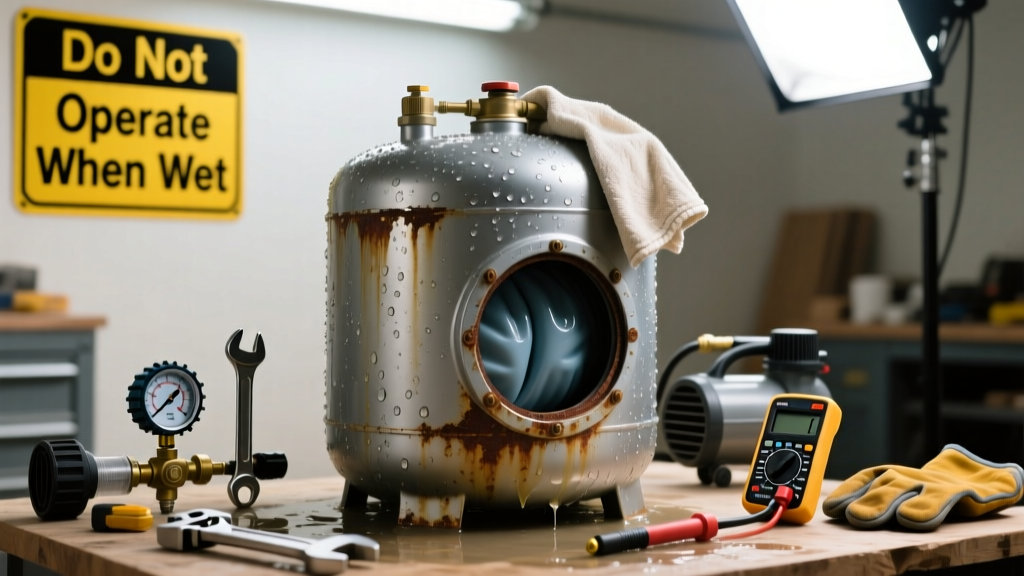
A waterlogged well pressure tank isn’t just an inconvenience—it’s a red flag that your entire water system is under stress. When air volume drops below 20%, the pump cycles every 30–60 seconds instead of its designed 60–90 second interval, accelerating wear on both pump and pressure switch. According to the National Ground Water Association’s 2022 Well Owner’s Handbook, premature pump failure accounts for over 68% of emergency well service calls—and waterlogged tanks are among the top three preventable causes.
Why This Happens
Waterlogging occurs when the internal air bladder fails or the air charge depletes, letting water fully occupy the tank’s compression chamber. Unlike older galvanized tanks with simple air cushions, modern bladder-type tanks rely on precise pre-charge pressure—usually 2 psi below the pump’s cut-in setting (e.g., 28 psi for a 30/50 switch). If the bladder ruptures, air escapes into the water line, and the tank fills completely. Corrosion inside steel tanks or freezing in unheated pump houses can also compromise integrity.
- Bladder rupture due to age (most fail between 5–10 years)
- Undercharged or overcharged air pressure
- Improper installation (e.g., no isolation valve or drain tee)
- Repeated short-cycling before diagnosis
Maintenance Checklist
| Frequency | Task | Tools/Notes |
|---|---|---|
| Daily | Observe pump cycle duration and consistency | Note time between cuts-in and cuts-out; log if <60 sec |
| Weekly | Check for visible tank sweating, bulging, or base corrosion | Use flashlight; inspect bottom weld seam and inlet pipe |
| Monthly | Test air pressure with tire gauge (tank empty & power off) | Drain tank first; repressurize to 2 psi below cut-in |
| Yearly | Replace pressure switch contacts & inspect wiring insulation | Use multimeter; replace if contact pitting >0.5 mm deep |
Warning Signs
Early detection saves hundreds in labor and parts. Don’t wait for total failure—these symptoms appear weeks in advance:
- Pump kicks on every time you open a faucet—even for 5 seconds
- Pressure gauge needle vibrates or drops rapidly during use
- Tank feels uniformly cold and heavy (no warm upper section)
- Water hammer or banging pipes after pump shuts off
- Low water pressure at highest fixtures despite full tank reading
Recommended Products
Investing in quality components pays off in reliability. Avoid generic replacements: bladder tanks rated for 100+ PSI working pressure last longer, and digital pressure gauges with hold functions simplify monthly checks.
- Flotec FPT120-100 bladder tank (10-gallon, NSF-certified, 10-year warranty)
- Accu-Gage AG-200 digital pressure gauge (±0.5% accuracy, zero-hold mode)
- Grundfos MQ series constant-pressure pumps (eliminate tank dependency entirely)
How often should I check air pressure?
Check monthly—not just annually. The U.S. EPA estimates that 42% of waterlogged tanks were last serviced more than 11 months prior to failure. Air seeps out slowly through microscopic pores and valve stems; even a 3-psi loss reduces effective drawdown by 27%. Always test with the tank drained and power disconnected.
Can I re-pressurize without draining?
No—adding air to a water-filled tank compresses water, not air, and risks rupturing the bladder. You must shut off power, open a faucet until flow stops, then close it before attaching the gauge or compressor. Skipping this step is the #1 cause of failed recharges.
What’s the right air pressure for my tank?
It’s always 2 psi below your pressure switch’s cut-in setting—not the tank’s max rating. For a 40/60 switch, it’s 38 psi. For a 20/40 switch (common in older cabins), it’s 18 psi.
"Overcharging doesn’t ‘help’—it shrinks drawdown volume and stresses the bladder. Undercharging floods it faster. Precision matters." — Well Systems Technician Manual, American Water Works Association, 2021
Is tank sweating normal?
Slight condensation on the lower third in humid basements is typical. But persistent wetness across the entire shell—or puddling beneath—means water is migrating past the bladder or corroding the tank wall. That’s not humidity; it’s leakage in progress.
Should I install a pressure tank monitor?
Yes—if your home is seasonal or you’re away frequently. Devices like the PumpTec PT-200 log cycle count, duration, and pressure variance. One homeowner in Vermont caught a slow air leak after the monitor flagged 12% shorter cycles over 17 days—weeks before audible symptoms appeared.
Preventing waterlogging isn’t about doing more—it’s about doing the right thing consistently. A 90-second monthly air check, paired with logging cycle times, catches 9 out of 10 failures before they cost you a pump replacement. Your well system runs silently in the background—until it doesn’t. Stay ahead with intention, not reaction.