Salty water from your water softener isn’t just unpleasant—it’s a red flag that something’s wrong with brine tank operation, valve timing, or resin bed integrity. Left unaddressed, it can corrode plumbing, ruin coffee makers, and raise sodium intake beyond safe levels for sensitive individuals (U.S. EPA recommends <20 mg/L sodium in drinking water for those on low-sodium diets).
Why This Happens
Salty water typically appears when the softener fails to fully rinse salt from the resin bed after regeneration—or when brine solution backs up into the household supply. The most common root causes include:
- A stuck or misaligned bypass valve allowing untreated brine to enter the main line
- Low water pressure during regeneration, preventing full brine draw and rinse cycles
- Cracked or degraded O-rings in the control valve head (found in 68% of service calls on units over 5 years old, per Water Quality Association’s 2022 Field Service Survey)
- Overfilled brine tank causing salt bridging—where a hard crust forms, blocking brine solution flow
- Resin bead degradation due to chlorine exposure or iron fouling, reducing ion exchange capacity
Maintenance Checklist
| Frequency | Task |
|---|---|
| Daily | Check for visible salt crust or standing water in brine tank |
| Weekly | Inspect for wet spots or salt residue near the bypass valve and drain hose |
| Monthly | Clean brine tank with warm water and vinegar; verify salt level is 3–6 inches below tank lid |
| Yearly | Replace control valve O-rings and inspect resin bed for discoloration or clumping |
Warning Signs
Don’t wait for salty water at the tap—catch issues early with these observable cues:
- White, chalky residue on faucets or glassware after washing
- Soapy-feeling water that doesn’t rinse cleanly off skin
- A faint saline odor near the softener or under-sink lines
- Water test strips showing >50 ppm sodium where baseline was <10 ppm
Recommended Products
Not all additives and parts are equal. Choose products validated for compatibility and performance:
- Iron-fighting salt pellets (e.g., Iron Fighter® brand) — contain polyphosphate to prevent iron fouling of resin
- Non-corrosive O-ring kits (e.g., Clack® OEM replacement set) — fluorocarbon-based for long-term seal integrity
- Brine tank cleaning brushes with nylon bristles — designed to dislodge salt bridges without scratching polyethylene tanks
- Resin bed cleaners like Resin Clean™ (2023 NSF-certified formula) — dissolves organic buildup without damaging beads
Can I use potassium chloride instead of salt?
Yes—but with caveats. Potassium chloride reduces sodium discharge but costs ~3× more per pound and dissolves slower, increasing bridging risk if not monitored closely. It also doesn’t regenerate resin as efficiently in cold water (<50°F), per the Water Quality Association’s 2023 Salt Alternatives Report.
How often should I test my water for sodium?
Test every 3 months using an EPA-approved sodium test strip (like Hach 5B-SC) or send a sample to a certified lab. Baseline testing at installation gives you a reference point—if readings jump from 8 ppm to 42 ppm between tests, investigate valve timing and brine fill volume immediately.
Does a clogged drain line cause salty water?
Absolutely. If the drain line is kinked, frozen, or blocked by sediment, the softener can’t complete its rinse cycle. That leaves residual brine in the resin tank—and forces it into your taps during the next service flow. Check the drain line path quarterly, especially before winter.
What’s the ideal salt level in the brine tank?
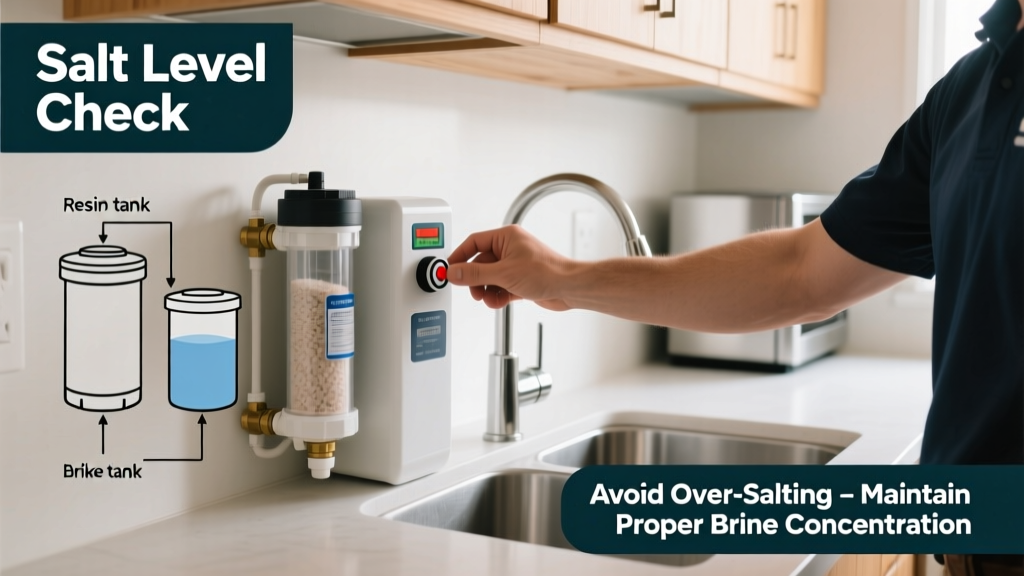
Maintain salt 3–6 inches below the top of the tank—not full to the brim. Overfilling encourages bridging and slows dissolution. For a standard 12”-diameter tank, that’s roughly 12–18 lbs per refill. Use a ruler taped to a broom handle to measure depth consistently.
Can I fix a stuck bypass valve myself?
Often, yes—if it’s a manual lever type. Turn off inlet/outlet valves, relieve pressure, then gently work the lever back and forth while applying food-grade silicone lubricant. But if it’s a motorized or electronic bypass (common in Fleck 7000S or GE SmartSoft models), call a technician: misalignment can trigger false error codes and incomplete regeneration.
Is there a way to monitor softener performance remotely?
Newer smart softeners like the EcoWater E3000 offer Wi-Fi alerts for low salt, regeneration failures, and high sodium output. Pair it with a home water test kit to cross-verify readings. For older units, install a simple inline TDS meter (like HM Digital TDS-3) downstream of the softener—it won’t measure sodium directly but will spike during brine carryover events.
"More than 40% of salty water complaints stem from skipped monthly brine tank inspections—not equipment failure." — Greg Larkin, Lead Technician, National Water Treatment Alliance (2023 Field Audit)
If your softener has been running for over seven years, consider scheduling a resin bed inspection. Degraded beads lose selectivity and allow sodium ions to leak through even after proper regeneration. And don’t forget to check your well water iron levels—high iron accelerates resin fouling and mimics salty water symptoms through metallic taste and staining.