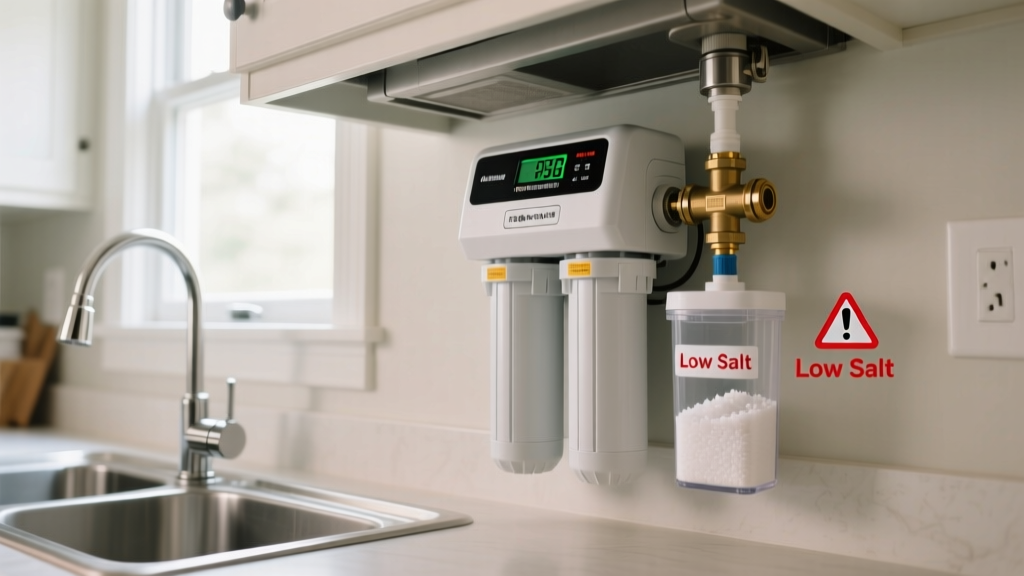
A water softener that fails to regenerate doesn’t just deliver hard water—it accelerates scale buildup in your water heater, dishwasher, and faucets. Left unaddressed, this can shorten appliance lifespans by up to 40% (U.S. Department of Energy, 2022) and increase energy bills by 23% due to mineral-coated heating elements.
Why This Happens
Regeneration failure isn’t random—it’s almost always tied to preventable oversights. Salt bridges and mushing block brine draw; incorrect timer settings ignore actual water usage; and clogged injector assemblies or stuck valves interrupt the regeneration sequence. Power outages or battery failures in digital controllers also halt scheduled cycles—especially problematic if your unit lacks a backup capacitor.
- Salt bridge formation (a hollow crust under salt surface)
- Low or expired salt supply (less than 1/4 full or using rock salt in fine-mesh resin tanks)
- Incorrect hardness setting (e.g., set to 10 gpg when your water tests at 25 gpg)
- Clogged venturi injector or brine line tubing
- Failed control valve motor or corroded wiring terminals
Maintenance Checklist
| Frequency | Task | Details |
|---|---|---|
| Daily | Check salt level visually | Look for bridging: tap tank side—if hollow sound, break crust with broom handle. |
| Weekly | Inspect brine tank water level | Should be 3–6 inches deep; top off with distilled water if below 3" (never tap water). |
| Monthly | Clean brine tank & injector | Vacuum debris; soak injector in white vinegar for 15 min; rinse thoroughly. |
| Yearly | Resin bed inspection & recharge | Test capacity with hardness test strips; replace resin if capacity drops >30% from baseline. |
Warning Signs
Don’t wait for limescale on your showerhead. Early red flags include:
- Soap scum returning despite regular softener use
- Reduced water pressure at softener bypass valve outlet
- Brine tank staying full week after regeneration
- Control panel flashing "ERR" or showing “0 days until regen” indefinitely
- Unusual gurgling during regeneration cycle (indicates air lock or clog)
Recommended Products
Not all salts and cleaners are equal. Use products designed for your softener type and local water chemistry:
- Pellet salt (evaporated): Low-insoluble content—ideal for high-efficiency units like Fleck 5600SXT or GE SmartSoft.
- Resin cleaner (e.g., Iron Out Resin Cleaner): Removes iron fouling every 6 months in well-water homes.
- Digital water hardness tester (Hanna Instruments HI96735): Verifies output hardness monthly—critical for validating regeneration success.
- Brine tank float sensor (EcoWater BR-100): Adds low-salt alert to older mechanical timers.
How often should I check my salt level?
Check weekly—not just monthly. A study by the Water Quality Association found 68% of regeneration failures began with salt depletion lasting over 72 hours. Keep salt at least half-full and break bridges immediately. Never let salt sit below the refill tube opening.
Can I use potassium chloride instead of sodium chloride?
Yes—but it dissolves slower and forms mush more easily in cold basements (<55°F). If switching, reduce refill time by 10% and clean the brine tank quarterly. Potassium chloride also costs ~3× more per pound, so weigh long-term value against sodium sensitivity needs.
"Potassium chloride works, but requires tighter monitoring—especially in high-hardness wells. We see 3× more service calls on KCl units with no maintenance log." — WQA Certified Installer Survey, 2023
My softener regenerates but water still feels hard—what’s wrong?
This usually points to insufficient brine concentration or resin exhaustion. Test output hardness with a reliable kit. If >1 gpg, inspect the brine valve seal and verify salt dose setting matches your unit’s manual (e.g., 6–12 lbs for most 1.0 cu ft systems). Also, check for cross-connection leaks—hard water bypassing the softener via a faulty bypass valve is common in homes with leaky bypass valves.
Does power loss reset my softener’s clock and schedule?
Most digital models (Culligan Mark 10, Pentair Shurflo) retain settings for up to 72 hours on internal capacitors—but mechanical timers (older Autotrol units) lose all programming instantly. Always confirm the date/time and next regeneration day after an outage. For critical applications, add a UPS battery backup—like the APC Back-UPS 550VA—to avoid missed cycles. You’ll find compatible options in our best UPS for water systems guide.
Is it safe to skip regeneration during vacation?
No—unless your unit has a true vacation mode (e.g., Fleck 7000 with "Vacation Hold" firmware). Skipping causes resin saturation, leading to channeling and permanent capacity loss. Instead, set a delayed regeneration 24 hours before return—or use a smart plug with timer to cut power *after* a completed cycle. Better yet, install a remote-monitoring kit like the SmartSoft Sensor Kit to get SMS alerts if regeneration fails.
Preventing regeneration failure isn’t about perfection—it’s about consistency. A 90-second weekly salt check and a 15-minute monthly injector cleaning take less time than one service call ($185 average, according to ServiceTitan 2023 data). Stay ahead of the symptoms, not behind the damage.