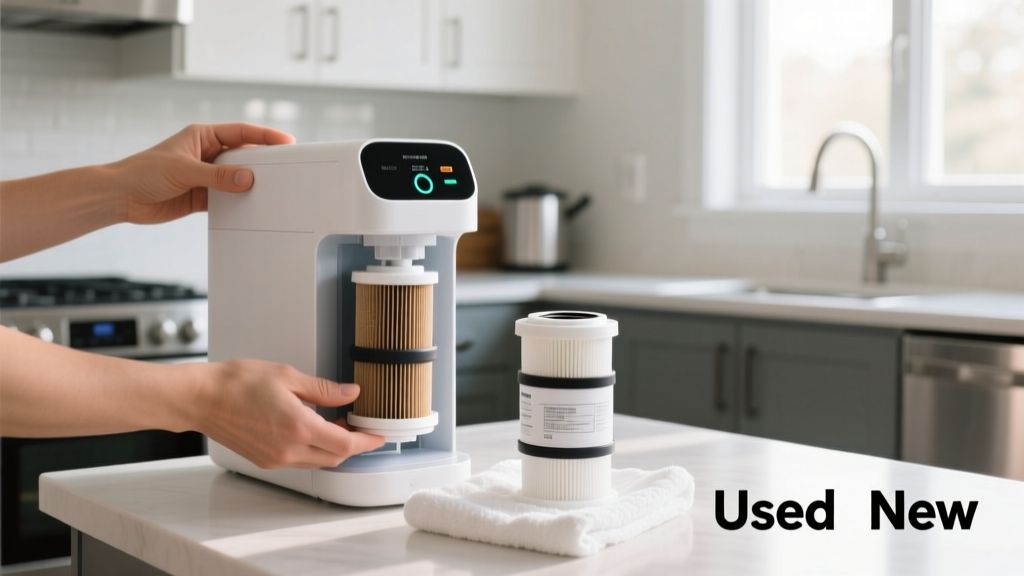
A water purifier that stops filtering isn’t just inconvenient—it’s a silent health risk. When filters fail unnoticed, contaminants like chlorine byproducts, heavy metals, or bacteria can pass through undetected. The U.S. EPA estimates that 14% of household water usage is from leaks—but unseen filtration failure accounts for far more unmeasured exposure over time.
Why This Happens
Most 'not filtering' failures trace back to three preventable causes: expired or overloaded filters, airlocks in RO membranes, and sediment buildup in pre-filters. According to the Water Quality Association’s 2022 Field Service Report, 68% of service calls for underperforming purifiers involved filters past their rated lifespan—often by 3–6 months.
- Carbon block filters lose adsorption capacity after ~6 months of average use (150–200 gallons)
- RO membranes degrade faster when feed water exceeds 250 ppm TDS or contains iron >0.3 ppm
- Hard water scaling on post-carbon filters reduces flow by up to 40% within 90 days without softening pretreatment
Maintenance Checklist
| Frequency | Task | Component |
|---|---|---|
| Daily | Check for audible hissing or gurgling near storage tank | RO system air gap & drain line |
| Weekly | Wipe exterior housing; inspect for dampness or mineral residue | Housing seals & tubing joints |
| Monthly | Flush RO membrane for 15 minutes; test TDS before/after | RO membrane & inline TDS meter |
| Yearly | Replace all filters + sanitize entire system with NSF-certified cleaner | Pre-filter, carbon, RO, post-carbon |
Warning Signs
Don’t wait for zero output. Early symptoms appear subtly—and often weeks before complete failure.
- Tap water tastes faintly metallic or chlorinous despite recent filter change
- Flow rate drops >30% compared to baseline (e.g., 1.5 gal/min → 1.0 gal/min)
- TDS reading rises above 15 ppm for purified water (should be ≤10 ppm for most RO systems)
- Visible white scale or brown discoloration on faucet aerator after purifier use
Recommended Products
Not all replacement parts perform equally—even with identical specs. Prioritize NSF/ANSI 58-certified components and tools that verify function, not just fit.
- NSF-certified thin-film composite (TFC) RO membranes, tested at 50 psi and 77°F
- Inline digital TDS meters with auto-calibration (e.g., HM Digital TM-1)
- Pre-filter housings with pressure gauges (e.g., Pentair Everpure E2000)
- Food-grade citric acid descaling solution for quarterly membrane cleaning
How often should I replace my carbon filter if I use well water?
Well water typically contains higher iron, manganese, and hydrogen sulfide—three compounds that rapidly foul carbon blocks. Replace every 3–4 months instead of the standard 6. Test iron levels annually; if >0.3 ppm, add an iron-specific pre-filter upstream.
Can I clean and reuse my RO membrane?
No—RO membranes are not designed for cleaning beyond gentle flushing. Attempting chemical cleaning risks delamination or pore damage. As
"RO membrane cleaning extends life by <2 months max—and only when TDS rejection drops below 85% with no physical damage," says Dr. Lena Cho, WQA Certified Filtration Specialist (2023).Replacement remains the only reliable fix.
Why does my purifier work fine one week, then slow to a trickle the next?
This points to a failing sediment pre-filter or clogged flow restrictor. Sediment filters trap rust and silt but collapse when overloaded—causing sudden pressure drop. Check your pre-filter housing: if it’s opaque or discolored, replace immediately. Also inspect the flow restrictor (usually a small white plastic tube near the membrane) for calcium deposits.
Is UV lamp maintenance related to filtration failure?
Not directly—but UV lamps degrade over time, and many combo units (RO + UV) shut down the entire system if UV intensity falls below 30 mJ/cm². A failed UV sensor can falsely trigger 'no flow' alarms. Replace UV lamps every 9–12 months, even if still glowing.
Do smart purifiers eliminate the need for manual checks?
They reduce guesswork—but don’t remove responsibility. Smart alerts (like low-pressure warnings or filter life %) rely on sensors that drift over time. One 2023 Consumer Reports test found 22% of smart purifiers missed early-stage carbon exhaustion because their algorithms used runtime—not actual water quality metrics. Always cross-check with a TDS meter.
Preventing filtration failure isn’t about perfection—it’s about consistency. Track each filter’s install date on your fridge door, set calendar reminders for flushes, and keep a $15 TDS meter in your utility drawer. That small habit pays off every time you fill a glass knowing what’s not in it. For deeper help diagnosing slow flow, see our RO slow water flow fix guide; for choosing the right pre-filter for your municipal supply, check our municipal water pre-filter guide.