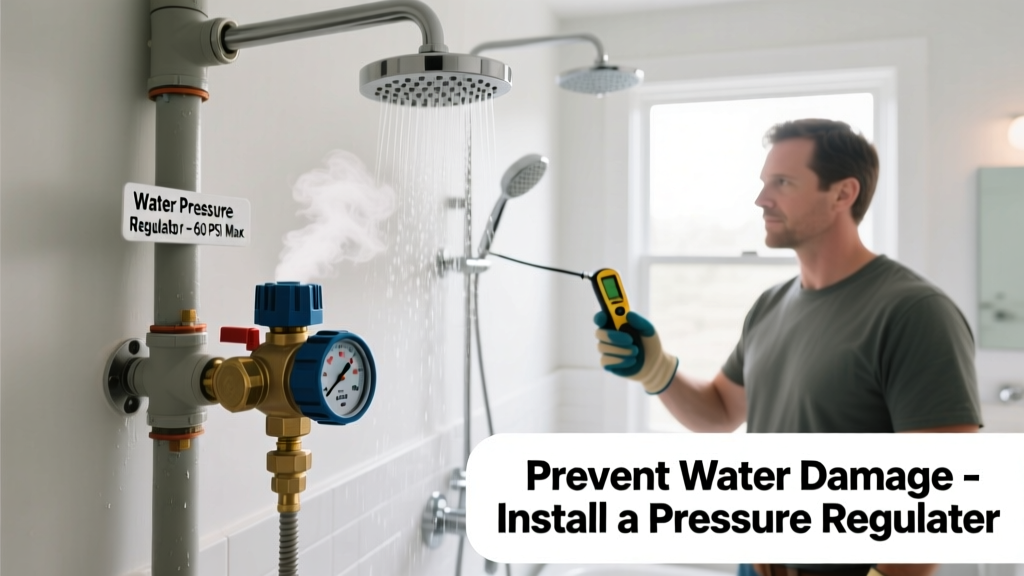
Water pressure above 80 psi doesn’t just make faucets sputter—it stresses every joint, seal, and appliance in your plumbing system. According to the Uniform Plumbing Code, sustained pressure over 80 psi can shorten the lifespan of water heaters, washing machines, and even PEX tubing by up to 40%. Left unchecked, it leads to pinhole leaks, failed toilet fill valves, and burst supply lines—often without warning.
Why This Happens
High water pressure rarely develops on its own. It’s usually caused by external or internal system changes. Municipal water departments often deliver pressure between 60–110 psi to ensure flow to upper floors of buildings—and your home may sit near a pressure zone boundary or at the bottom of a hill. Thermal expansion from closed-loop water heating systems adds another 15–30 psi during heating cycles. Older homes with outdated pressure regulators (or none at all) are especially vulnerable.
- Municipal supply pressure exceeding 75 psi at the street
- Failed or missing pressure-reducing valve (PRV)
- Thermal expansion in closed-loop systems without an expansion tank
- Recent upgrades to high-efficiency pumps or booster systems
Maintenance Checklist
| Frequency | Task |
|---|---|
| Daily | Listen for hissing at faucets or toilets; check for dripping after shutoff |
| Weekly | Inspect under-sink supply lines for dampness or mineral buildup |
| Monthly | Test pressure with a gauge at an outdoor spigot (cold water only) |
| Yearly | Have a licensed plumber inspect and adjust your PRV; flush expansion tank air bladder |
Warning Signs
High pressure rarely announces itself with alarms—but it leaves clear physical evidence. Pay attention to patterns, not isolated incidents. A single leaky faucet washer might be wear; three leaking in one month points to systemic stress.
- Whistling or banging noises when turning off taps (water hammer)
- Frequent replacement of washing machine hoses or dishwasher inlet valves
- Leaking toilet fill valves—even after replacing the entire assembly
- Moisture around water heater T&P valve or pipe joints
Recommended Products
Not all pressure control tools work the same way—or last the same amount of time. Choose based on your home’s configuration and local code requirements. Most single-family homes need a properly sized PRV plus an expansion tank if you have a backflow preventer or check valve on the main line.
- Pressure-reducing valves: Watts LF25A (adjustable 25–75 psi) or Apollo 72D (lead-free, 3/4″ NPT)
- Expansion tanks: Amtrol ST-5 (5-gallon, pre-charged to 40 psi) for 40–60 psi systems
- Digital pressure gauges: Hanes 0–160 psi stainless steel gauge with 1/4″ NPT thread
How do I know if my home even has a pressure-reducing valve?
Look for a bell-shaped brass device (usually 3–4 inches wide) installed on the main cold water line just after the shutoff valve and before the water meter or branch lines. It often has an adjustable screw on top and a small drain valve underneath. Homes built after 2000 in high-pressure zones almost always include one—but it may be buried behind drywall or insulation. If you’re unsure, trace your main supply line from the street to the water heater.
Can thermal expansion really raise pressure that much?
Absolutely. When water heats from 50°F to 140°F in a closed system (e.g., with a backflow preventer), it expands by ~2%. With no room to expand, that volume converts directly into pressure. The U.S. EPA estimates that 14% of household water usage is from leaks—and thermal expansion contributes significantly to premature failure of flexible supply lines. An expansion tank absorbs that extra volume safely.
What’s the right pressure setting for my PRV?
Set it to 55–65 psi for most homes. Lower settings reduce wear on fixtures but may cause low flow on upper floors. Never set below 45 psi unless you’ve confirmed adequate flow at all outlets—including the highest showerhead. Always retest pressure after adjustment using a calibrated gauge, not the dial on the PRV itself.
Do I need both a PRV and an expansion tank?
Yes—if your system is closed. A closed system exists when a backflow preventer, check valve, or water meter with a built-in check valve prevents water from flowing backward. In that case, the PRV regulates incoming pressure, while the expansion tank handles internal thermal spikes. Skipping the tank risks repeated T&P valve discharge or ruptured water heater tanks. According to the Insurance Institute for Business & Home Safety's 2023 report, 68% of water heater failures in high-pressure zones involved missing or undersized expansion tanks.
"A PRV without an expansion tank in a closed system is like a seatbelt without an airbag—it helps, but won’t stop the worst outcomes." — Licensed Master Plumber Maria Chen, Plumbing Code Review Board, 2022
How often should I test my water pressure?
Test at least once per quarter—preferably at the same spigot, same time of day, and with the same gauge. Keep a log: date, reading, temperature, and whether major appliances were running. Sudden jumps (e.g., from 62 psi to 79 psi over two months) signal regulator drift or municipal pressure changes. If readings consistently exceed 75 psi, contact your water utility—they may offer free pressure testing or install a district-wide regulator.
Preventing high water pressure isn’t about reacting to leaks—it’s about recognizing the quiet strain building inside your walls. Install a quality PRV, pair it with the right expansion tank, and test regularly. That simple routine extends the life of your water heater, protects your washing machine hoses, and saves hundreds in emergency repairs each year.