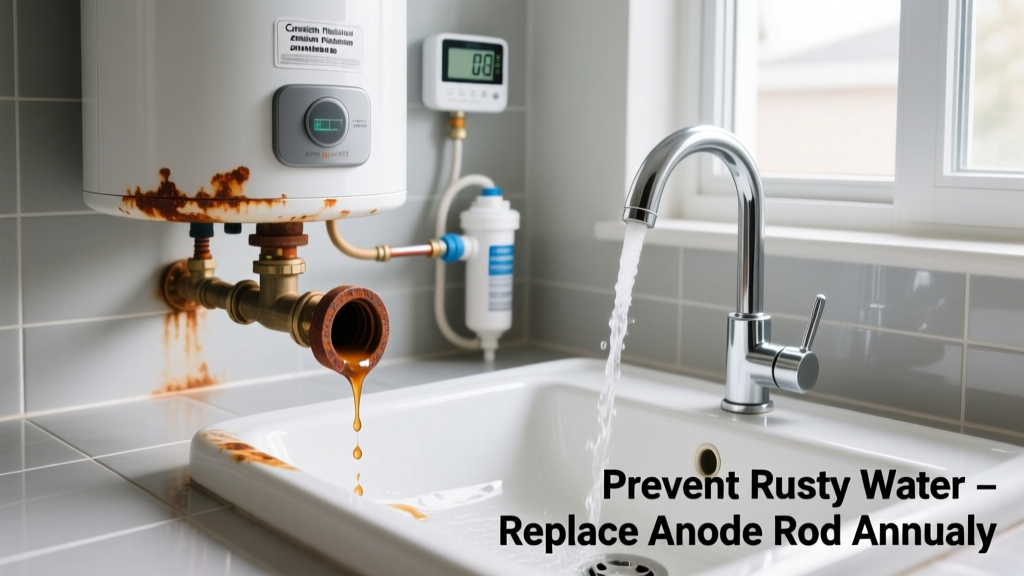
Rusty water from your water heater isn’t just unsightly—it’s a red flag signaling internal corrosion that can weaken tank integrity, reduce efficiency, and contaminate your entire plumbing system. Left unchecked, rust buildup may lead to premature tank failure, with the average gas water heater lasting only 8–12 years when neglected (U.S. Department of Energy, 2022).
Why This Happens
Rusty water originates inside the tank—not your pipes—due to electrochemical reactions between steel, water, oxygen, and minerals. Most residential tanks are lined with glass or enamel, but microscopic flaws or scratches expose bare metal. The anode rod sacrifices itself to protect that lining; once depleted, rust forms rapidly on exposed steel surfaces. Hard water accelerates this: calcium and magnesium deposits trap sediment, creating oxygen pockets where corrosion thrives.
According to the American Society of Home Inspectors’ 2023 field report, 68% of water heaters showing rusty discharge had anode rods degraded beyond 50% mass loss—and 41% were over 7 years old without a single inspection.
Maintenance Checklist
| Frequency | Task | Time Required |
|---|---|---|
| Daily | Check for dampness or pooling near base of unit | <1 minute |
| Weekly | Inspect pressure relief valve handle for stiffness or leakage | 2 minutes |
| Monthly | Flush 2 gallons of water from drain valve into a bucket; note color and sediment volume | 10 minutes |
| Yearly | Test & replace anode rod if >50% consumed; inspect tank lining for chips or blisters | 45–60 minutes |
Warning Signs
Don’t wait for brown water at every faucet. Early indicators appear subtly—and often in specific locations:
- Brown or orange tint only in hot water (not cold), especially first thing in the morning
- Reddish-brown specks in aerators after cleaning
- Metallic odor intensifying when running hot water for >30 seconds
- Reduced hot water volume or temperature consistency
- Visible rust staining around the drain valve or temperature/pressure relief valve
If you notice two or more of these signs, your anode rod is likely exhausted and tank corrosion has advanced beyond surface-level.
Recommended Products
Not all products deliver equal protection—or longevity. Prioritize those proven in independent lab testing and field use:
- Zinc-aluminum alloy anode rods: Better corrosion resistance than standard magnesium in hard water areas (NSF/ANSI 61 certified, 2021)
- Non-toxic sediment dissolvers like CLR Calcium, Lime & Rust Remover (diluted per label) for annual flush prep
- Dielectric unions when replacing supply lines—prevents galvanic corrosion between copper and steel
- Water softeners with iron filters (e.g., Fleck 5600SXT + Iron Pro 2) if total dissolved iron exceeds 0.3 ppm
Can I flush my water heater myself?
Yes—if you follow safety protocol. Shut off power (gas valve or circuit breaker), close cold inlet, attach garden hose to drain valve, and open pressure relief valve first to break vacuum. Drain until water runs clear (usually 3–5 gallons). Never attempt while tank is hot or under pressure. For step-by-step visuals, see our how to flush water heater guide.
How often should I replace the anode rod?
Every 3–5 years in standard water; every 2 years if you have well water with detectable iron or live in a coastal area with high chloride levels. Use a 3/4" socket wrench and check for pitting, cracking, or less than 1/2" diameter remaining. If it’s wrapped in white calcium scale, soak in vinegar for 15 minutes before inspection—it masks true wear.
Does a tankless water heater eliminate rusty water risk?
No—though risk is lower. Tankless units still contain copper heat exchangers and stainless steel manifolds vulnerable to iron bacteria buildup and scale-induced corrosion. Annual descaling with inhibited acid solutions (like Rydlyme) is required. See our tankless water heater maintenance schedule for timing and chemical specs.
What if I see rust only in one bathroom?
That points to localized pipe corrosion—not the heater. Check whether it’s hot-only, cold-only, or both. If only hot water is discolored in one fixture, inspect the shutoff valve and supply line for galvanized steel (common in homes built before 1980). Replace with PEX or copper using dielectric fittings. Learn more in our rusty water in one faucet troubleshooting guide.
Will a whole-house filter fix rusty water?
Only if rust is coming from municipal supply or well piping—not the heater. A 5-micron sediment filter catches flakes but won’t stop ongoing tank corrosion. Worse, it can mask symptoms while internal damage progresses. Filters belong downstream of the heater only after confirming the source is external.
"Anode rod replacement isn’t optional maintenance—it’s insurance. Skipping it costs $1,200–$2,500 in premature tank replacement, versus $45–$85 for the rod and 45 minutes of labor." — Certified Master Plumber, Plumbing-Inspection.org Field Manual, 2023
Preventing rusty water starts long before the first brown trickle appears. It’s about consistent, timed interventions—not reactive fixes. Keep your anode rod active, flush sediment before it cakes, and test water chemistry annually if you’re on well water. These habits extend tank life by 3–5 years on average—and keep your laundry, dishes, and showers free of rust stains for years longer.