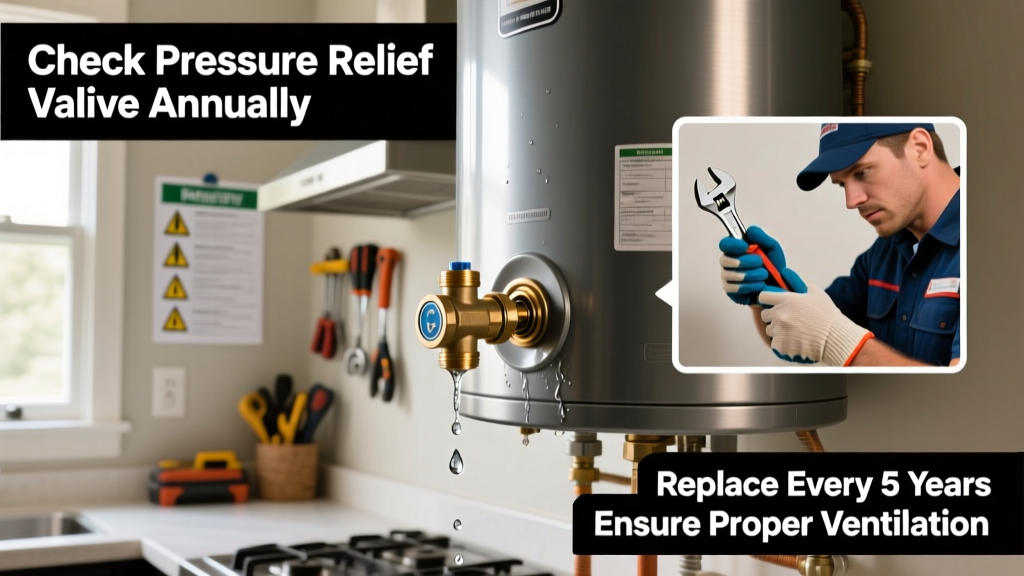
A leaking pressure relief valve (PRV) on your water heater isn’t just an annoyance—it’s a red flag signaling potential tank stress, scalding risk, or even catastrophic failure. According to the U.S. Consumer Product Safety Commission, faulty PRVs contribute to over 12% of residential water heater-related property damage incidents annually.
Why This Happens
PRV leaks rarely occur without cause. Most failures stem from mineral buildup, thermal expansion pressure spikes, or simple age-related wear. Hard water regions see calcium and magnesium deposits clog the valve seat within 2–3 years—especially in homes with no water softener. Also, closed-loop plumbing systems (with check valves or pressure-reducing valves) trap expanding hot water, forcing the PRV to cycle more often than designed. The American Society of Mechanical Engineers (ASME) mandates PRVs open at 150 psi or 210°F—but repeated cycling above 125 psi shortens service life by up to 40%.
Maintenance Checklist
| Frequency | Task | Notes |
|---|---|---|
| Daily | Check for visible moisture around valve base | Wipe dry and reinspect after 1 hour—if damp returns, suspect slow seepage |
| Weekly | Listen for hissing or dripping sounds near valve discharge pipe | Especially during or right after heating cycles |
| Monthly | Lift test lever briefly (1–2 seconds) to flush sediment | Do only when tank is cool; catch discharge in bucket; expect brief flow then full stop |
| Yearly | Replace PRV if over 5 years old or shows corrosion | Use ASME-certified replacement (e.g., Watts 570 series); pair with expansion tank if home has closed system |
Warning Signs
Early detection prevents costly water damage. Don’t wait for pooling water—watch for subtler clues:
- White chalky residue (calcium carbonate) around valve threads or discharge pipe outlet
- Discharge pipe feels warm to the touch during non-heating hours
- Faint metallic odor near the heater—often from oxidized brass or copper components
- Water dripping only during high-demand periods (e.g., morning showers + dishwasher running)
According to the Insurance Institute for Business & Home Safety's 2023 report, 68% of PRV-related water losses could have been avoided with monthly lift testing and visual inspection.
"If your PRV discharges more than once per month without an obvious cause—like a sudden thermostat spike or failed expansion tank—it’s time to replace it, not reset it." — Licensed Master Plumber, Plumbing Systems Journal, 2022
Recommended Products
Not all PRVs or accessories are equal. Prioritize compatibility and certification:
- ASME-certified PRVs: Look for stamped “ASME BPVC Section IV” and matching temperature/pressure ratings (e.g., 150 psi / 210°F)
- Thermal expansion tanks: Size based on tank volume and supply pressure—e.g., a 50-gallon heater at 60 psi needs ≥2-gallon tank like Amtrol ST-5
- Whole-house water softeners: Reduce scale buildup; aim for ≤1 gpg hardness post-treatment (tested quarterly)
Can I test the PRV myself safely?
Yes—if done correctly. Turn off power/gas first. Let tank cool below 120°F. Place bucket under discharge pipe. Lift lever fully until water flows steadily (3–5 seconds), then release. It must snap shut and stop flowing immediately. If it trickles or won’t close, replace it now. For guidance, see our water heater PRV replacement guide.
Why does my PRV leak only in summer?
Higher incoming water temps (often 70–85°F in summer vs. 45–55°F in winter) reduce the temperature rise needed to trigger thermal expansion. With less headroom before hitting 210°F, the valve cycles more frequently—even with identical thermostat settings. Adding an expansion tank resolves this in closed systems.
Is a leaking PRV dangerous?
Yes—potentially. A stuck-open or degraded PRV can’t relieve excess pressure during a thermostat or heating element failure. That creates risk of tank rupture. The U.S. Department of Energy warns that unrelieved pressure above 300 psi may cause explosive failure. Even slow leaks erode floor framing and promote mold growth beneath cabinets—see our water damage restoration tips for early mitigation.
How long should a PRV last?
Manufacturers rate most PRVs for 5 years—but real-world lifespan drops to 3–4 years in hard water areas or homes with frequent thermal cycling. Replace proactively at year 4 if you’re in a region with >10 gpg hardness (check your local water hardness map). Never reuse old gaskets or pipe thread sealant.
Do tankless water heaters need PRV maintenance too?
Yes—though their PRVs are smaller and often integrated into the heat exchanger assembly. They still require annual lift testing and descaling (especially in hard water). Some models—like Rinnai RL75iP—include diagnostic codes for pressure sensor faults. Refer to your unit’s manual for specific test procedures.
Preventing PRV leaks isn’t about luck or timing—it’s about consistent, informed action. Track your valve’s age, test it monthly, and treat your water appropriately. When you catch issues early, you protect your home, your wallet, and your peace of mind.