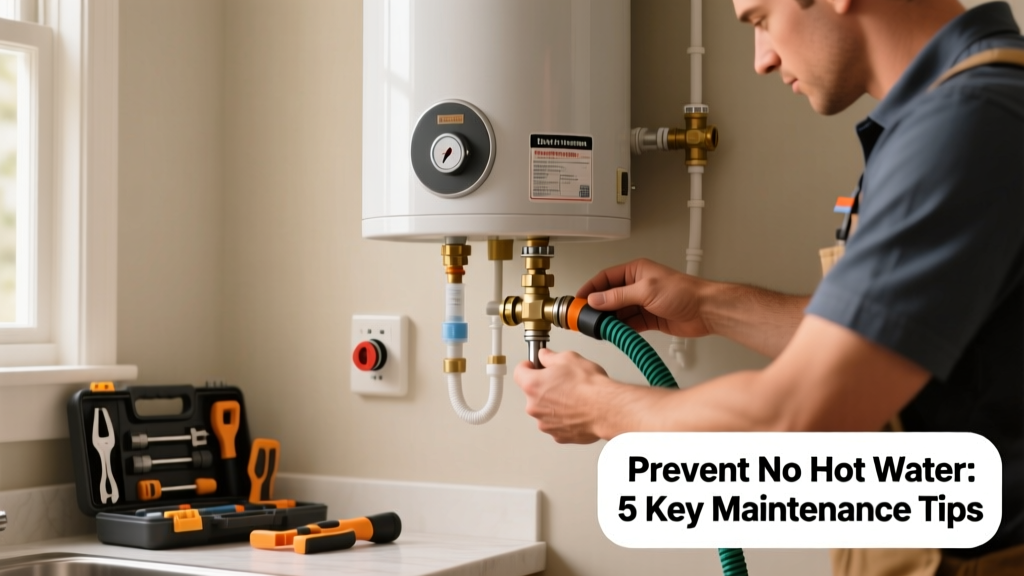
Running cold water when you expect hot isn’t just annoying—it’s a red flag that your water heater is struggling, possibly failing. According to the U.S. Department of Energy, 30% of water heater failures stem from neglected maintenance, not age or manufacturing defects. A single unaddressed issue—like sediment buildup or thermostat drift—can leave your household without hot water for days, especially during winter.
Why This Happens
Most 'no hot water' incidents aren’t sudden breakdowns—they’re the final symptom of slow degradation. Common root causes include:
- Sediment accumulation in tank-type heaters (especially in hard water areas), insulating the heating element and reducing efficiency by up to 30% (Energy Star, 2022)
- Thermostat misalignment or failure, often triggered by voltage fluctuations or aging wiring
- Tripped high-limit switch due to overheating from restricted airflow or blocked flue vents
- Failed heating elements (electric) or pilot light extinction (gas), both frequently preventable with routine checks
- Corroded anode rod, accelerating tank lining deterioration and leading to leaks before heat loss becomes obvious
Maintenance Checklist
| Frequency | Task | Time Required |
|---|---|---|
| Daily | Check for pooling water near base or unusual sounds (hissing, popping) | 30 seconds |
| Weekly | Test pressure relief valve by lifting lever briefly; listen for steady water flow | 2 minutes |
| Monthly | Inspect gas connections for odor or soot; verify electric unit breaker hasn’t tripped | 5 minutes |
| Yearly | Drain 2–3 gallons to remove sediment; replace anode rod if >50% corroded | 45 minutes |
Warning Signs
Don’t wait for total failure. These early indicators mean action is needed within 7–14 days:
- Hot water runs out 5–10 minutes faster than usual
- Temperature fluctuates wildly—even with consistent thermostat setting
- Faint metallic or sulfur-like odor from hot taps
- Visible rust on tank exterior or discharge pipe connections
- Water heater cycles on/off more frequently than normal
Recommended Products
Investing in the right tools and parts makes maintenance reliable—not guesswork. Focus on these categories:
- Sediment-flushing kits with reinforced hose and brass valve (e.g., Camco 40101)
- Water hardness test strips (Taylor K-1766) to determine flush frequency—hardness >7 gpg warrants quarterly draining
- Anode rods with zinc-aluminum alloy for mixed water supplies; magnesium for soft water
- Smart thermostats compatible with tank heaters (like Honeywell RTH9580WF) to log temperature variance trends
How often should I flush my water heater?
In areas with water hardness above 7 grains per gallon (gpg), flush every 3 months. For moderate hardness (3–7 gpg), biannual flushing suffices. Soft water (<3 gpg) still requires annual flushing—sediment forms from mineral deposits in the tank lining itself, not just incoming water. The U.S. EPA estimates that skipping even one annual flush increases energy use by 4–7% annually.
Can a faulty dip tube cause no hot water?
Yes—and it’s often overlooked. A cracked or disintegrated dip tube (common in units installed 1993–2000) sends cold water directly into the top of the tank instead of pushing it downward. That means cold water mixes with hot at the outlet, delivering lukewarm or cold output even when the tank is fully heated. Replacing the dip tube costs under $20 and takes ~45 minutes—far less than replacing the entire unit.
Why does my electric water heater trip the breaker repeatedly?
This usually signals either a shorted heating element or moisture intrusion in the junction box. Before assuming the element is bad, shut off power, remove the access panel, and inspect for condensation or corrosion. According to the National Electrical Code (NEC 2023), junction boxes on water heaters must be sealed against vapor migration—if yours lacks a proper gasket, humid air can cause intermittent shorts. Replace the gasket and test continuity on both elements with a multimeter.
Is it safe to adjust the thermostat myself?
Yes—if you follow safety protocol. Turn off power (or gas supply), wait 10 minutes for residual heat to dissipate, then locate the thermostat behind the access panel. Most units run safely at 120°F: higher settings increase scald risk and scale buildup. As plumbing contractor Maria Chen notes in Home Systems Quarterly (2023):
"Every 10°F above 120°F cuts tank life by 18 months—and raises standby heat loss by 12%. If you need hotter water for dishwashers, install a booster heater at the point of use instead."
What’s the average lifespan of a well-maintained water heater?
Tank-type units last 10–12 years with consistent care—up from 6–8 years with no maintenance (Plumbing-Heating-Cooling Contractors Association, 2022). Tankless models exceed 20 years when flushed twice yearly and fitted with whole-house sediment filters. Key longevity factors: anode rod replacement every 3–5 years, keeping clearance around the unit ≥12 inches for airflow, and installing a thermal expansion tank if your home has a closed-loop system.
Prevention isn’t about avoiding repair—it’s about extending reliability so your water heater works as silently and dependably as your refrigerator. Start with one task this month: drain 2 gallons and check your anode rod. Then build from there. For deeper diagnostics, see our guide on water heater leaking from bottom or water heater making banging noise.