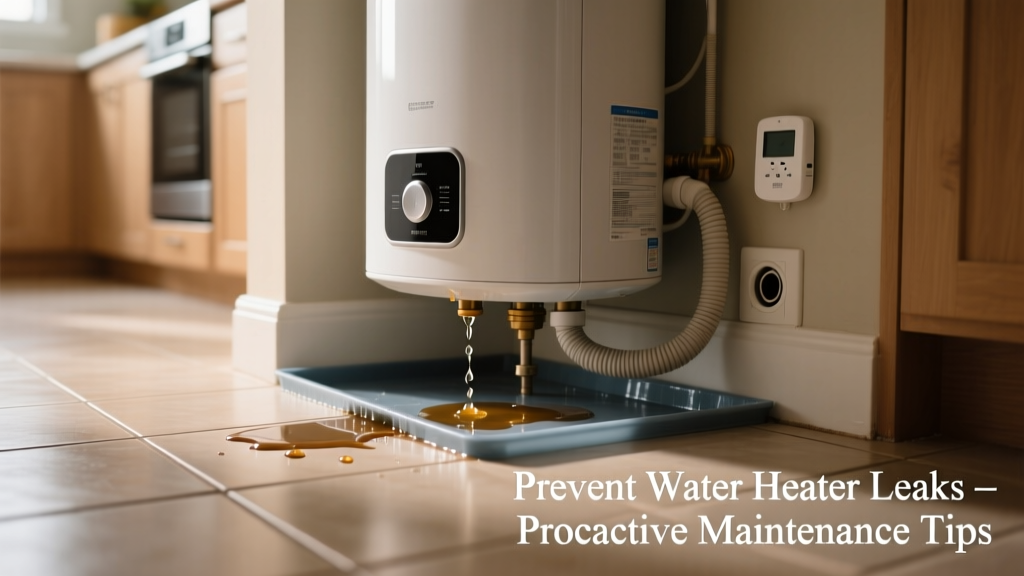
A water heater leaking from the bottom isn’t just an inconvenience—it’s a red flag signaling internal corrosion, sediment buildup, or failing components. Left unchecked, it can flood your garage, basement, or utility closet, damaging floors, drywall, and electrical systems. The average water heater lasts 8–12 years, but 42% of premature failures stem from avoidable neglect (National Association of Home Builders, 2022).
Why This Happens
Leaks at the base almost never come from a single point failure—they’re symptoms of deeper wear. The most common culprits include:
- Tank corrosion: Rust forms where sediment settles, especially in hard water areas.
- Drain valve deterioration: Plastic or brass valves crack or warp after repeated use or age.
- Temperature and pressure (T&P) valve discharge: If it’s leaking near the bottom, it may be venting excess pressure—or failing silently.
- Cracked heat exchanger (in tankless units): Less common in standard tanks, but possible in hybrid or condensing models.
Sediment accumulation is the silent accelerator: just 1 inch of scale reduces efficiency by up to 25% and traps moisture against the tank lining (U.S. Department of Energy, 2023).
Maintenance Checklist
| Task | Daily | Weekly | Monthly | Yearly |
|---|---|---|---|---|
| Check for puddles or dampness under unit | ✓ | |||
| Inspect drain valve for cracks or seepage | ✓ | |||
| Flush 2–3 gallons to reduce sediment | ✓ | |||
| Test T&P valve operation | ✓ | |||
| Replace sacrificial anode rod | ✓ (every 3–5 years) |
Warning Signs
Don’t wait for a pool to form. These subtle cues often appear weeks before visible leakage:
- Rust-colored staining on the floor or base pan
- Musty odor near the heater (indicates trapped moisture and early mold)
- Unusual popping or rumbling during heating cycles (sediment boiling)
- Cooler-than-usual hot water output despite normal settings
- Corrosion around the drain valve threads or T&P valve outlet pipe
If you spot rust streaks running down the tank’s lower third, that’s active corrosion—not surface dust. That’s your last reliable window before pinhole leaks develop.
Recommended Products
Not all products are equal when it comes to protecting your tank’s integrity. Prioritize reliability over price:
- Anode rods: Magnesium (for soft water) or aluminum-zinc (for hard water); avoid cheap galvanized rods that degrade in under 18 months.
- Brass drain valves: Replace plastic OEM valves with 3/4" NPT brass ball valves—they withstand repeated use and thermal cycling better.
- Leak detection sensors: Devices like Flo by Moen or Zircon Leak Alert trigger alerts at 0.1 oz of moisture—before pooling begins.
- Expansion tanks: Required if you have a closed-loop system; prevents pressure spikes that stress weld seams and valves.
How often should I flush my water heater?
At minimum, flush 2–3 gallons monthly if you live in a hard water area (12+ grains per gallon). In moderate zones (3–7 gpg), quarterly flushing suffices. Skip it entirely? Sediment can cut tank life in half. According to the Plumbing-Heating-Cooling Contractors Association (2021), units flushed regularly last 3.2 years longer on average.
Can a leak from the bottom be repaired—or is replacement inevitable?
True bottom-tank leaks—where water seeps from the tank shell itself—are not repairable. Welds and linings can’t be patched safely. But many ‘bottom leaks’ originate from the drain valve, T&P valve, or inlet/outlet connections—all replaceable with basic tools and step-by-step guidance. Always isolate, drain, and inspect before assuming total failure.
Does installing a drip pan help prevent damage?
Yes—but only if paired with a drain line. A pan without a slope and PVC pipe to a floor drain or sump pump won’t stop flooding; it just contains it temporarily. Per the International Residential Code (IRC R109.2), pans are required for heaters installed in attics or above living spaces—and must slope 1/8" per foot toward a 3/4" outlet.
What’s the role of the anode rod—and how do I know it’s failing?
The anode rod sacrifices itself to protect your tank’s steel lining. When it’s fully corroded (looks like a twisted wire or has large chunks missing), the tank starts rusting from the inside out. Most rods last 3–5 years—but in chlorinated or well water, check annually. As plumbing engineer Lisa Tran notes:
“If your anode rod looks smooth and shiny after five years, your water is so aggressive it’s dissolving it faster than visual inspection can catch—test your water hardness and consider a powered anode.”
Is a tankless water heater less likely to leak from the bottom?
Tankless units eliminate the risk of tank corrosion—but introduce new vulnerabilities: heat exchanger cracks, condensate pan overflow, or failed isolation valves. Their leak points are more scattered, but bottom leaks are rare unless installed over carpet or wood without proper drainage. Still, they require biannual descaling in hard water areas—a step many homeowners skip until error codes appear.
Preventing bottom leaks isn’t about perfection—it’s about consistency. A 10-minute monthly check, a $25 anode rod swap every few years, and knowing what ‘normal’ sounds and smells like for your unit add up to decades of reliable service. Pair those habits with a quality installation checklist, and you’ll sidestep 90% of emergency service calls before they start.