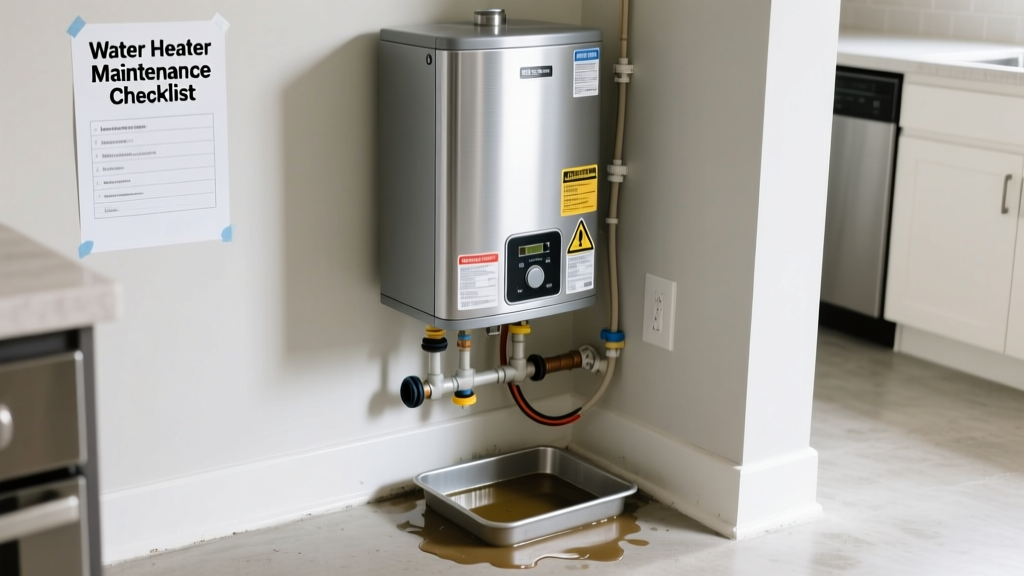
A leaking water heater isn’t just an inconvenience—it’s a potential source of $4,000+ in water damage, mold remediation, and replacement costs. According to the Insurance Institute for Business & Home Safety's 2023 report, 27% of residential water damage claims stem from failed water heaters—and 81% of those failures were preventable with routine maintenance.
Why This Happens
Leaks rarely appear out of nowhere. Most originate from three core failure points: corroded tank linings (especially in older units over 8 years), failing temperature and pressure (T&P) relief valves, or degraded pipe fittings and flex connectors. Hard water accelerates internal corrosion—homes with >10 grains per gallon (gpg) mineral content see tank life drop by 3–5 years on average (Water Quality Association, 2022).
- Galvanized steel tanks rust from the inside out when anode rods deplete
- Plastic or rubber gaskets dry out and crack after 3–5 years of thermal cycling
- Over-pressurized systems (>80 psi) stress joints and valves beyond design limits
Maintenance Checklist
| Frequency | Task | Tools/Notes |
|---|---|---|
| Daily | Check for visible moisture around base or connections | Use a dry paper towel to wipe and inspect drip pan |
| Weekly | Listen for hissing, popping, or rumbling sounds | Indicates sediment buildup or steam pockets forming |
| Monthly | Test T&P valve operation (lift lever briefly; expect brief discharge) | Turn off power/gas first; catch discharge in bucket |
| Yearly | Drain 2–3 gallons to remove sediment; replace anode rod if <½” diameter remains | Anode rods cost $25–$45; extend tank life by 3–5 years |
Warning Signs
Don’t wait for puddles. Early indicators include rust-colored water from hot taps, a sulfur-like odor (suggesting bacterial growth in stagnant water), or wet insulation near the top of the unit. A warm floor around the heater—even without visible water—can signal a slow leak beneath the tank.
- Faint metallic or musty smell near the heater closet
- Increased energy bills despite consistent usage
- Visible efflorescence (white chalky residue) on concrete floor near base
- Corrosion on cold-water inlet pipe threads or dielectric nipples
Recommended Products
Not all products are equal—choose ones designed for longevity and compatibility. Dielectric unions prevent galvanic corrosion between copper and steel pipes. Expansion tanks absorb pressure spikes in closed-loop systems. And smart leak detectors like the Moen Flo or Phyn Plus alert you via app *before* 90% of leaks become visible.
- Anode rods — aluminum-zinc for hard water, magnesium for soft water
- Pressure-reducing valves — install if home pressure exceeds 75 psi
- Smart leak sensors — place under tank and near shutoff valves
How often should I flush my water heater?
In areas with hard water (≥7 gpg), flush every 6 months. In soft water zones (<3 gpg), once per year is sufficient. Sediment buildup insulates the heating element or burner, causing overheating and premature tank fatigue. The U.S. Department of Energy estimates that just ½ inch of sediment reduces efficiency by 22%.
Can a leaking T&P valve be fixed—or must it be replaced?
It must be replaced. T&P valves are single-use safety devices. If it leaks after testing—or drips continuously—it’s failed and poses a rupture risk. Replacement takes 15 minutes and costs $12–$20. Never cap or plug a leaking T&P valve: that’s a fire and explosion hazard.
Is a tankless water heater less likely to leak?
Tankless units eliminate the large reservoir—but they’re not leak-proof. Their heat exchangers scale up fast in hard water, leading to microfractures and pinhole leaks. They also require annual descaling and more frequent filter cleaning. According to the Plumbing-Heating-Cooling Contractors Association (2023), 34% of tankless service calls involve leak-related diagnostics.
What’s the best location for a water heater to minimize leak impact?
Elevate it on a 4” concrete pad above garage or utility room flooring—or install a secondary containment pan with a drain line to daylight or sump pump. Avoid placing directly on wood subfloors unless protected by a welded stainless steel drip pan rated for 24-hour hold.
Does homeowner’s insurance cover water damage from a leaking heater?
Most policies cover sudden, accidental discharge—but exclude damage from ‘gradual leakage’ or lack of maintenance. If your insurer finds evidence of neglected anode rods or untested T&P valves, coverage may be denied. Document all maintenance with dated photos and receipts.
"A water heater that hasn’t had its anode rod checked by year five is already playing Russian roulette with its tank integrity." — Certified Master Plumber, National Association of Home Builders, 2022
Preventing a leak isn’t about perfection—it’s about consistency. Replace worn parts before they fail, monitor pressure and temperature regularly, and treat your water heater like the high-stakes mechanical system it is. Small actions—like flushing sediment or tightening loose flex lines—add up to years of reliable, dry operation. For deeper guidance, see our water heater lifespan calculator and hard water mitigation guide.