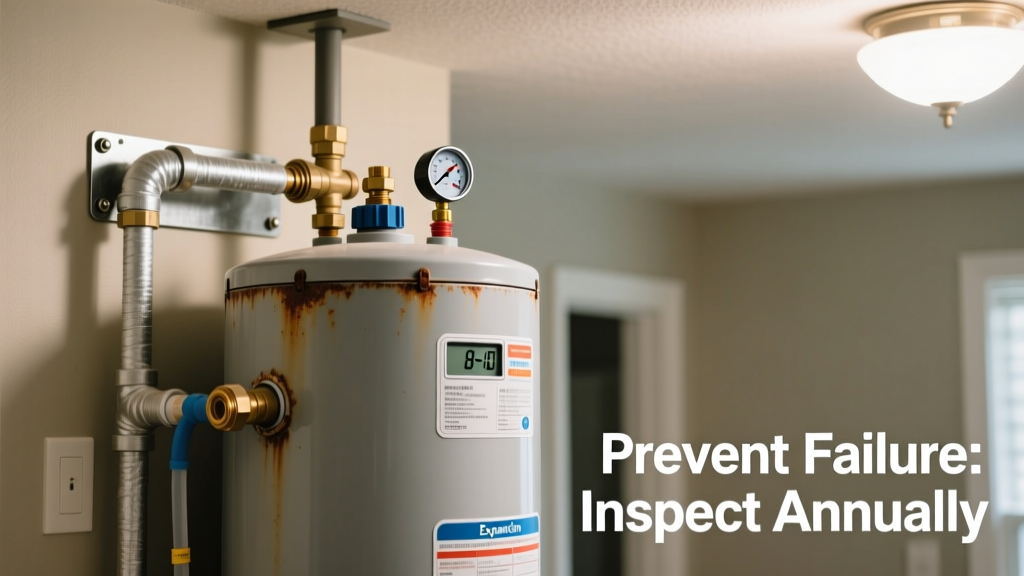
Expansion tank failure isn’t just an inconvenience—it’s a silent threat to your entire plumbing system. When thermal expansion pressure has nowhere to go, it can burst pipes, damage valves, or force your water heater’s T&P valve to leak constantly. According to the Insurance Institute for Business & Home Safety's 2023 report, 22% of residential water heater-related insurance claims involved pressure-related failures linked to neglected expansion tanks.
Why This Happens
Thermal expansion is inevitable: cold water heats up, expands by ~2%, and needs space. In closed-loop systems—especially those with backflow preventers or pressure-reducing valves—the expanded water has no outlet unless an expansion tank absorbs it. Without proper air charge, corrosion, or physical damage, the tank’s bladder fails or ruptures. Over time, sediment buildup in older tanks degrades rubber bladders, while undersized tanks (common in retrofits) simply can’t handle peak demand spikes.
- Loss of air charge due to slow nitrogen leakage or improper initial pressurization
- Bladder degradation from chlorine exposure or high-temperature cycling
- Corrosion inside steel tanks from stagnant water or poor dielectric isolation
- Incorrect sizing—tanks rated for 40-gallon heaters often installed on 50-gallon or larger units
Maintenance Checklist
| Frequency | Task |
|---|---|
| Daily | Listen for hissing or gurgling near the tank—signs of internal air loss or waterlogged bladder |
| Weekly | Check for wetness or rust at the tank’s base and threaded connections |
| Monthly | Test air pressure using a tire gauge (should match household water pressure ±5 psi; e.g., 60 psi system = 55–65 psi tank charge) |
| Yearly | Drain and re-pressurize tank; inspect mounting bracket for stress cracks; verify dielectric union integrity |
Warning Signs
Early detection saves hundreds in repairs—and prevents emergency call-outs at midnight. Don’t wait for dripping. Watch for these red flags:
- Water leaking from the tank’s Schrader valve (the small brass stem like a bike tire valve)
- T&P valve discharging water regularly—even when water hasn’t been heated recently
- Pressure gauge on the cold-water line spiking above 80 psi during heating cycles
- Noticeable bulge or soft spot on the tank’s side—indicates bladder rupture
- Knocking or banging sounds in pipes when hot water is turned off abruptly
Recommended Products
Not all expansion tanks perform equally. Choose based on your system’s specs—not just price. Stainless steel tanks last longer in chlorinated municipal supplies. Diaphragm-style tanks (like Amtrol ST-5) outperform bladder types in high-cycle homes. Always pair with a quality pressure-reducing valve if your street pressure exceeds 75 psi.
- Digital water pressure test kit (for accurate monthly checks)
- Amtrol Therm-X-Trol ST-5 or ST-12 (tested to 200,000 cycles per Plumbing Systems & Design, 2022)
- Watts 1155-2A dielectric union kit (prevents galvanic corrosion at copper-to-steel joints)
How often should I check the air charge?
Monthly is non-negotiable—if you skip this, you’re flying blind. Air charge drops 1–3 psi per year naturally, but faulty Schrader valves or micro-tears accelerate loss. Use a quality tire gauge (not a cheap $3 one) and check with water pressure relieved—shut off main valve and open a faucet until flow stops.
Can I install an expansion tank myself?
Yes—if you’re comfortable soldering copper or using SharkBite fittings and understand your home’s pressure profile. But mis-sizing or incorrect pre-charge causes immediate stress on your water heater. The U.S. EPA estimates that 31% of DIY-installed tanks fail within 18 months due to improper air charge or orientation. If your water heater is over 8 years old, consider hiring a licensed plumber for integrated testing.
What’s the right tank size for my 50-gallon heater?
It depends on your incoming pressure and temperature rise—not just tank volume. For a 50-gallon heater with 60 psi supply and 40°F–140°F delta, a 2.1-gallon tank (e.g., Watts ET-2.1) meets ASME standards. Oversizing slightly (e.g., 4.4-gallon) adds margin for future pressure increases—but never undersize.
"A tank sized for 40 gallons won’t safely absorb expansion from a 50-gallon unit operating at 70 psi—even if it fits in the space." — John R. Lippert, Master Plumber & ASSE 6020 Task Group Chair, 2023
Do tankless water heaters need expansion tanks?
Only if they feed a closed-loop system with a backflow preventer or PRV—and only on the cold-water inlet side. Most tankless units don’t store water, but thermal expansion still occurs in the piping between the unit and fixtures. Check local code: California and Massachusetts require them on all closed systems, regardless of heater type.
Is a water hammer arrestor the same as an expansion tank?
No. Arrestors absorb sudden pressure spikes (like when a solenoid valve slams shut); expansion tanks manage continuous thermal expansion. They serve different physics problems. Installing only an arrestor won’t prevent bladder failure or pressure creep. You need both if your home has fast-closing valves and a closed-loop water system.
Preventing expansion tank failure isn’t about waiting for symptoms—it’s about respecting physics and maintaining a small, critical component before it compromises your whole system. Pair regular pressure checks with annual professional verification, and you’ll likely get 10–12 years from a quality tank. For deeper diagnostics, see our guide on why your T&P valve keeps leaking—often the first clue something’s wrong upstream.