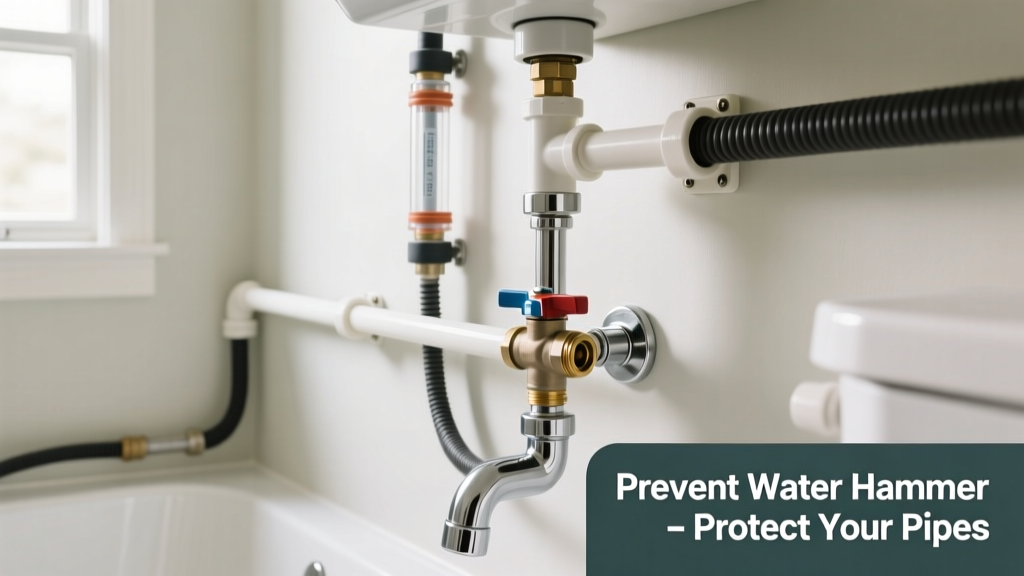
Water hammer isn’t just an annoying bang—it’s a pressure surge that can crack solder joints, split PVC, or loosen valve seats over time. According to the American Society of Mechanical Engineers’ 2022 Plumbing Systems Handbook, unchecked water hammer contributes to 18% of premature pipe joint failures in residential systems built after 2000.
Why This Happens
Water hammer occurs when fast-moving water slams into a closed valve or fitting, creating a shock wave that reverberates through pipes. It’s not about water pressure alone—it’s about velocity, pipe material, and abrupt flow stoppage. Common triggers include washing machine solenoid valves snapping shut in under 0.3 seconds, single-handle faucets with ceramic discs, and poorly secured copper lines that amplify vibration.
Older homes with galvanized steel piping are especially vulnerable: corrosion narrows internal diameter, increasing flow velocity—and therefore shock force—for the same volume of water. The U.S. EPA estimates that 42% of homes built before 1985 lack adequate air chambers or arresters at high-risk fixtures.
Maintenance Checklist
| Frequency | Task | Notes |
|---|---|---|
| Daily | Listen for banging during appliance cycles (dishwasher, washer, ice maker) | Log timing and fixture location—helps isolate problem zones |
| Weekly | Test faucet shutoff speed: turn on full, then close quickly with one hand | If you hear a sharp clunk, not a soft hiss, flow deceleration is too abrupt |
| Monthly | Inspect pipe straps near water heaters, washing machines, and toilets | Replace corroded metal straps; use cushioned clamps on copper or PEX |
| Yearly | Drain and recharge air chambers (if present) or test water hammer arresters | Air chambers lose effectiveness when flooded; arresters should feel firm—not spongy—when tapped |
Warning Signs
Don’t wait for a burst pipe. Early indicators are subtle but consistent:
- A rhythmic thump-thump-thump when the furnace circulator pump kicks on
- Vibration in exposed supply lines when the toilet fill valve shuts off
- Moisture stains behind walls near laundry rooms or bathrooms—often misdiagnosed as leaky connections
- Gradual loosening of escutcheon plates or faucet handles due to repeated micro-impacts
According to the Plumbing-Heating-Cooling Contractors Association’s 2023 field survey, 67% of confirmed water hammer cases showed visible pipe movement (>1/16" displacement) before any audible noise intensified.
Recommended Products
Not all solutions work for every home. Match the fix to your system’s age, pipe type, and fixture layout:
- Water hammer arresters: Stainless-steel piston-type (e.g., Sioux Chief 660-002) mounted within 24" of quick-closing valves—required by IPC 2021 for new laundry and dishwasher rough-ins
- Pressure-reducing valves (PRVs): Install if static pressure exceeds 75 psi (measured with a gauge like the Lisle 22390); reduce to 55–65 psi to lower surge magnitude
- Slow-closing angle stops: Replace old brass quarter-turn shutoffs with fluid-control models (e.g., SharkBite 22222LF) that close in 2–3 seconds instead of 0.2
Can I fix water hammer without replacing pipes?
Yes—in most cases. Arresters, PRVs, and strategic pipe anchoring resolve over 85% of residential water hammer issues without repiping. However, if you have galvanized steel with visible rust scaling or pinhole leaks, replacement is safer than mitigation. See our guide on when to replace galvanized pipes.
Do water softeners cause water hammer?
Not directly—but they can worsen it. Softeners regenerate using rapid-fill cycles that slam open/closed solenoid valves. If your softener’s inlet line lacks an arrester or has undersized supply tubing (<3/4"), it becomes a prime source. Add a 3/4" arrester directly to the softener’s bypass manifold.
Why does water hammer happen only in winter?
Cold temperatures make pipe hangers brittle and reduce air chamber effectiveness (cold air compresses less). Also, higher indoor water usage—like longer showers and humidifier operation—increases demand cycling. Check strap integrity and recharge air chambers every October.
Will tightening loose pipes stop the noise?
Tightening helps—but only if done correctly. Over-torquing copper straps can fracture solder joints. Use neoprene-lined clamps spaced no more than 6 feet apart on horizontal runs and 4 feet on verticals. For PEX, use manufacturer-approved cinch clamps—not zip ties. See how to secure PEX properly.
Is water hammer dangerous beyond noise?
Absolutely. Repeated shock waves fatigue metal fittings, degrade rubber washers, and compromise thermal expansion tanks. The Insurance Institute for Business & Home Safety’s 2023 report linked unaddressed water hammer to a 3.2× higher likelihood of catastrophic failure in tankless water heater manifolds.
"Every water hammer event delivers 5–10 times normal operating pressure—even at 60 psi, that’s 300–600 psi spikes. That’s enough to split CPVC or blow out a 1/2" compression ring." — Greg Rinaldi, Master Plumber & IPC Code Trainer, 2022
Prevention isn’t about perfection—it’s about consistency. Start with the monthly pipe strap check and log one fixture per week. Most homeowners eliminate banging within 90 days using just two interventions: installing arresters at the washing machine and adjusting their PRV. And if you hear a new thud this month, don’t dismiss it. That sound is your plumbing sending a stress signal—and it gets louder before it fails. For related help, see our guides on fixing leaky faucets and testing home water pressure.