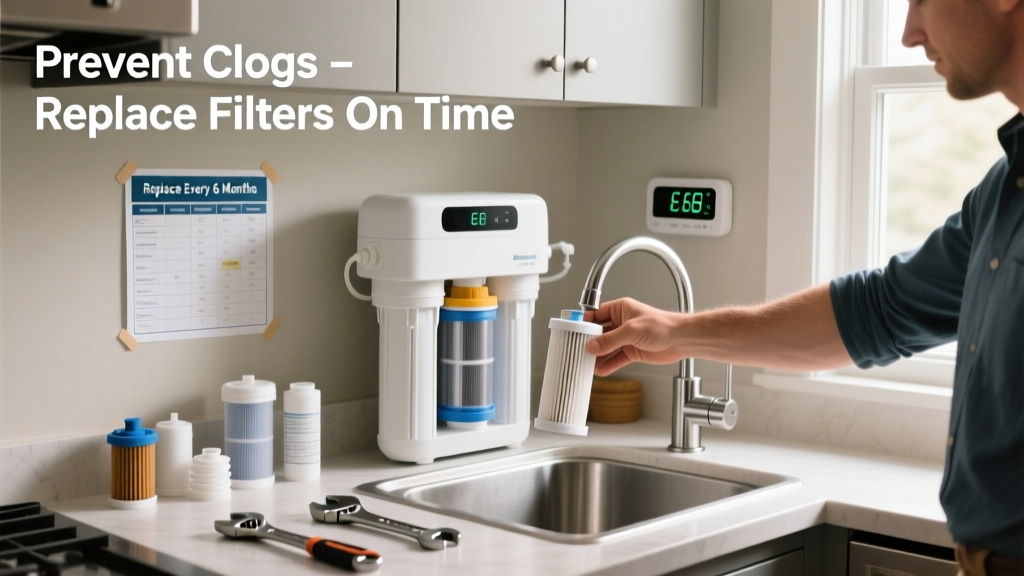
A clogged water filter isn’t just an inconvenience—it’s a red flag that your system is struggling with sediment, rust, or scale buildup. Left unaddressed, it can reduce water pressure by up to 40%, spike chlorine exposure downstream, and even let contaminants bypass filtration entirely (NSF International, 2022). Prevention isn’t optional; it’s the cheapest, safest layer of protection for your whole-house or under-sink system.
Why This Happens
Water filters clog when particulate matter overwhelms their design capacity. The most common culprits aren’t mysterious—they’re measurable and predictable. Sediment from aging municipal lines or well sources delivers sand, silt, and rust flakes. Hard water adds calcium carbonate crystals that coat carbon blocks. And seasonal shifts—like spring runoff or post-hurricane infrastructure stress—can spike turbidity 3–5× above baseline (U.S. Geological Survey, 2021).
- High iron or manganese content (common in private wells) oxidizes into sticky orange/brown sludge
- Older galvanized pipes shedding zinc oxide and rust
- Carbon filters exposed to chloramine without pre-reduction stages
- Incorrect micron rating—e.g., using a 5-micron filter where 20-micron is recommended for well water
Maintenance Checklist
| Task | Daily | Weekly | Monthly | Yearly |
|---|---|---|---|---|
| Check for visible debris on pre-filter screen | ✓ | |||
| Rinse sediment pre-filter (if installed) | ✓ | |||
| Log flow rate & pressure drop across filter | ✓ | |||
| Replace carbon block (under-sink) | ✓ (or every 6 months if >2 people) | |||
| Backwash whole-house sediment filter | ✓ (if automatic) | ✓ (manual clean + O-ring inspection) |
Warning Signs
Don’t wait for zero flow. Early indicators appear gradually—and they’re easy to miss without routine checks. A 15% pressure drop across the filter housing signals 30–40% capacity loss. Slow faucet flow? That’s often the last symptom—not the first.
- Cloudy or discolored water after filter change (indicates upstream sediment release)
- Musty or chemical odor returning within 2 weeks of new carbon filter
- Filter housing feels warm during use (friction from restricted flow)
- Leaking at filter housing threads (often from over-tightening due to misdiagnosis)
Recommended Products
Prevention starts with matching hardware to your water profile—not just brand names. For homes on municipal supply with known chlorine spikes, consider a dual-stage setup: a 25-micron pleated sediment filter followed by a catalytic carbon block. Wells with iron >0.3 ppm need a manganese greensand pre-filter before carbon stages. Salt-free conditioners like NuvoH2O help reduce scaling without sodium discharge—critical for RO membrane longevity.
"A sediment pre-filter costs $12–$28 but extends carbon filter life by 3–5 months in high-turbidity homes. Skipping it is like skipping an oil filter in your car." — Mike Torres, Lead Technician, AquaPure Service Group (2023)
How often should I replace my refrigerator water filter?
Every 6 months—even if the indicator light hasn’t turned on. Refrigerator filters see low flow rates and constant temperature swings, accelerating carbon exhaustion. In households with hard water (>7 gpg), test output TDS monthly: if it climbs more than 10 ppm above inlet, replace immediately. See our guide on refrigerator water filter replacement for model-specific torque specs and flush procedures.
Can I clean and reuse a clogged carbon filter?
No—carbon filters are not washable. Rinsing removes surface dust but doesn’t restore adsorption capacity or remove trapped organics. Attempting to scrub or soak them risks breaking the carbon matrix and releasing trapped contaminants. Replace them. Pleated sediment filters, however, can be rinsed under cold water and reused up to 3 times—if no tears or deformation are visible.
Does water softener use affect filter clogging?
Yes—especially if your softener is undersized or regenerates infrequently. Sodium ions exchanged during softening increase total dissolved solids (TDS), which can accelerate fouling of reverse osmosis membranes and carbon blocks. Always install a 5-micron sediment filter after the softener and before the RO unit. Also, check brine tank salt bridges annually—undissolved salt cakes cause inconsistent regeneration and iron carryover.
What’s the best filter for well water with sulfur smell?
Start with an air-injection oxidizer (like the Viqua Air-Inject) paired with a Birm or Filox iron filter—not carbon alone. Carbon traps hydrogen sulfide only temporarily and becomes a breeding ground for sulfur bacteria if not replaced aggressively. A properly sized oxidizer knocks out H₂S at the source, letting downstream carbon focus on VOCs and chlorine byproducts. Learn more about well water sulfur treatment options and maintenance cycles.
Is a whole-house filter necessary if I only drink filtered water?
It depends on your plumbing material and usage patterns. If you have copper or PEX lines and only use point-of-use filters, whole-house may be overkill. But if you have older galvanized or cast-iron pipes—or run hot water through unfiltered lines—you’ll get rust and scale buildup in water heaters and showerheads regardless of drinking water quality. Whole-house sediment filters cost less than replacing a failed tankless heater’s heat exchanger.
Preventing a clogged filter isn’t about doing more—it’s about doing the right thing at the right time. Track your pressure readings, match your media to your water report, and treat your filter like the mechanical component it is—not a ‘set and forget’ consumable. When in doubt, pull the housing and inspect. Most clogs start as visible grit you can rinse away—before they become a $200 service call or a week without safe water.