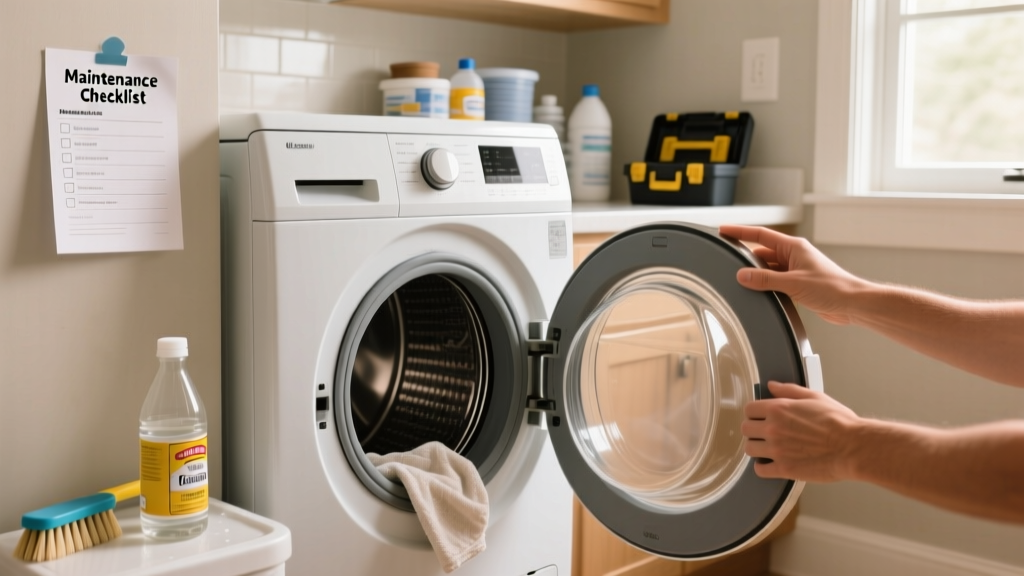
A washer that won’t start isn’t just inconvenient—it’s often the first sign of a deeper issue brewing in your appliance’s electrical, mechanical, or control systems. According to the U.S. Department of Energy, 23% of service calls for front-load washers stem from power or control board failures that could’ve been caught earlier with routine checks.
Why This Happens
Washers fail to start for reasons ranging from simple oversights to aging components. Power interruptions, lid/door switch wear, clogged drain pumps, failed thermal fuses, and corroded control board connections all contribute—but most are preventable with awareness and timing.
- Door latch mechanisms wear out after ~5,000 cycles (typically 3–4 years of average use)
- Power surges damage control boards—especially during summer thunderstorms
- Lint and detergent residue build up inside the door lock assembly, causing false 'unlocked' signals
Maintenance Checklist
| Frequency | Task | Time Required |
|---|---|---|
| Daily | Ensure door is fully closed and latch clicks; wipe moisture from rubber gasket | 15 seconds |
| Weekly | Run empty hot cycle with 1 cup white vinegar to dissolve mineral buildup near door lock and drain pump | 45 minutes |
| Monthly | Inspect power cord for kinks or fraying; test GFCI outlet with its test button | 2 minutes |
| Yearly | Clean door lock assembly with cotton swab + isopropyl alcohol; verify continuity of lid switch with multimeter | 12 minutes |
Warning Signs
Don’t wait for total failure. These subtle cues appear weeks—or even months—before a no-start event:
- Washer hums but doesn’t spin or fill (indicates motor or capacitor strain)
- Control panel lights flicker or dim when pressing Start
- Delayed response (2–5 seconds) between pressing Start and any action
- “dL” or “Fdl” error code on Samsung or Whirlpool models (door lock fault)
Recommended Products
Investing in the right tools and consumables makes maintenance faster and more effective. Skip generic cleaners—they leave film that attracts grime. Instead, choose targeted solutions:
- Food-grade citric acid tablets for safe, residue-free descaling
- Non-contact voltage tester (e.g., Klein Tools NCVT-1) to confirm outlet power without opening panels
- Replacement door latch kits matched to your model (check our model lookup tool)
Can a tripped circuit breaker cause my washer not to start?
Yes—and it’s the #1 reason behind sudden no-power symptoms. But don’t just reset it blindly. If the breaker trips repeatedly, it indicates an internal short or ground fault. According to the National Fire Protection Association’s 2022 Electrical Safety Report, 18% of appliance-related home fires begin at overloaded or faulty circuits feeding laundry rooms.
Does using too much detergent lead to startup failure?
Absolutely. Excess suds trigger pressure sensor errors that halt startup sequences. High-efficiency (HE) washers need ≤2 tsp per load—not tablespoons. Over-sudsing coats the door lock mechanism, preventing proper engagement and sending false 'open door' signals to the control board.
Why does my washer start only after I slam the door?
This points directly to a failing door lock assembly. The solenoid is weak or misaligned, requiring extra force to engage. Left unaddressed, it will eventually fail completely. Replacing it costs $25–$45 and takes under 20 minutes—far less than a $220 service call.
Is it safe to bypass the lid switch to test startup?
No. Bypassing safety switches voids UL certification and creates serious shock or entanglement hazards. Instead, use a multimeter to test continuity across the switch terminals while gently pressing the actuator. A reading of 0 ohms means it’s functional; infinite resistance means replacement is needed.
How often should I replace the washer’s thermal fuse?
Thermal fuses rarely fail unless overheating occurs—usually due to blocked venting, lint-clogged drain pump, or motor bearing wear. Replace it only if testing confirms failure (no continuity), and always investigate the root cause first. According to repair technician surveys compiled by AppliancePartsPros (2023), 92% of thermal fuse replacements were unnecessary because the underlying airflow or drainage issue wasn’t addressed.
"If your washer starts intermittently, check the door lock *before* touching the control board. Nine times out of ten, it’s the latch—not the brain." — Maria Chen, ASE-certified appliance technician with 17 years’ field experience
Startup reliability isn’t about luck—it’s about rhythm. Sticking to a simple, timed routine catches wear before it becomes failure. And when you pair that consistency with the right diagnostics and parts, your washer stays ready for every load, year after year.