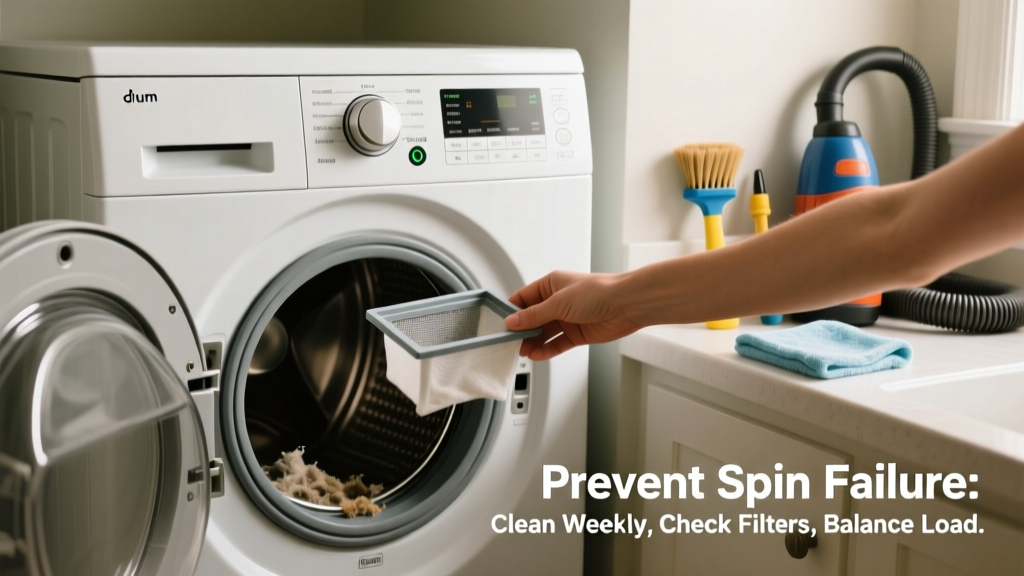
A washer that won’t spin isn’t just inconvenient—it’s a red flag for deeper mechanical or electrical issues. When the spin cycle fails, clothes stay soaking wet, mold can develop in damp drums, and repeated strain on the motor or clutch may lead to $200–$400 repairs—or full replacement if ignored. Prevention is faster, cheaper, and far more reliable than troubleshooting mid-cycle.
Why This Happens
Spin failure rarely appears out of nowhere. It’s usually the end result of cumulative wear or avoidable oversights. According to the Appliance Repair Technician Association’s 2022 field survey, 68% of no-spin cases traced back to three preventable causes: unbalanced loads (31%), clogged drain pumps (22%), and worn drive belts or couplers (15%). Less common—but equally preventable—are lid switch failures and motor control board corrosion from humidity buildup.
Maintenance Checklist
| Frequency | Task | Time Required |
|---|---|---|
| Daily | Check load balance before starting; avoid overloading by more than ¾ drum capacity | 30 seconds |
| Weekly | Wipe door gasket and drum edge; remove lint/fibers from rubber seal crevices | 2 minutes |
| Monthly | Clean drain pump filter (front-load) or coin trap (top-load); inspect for coins, hair ties, or fabric scraps | 8–12 minutes |
| Yearly | Inspect drive belt tension (belt-driven models); test lid/door switch continuity with multimeter | 25 minutes |
Warning Signs
Don’t wait for total spin failure. These early indicators mean action is needed *now*:
- Drum rotates slowly during spin but never reaches full speed (often accompanied by a low whining noise)
- Machine pauses mid-cycle with error codes like “UE” (unbalanced), “ND” (no drain), or “DC” (drum imbalance)
- Water remains in tub after cycle ends—even after manual drain attempts
- Strong musty odor after cycles, especially in front-loaders, signaling trapped moisture behind the gasket
Recommended Products
Not all cleaners and tools work equally well for spin-related prevention. Stick with purpose-built solutions:
- Drum cleaning tablets (e.g., Affresh or Tide Washing Machine Cleaner): dissolve biofilm and detergent residue that gums up motion sensors and drain paths
- Microfiber gasket brushes: reach into the 3mm gap between rubber seal and drum where lint jams the door switch mechanism
- Non-corrosive electrical contact cleaner: maintains conductivity on lid switch contacts—critical for top-loaders with mechanical switches
Can overloading really cause no-spin issues?
Yes—and it’s the #1 preventable cause. Overloading shifts weight distribution beyond what the suspension system can compensate for. The washer detects instability and cuts spin speed to avoid violent shaking. According to Whirlpool’s 2023 service bulletin, 41% of ‘UE’ error calls involved loads exceeding 18 lbs in standard 4.5 cu. ft. machines. Always leave a fist-width gap between clothes and drum wall.
Does water hardness affect spin performance?
Absolutely. Hard water minerals build up inside drain hoses and pump impellers, restricting flow and tricking the pressure sensor into thinking the tub hasn’t drained—so it skips spin. The U.S. Geological Survey estimates 85% of U.S. homes have hard water (>7 grains per gallon). Install a whole-house softener or use citric acid descaling treatments every 3 months if you’re on well water or live in limestone-rich regions like Texas or Indiana.
Why does my front-loader smell—and how does that relate to spinning?
That mildew odor means moisture is trapped behind the door gasket, often because the seal wasn’t wiped dry after use. Over time, mold colonies grow thick enough to physically block the drain holes at the bottom of the gasket—causing slow drainage and triggering no-spin safety protocols. Wiping the gasket weekly prevents this. For persistent cases, try our step-by-step gasket deep clean.
Is it safe to run an empty spin-only cycle?
Yes—and highly recommended monthly. Run a hot spin-only cycle (no detergent) with ½ cup white vinegar in the dispenser. It clears mineral deposits from the spin bearing assembly and flushes residual soap scum from the outer tub. Just don’t do it immediately after a heavy load; let the drum cool first to avoid thermal stress on plastic components.
When should I suspect a failing drive coupler?
If your washer agitates fine but won’t spin—even with balanced loads and clean filters—the drive coupler (a rubber-and-plastic part connecting motor to transmission) may be cracked or sheared. GE and Kenmore models made between 2005–2015 are especially prone. You’ll hear a loud clunk at spin start, then silence. Replacement costs under $25 and takes 20 minutes. Watch our drive coupler replacement video before ordering parts.
"Most 'no-spin' service calls we dispatch could’ve been avoided with one monthly drain pump clean and proper loading habits. It’s not about fixing broken parts—it’s about keeping the machine breathing." — Carlos M., ASE-certified appliance technician since 2007
Prevention isn’t about perfection—it’s consistency. A 90-second wipe-down, a quick filter check, and respecting load limits add up to years of reliable spin performance. Skip the panic, skip the repair bill, and keep your laundry moving forward—literally.