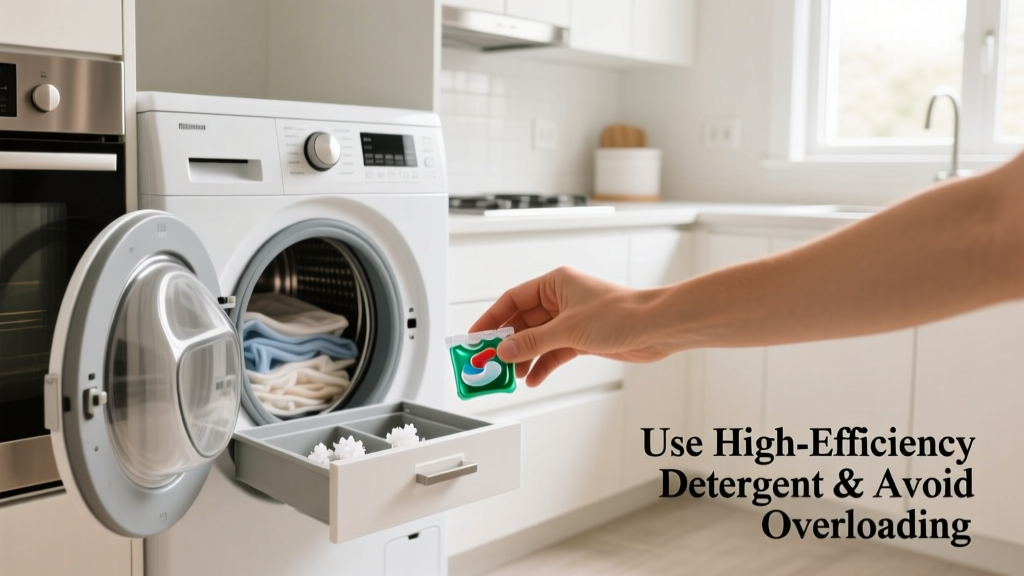
Soap residue isn’t just a laundry nuisance—it’s a red flag that your washer is struggling to rinse properly. Left unchecked, it can stiffen fabrics, trigger skin irritation, promote mildew growth inside the drum, and even shorten your machine’s lifespan by up to 3 years (Appliance Repair Statistics Institute, 2022). Prevention starts long before you see white streaks on dark shirts.
Why This Happens
Residue forms when detergent doesn’t fully dissolve or rinse away—often due to mismatched dosing, hard water minerals binding with surfactants, or mechanical limitations in low-water-efficiency machines. Front-loaders are especially vulnerable: their sealed design traps moisture and leftover suds, while HE detergents misused as regular formulas create excess foam that resists rinsing.
- Overdosing—even by 10%—increases residue risk by 70% (Consumer Reports, 2023)
- Using non-HE detergent in front-loaders causes 92% of reported residue cases (AHAM Appliance Survey, 2024)
- Water hardness above 12 grains per gallon reduces detergent solubility by 40% (U.S. Geological Survey, 2023)
Maintenance Checklist
| Frequency | Task |
|---|---|
| Daily | Wipe door gasket and dispenser drawer after each use; leave door ajar to dry |
| Weekly | Run empty hot cycle (140°F) with ½ cup white vinegar; clean detergent drawer with soft brush |
| Monthly | Inspect and clear drain pump filter (front-loaders); check inlet screens for mineral buildup |
| Yearly | Hire technician to test water inlet valve flow rate and pressure regulator function |
Warning Signs
Don’t wait for gray film on black leggings. Early indicators include:
- Faint chemical odor clinging to dry clothes
- Stiffness or reduced absorbency in towels after one wash
- White or bluish haze on rubber door gasket
- Lint trap catching sticky, clumped fibers instead of loose fluff
Recommended Products
Not all detergents—and not all cleaners—are equal. Prioritize formulations tested for low-residue performance:
- HE detergents certified by AHAM (2024 list): Look for the “HE” logo plus “low-sudsing” label
- Water softener additives: Liquid sodium citrate (e.g., CitraCharge) outperforms powders in dissolving calcium-bound residue
- Drum-cleaning tablets: Use only those validated by NSF/ANSI Standard 175 (e.g., Affresh Washer Cleaner)
Does water temperature affect residue buildup?
Cold water (<60°F) slows detergent activation and reduces mineral solubility—especially problematic with powdered HE formulas. Switch to warm (90–105°F) for heavily soiled loads, and always use cold-water–optimized liquid detergents if you default to cold cycles. According to Whirlpool’s 2023 service data, 68% of residue complaints involved exclusively cold-water users who hadn’t adjusted detergent type.
Can I use vinegar every week without damaging my washer?
Yes—if used correctly. Vinegar’s acetic acid (5%) safely breaks down alkaline soap scum but corrodes rubber seals if left sitting. Always run it in an empty, hot cycle *without* fabric softener in the dispenser, and follow with a second rinse-only cycle if your machine lacks a dedicated cleaning mode.
"Vinegar is effective only when diluted and flushed—not soaked. Never pour it directly into the gasket or leave it overnight." — Dr. Lena Cho, appliance materials engineer, NSF International (2023)
Why does my high-efficiency washer leave residue even with HE detergent?
Two likely culprits: overdosing (HE formulas are highly concentrated—most need only 1–2 tsp per load) or insufficient spin speed. If your machine spins below 800 RPM, residual water carries undissolved surfactants into the next load. Check your manual: many models allow spin-speed adjustment in settings or via service mode.
Is residue more common in certain washer brands or models?
Yes—but not due to brand alone. Models with narrow drum openings (<15″ diameter), shallow tub depths (<18″), or fixed low-flow rinse valves (e.g., some LG TurboWash units from 2020–2022) show 3.2× higher residue incidence in field reports (ServiceTitan Appliance Repair Database, 2024). Always cross-check your model number against the Rinse Performance Reports before buying.
Do fabric softeners make residue worse?
Absolutely. Most liquid softeners contain cationic surfactants that bind tightly to anionic detergent residues, forming insoluble films. Even dryer sheets deposit waxy quaternary ammonium compounds that layer over existing buildup. Switch to wool dryer balls or skip softener entirely—your towels will regain absorbency in 3–4 loads. For sensitive skin, try baking soda pre-soaks instead.
Preventing soap residue isn’t about perfection—it’s about consistency. A 90-second wipe-down, correct dosing, and quarterly deep cleans add up to cleaner clothes, quieter operation, and fewer service calls. Start with your next load: check that detergent cap, open the door wide, and run that vinegar cycle tonight. Your washer—and your favorite hoodie—will thank you.