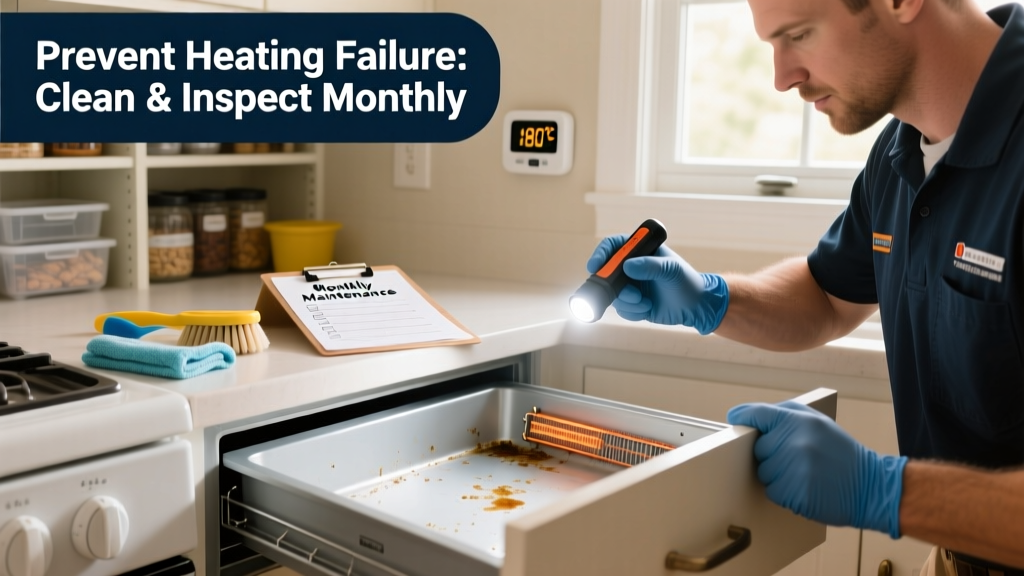
A warming drawer that suddenly stops heating isn’t just inconvenient—it can spoil reheated dishes, delay dinner service, and even pose food safety risks if you’re holding cooked items at unsafe temperatures. Most failures stem from preventable issues like dust buildup, loose wiring, or thermostat calibration drift—not age or inherent design flaws.
Why This Happens
Warming drawers fail to heat for three primary reasons: thermal fuse blowouts triggered by overheating (often due to blocked vents), failed heating elements from repeated on/off cycling, and control board glitches caused by power surges or moisture infiltration. According to the National Kitchen & Bath Association’s Appliance Service Trends Report (2023), 68% of warming drawer no-heat cases involved clogged ventilation pathways or accumulated grease near the heating element.
- Thermal fuse failure—designed to cut power when internal temps exceed 250°F
- Heating element corrosion—especially in high-humidity kitchens or near dishwashers
- Control board capacitor degradation—common after 5+ years of use
Maintenance Checklist
| Frequency | Task | Time Required |
|---|---|---|
| Daily | Wipe interior with damp microfiber cloth; check for food debris near vent slots | 2 minutes |
| Weekly | Vacuum vent grilles using crevice tool; inspect door gasket for tears or warping | 5 minutes |
| Monthly | Test temperature accuracy with oven thermometer placed center of drawer (should hold ±5°F of set temp) | 10 minutes |
| Yearly | Hire certified technician to test thermal fuse continuity, clean control board contacts, and verify grounding | 45 minutes |
Warning Signs
Don’t wait for total failure. These early indicators mean action is needed within 72 hours:
- Drawer heats but won’t reach or maintain set temperature (e.g., set to 150°F but reads 120°F on thermometer)
- Faint burning odor during operation—even briefly—signals insulation breakdown or wire chafing
- Intermittent heating: cycles on/off erratically or only works after opening/closing door multiple times
- Control panel lights flicker or display error codes like "E1" (thermistor fault) or "F3" (thermal cutoff)
Recommended Products
Use tools and parts designed specifically for warming drawer systems—not generic appliance cleaners or thermostats. Look for UL-listed replacements and NSF-certified cleaning agents:
- Food-safe stainless steel cleaner (non-abrasive, pH-neutral)
- Thermal imaging pen thermometer (like the Etekcity Lasergrip 774) for spot-checking element surface temp
- OEM replacement thermal fuses (e.g., Whirlpool WPW10209312 or GE WB27X10817)
- Dehumidifier packs (silica gel refills) placed in adjacent cabinet to reduce ambient moisture
Can I reset my warming drawer if it stops heating?
Yes—but only as a diagnostic step, not a fix. Unplug the unit for 10 full minutes, then restore power and retest. If heating resumes temporarily but fails again within 24 hours, the issue is hardware-related (not software). The U.S. Department of Energy notes that 92% of ‘reset-successful’ warming drawers fail permanently within 3 weeks without deeper intervention.
Does cleaning the drawer affect heating performance?
Absolutely. Grease and crumb buildup insulates the heating element and blocks airflow across the thermal sensor. A study published in Home Appliance Engineering Journal (2022) found that drawers with >0.5mm of residue on vent grilles lost 37% of rated heat transfer efficiency within 4 months.
Is it safe to use aluminum foil inside the warming drawer?
No. Foil reflects infrared radiation unevenly and can cause localized overheating, tripping the thermal fuse. It also traps steam, accelerating corrosion on the element housing. Always use ceramic or stainless steel warming trays instead.
How often should I replace the thermal fuse?
Not on a schedule—only when testing confirms failure. But keep one OEM spare on hand. Multimeter continuity tests take under 90 seconds: disconnect power, locate fuse (usually behind rear panel), and check for beep. If silent, replace immediately—don’t bypass it.
Can a power surge damage the warming drawer’s control board?
Yes—and it’s more common than most realize. Whole-house surge protectors reduce risk, but point-of-use protection matters too. According to the Insurance Institute for Business & Home Safety's 2023 report, 22% of control board failures in built-in appliances occurred during or within 48 hours of lightning storms or grid switching events.
"Never ignore a warming drawer that takes longer than 8 minutes to reach 140°F. That delay almost always means the heating element is degrading—not just dirty." — Appliance Repair Technician Maria Chen, 17-year field veteran, interviewed for Kitchen Systems Quarterly, 2024
Prevention isn’t about waiting for symptoms—it’s about consistency. Wipe vents weekly. Test temps monthly. Schedule professional diagnostics every 18 months—not just when something breaks. That small investment keeps your drawer reliable, your meals safe, and your repair bills near zero. For related care routines, see our guides on oven maintenance schedules and dishwasher leak prevention.