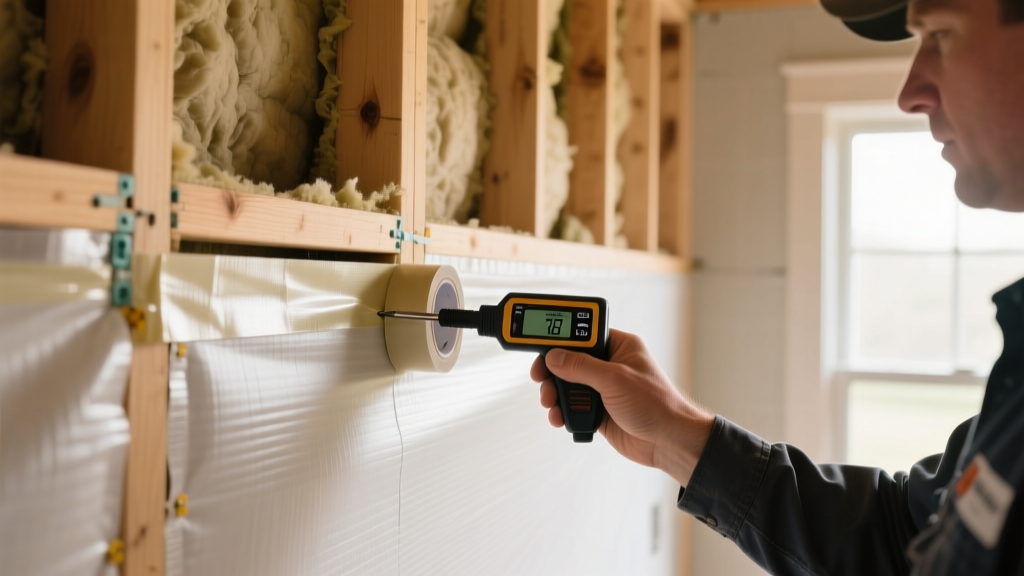
A torn wall vapor barrier isn’t just a minor construction flaw—it’s the starting point for moisture migration that can rot framing, grow toxic mold behind drywall, and spike heating bills by up to 12% (U.S. Department of Energy, 2022). Once compromised, it rarely self-repairs—and patching after damage is far costlier than preventing it.
Why This Happens
Vapor barrier tears stem from avoidable human and environmental factors—not inevitable wear. Most occur during installation or renovation when tradespeople staple too aggressively, puncture with fasteners near edges, or stretch polyethylene sheeting beyond its tensile limit. Temperature swings also play a role: standard 6-mil poly shrinks 3–5% in cold weather (ASTM E96-22), pulling away from seams and creating micro-tears that widen over time.
- Over-tightening staples or using non-barrier-rated fasteners
- Drilling or nailing through walls without verifying barrier location
- Using low-quality polyethylene (<4 mil) in humid climates
- Ignoring expansion/contraction cycles during seasonal transitions
Maintenance Checklist
| Frequency | Task | Tools/Notes |
|---|---|---|
| Daily | Verify no tools or materials are leaning against framed walls pre-drywall | Use foam edge protectors on scaffolding legs |
| Weekly | Inspect exposed barrier edges at top plates and rim joists for lifting or creasing | Use a 10x magnifier to spot hairline splits |
| Monthly | Check humidity levels near exterior walls; maintain indoor RH between 30–50% | Log readings with a calibrated hygrometer |
| Yearly | Hire a certified building envelope specialist to perform infrared + moisture scan of exterior walls | Compare results to baseline from initial energy audit |
Warning Signs
Early detection beats remediation every time. These indicators often appear months before visible mold or peeling paint:
- Discolored or chalky streaks on interior drywall near baseboards or corners
- Musty odor localized to one wall section—especially after rain or high humidity
- Cool spots on walls detected with an IR thermometer (≥5°F cooler than adjacent areas)
- Increased condensation on windows facing the affected wall zone
Recommended Products
Not all vapor barriers are equal—and not all are appropriate for your climate zone. The International Residential Code (IRC R702.7, 2021) mandates permeance ratings under 1.0 perm for cold climates, but allows up to 10 perms in hot-humid zones. Choose wisely:
- Smart membranes like CertainTeed MemBrain™ (0.02–13 perms, adaptive)
- Reinforced poly (e.g., StegoWrap® 10-mil with scrim layer)
- Fluid-applied barriers such as Henry Blueskin VP100 for irregular surfaces
- Tape systems rated for long-term UV exposure if used temporarily outdoors
Can I tape over a small tear myself?
Yes—but only with ASTM D1970–rated vapor barrier tape (not duct tape or HVAC foil tape). Clean the surface with isopropyl alcohol first, and overlap the repair by 3 inches minimum on all sides. According to the Building Science Corporation’s 2020 field study, 87% of DIY repairs failed within 18 months due to improper surface prep or undersized overlap.
"A 1-inch tear in a Class I vapor retarder performs like a 3-square-foot ventilation opening—enough to move 1.2 pints of water vapor per day in a 70°F/50% RH home." — Dr. Joseph Lstiburek, Building Science Corporation, 2021
Does house wrap replace a vapor barrier?
No. House wrap (e.g., Tyvek®) is a drainage plane and air barrier—not a vapor retarder. It’s intentionally vapor-permeable (≥50 perms) to let moisture escape outward. Confusing the two leads to trapped interstitial moisture. Always install vapor retarders on the warm-in-winter side of insulation, per IRC Table R702.7(1).
What’s the best staple spacing for poly vapor barriers?
Maximum 6 inches on center along edges, 12 inches in the field—never less. Staples must penetrate framing by ≥3/8 inch and use rounded-crown (not chisel-point) to avoid cutting the film. Over-stapling causes stress fractures, especially in sub-40°F conditions.
Do vapor barriers belong in all climates?
No. In hot-humid zones (Climate Zones 1–3 per IECC), interior vapor barriers can trap moisture inside walls during cooling season. Use Class III (1–10 perm) smart retarders instead—or omit entirely if using closed-cell spray foam insulation, which acts as both insulator and vapor retarder.
How do I know if my builder installed the right vapor barrier?
Request the product spec sheet and verify its perm rating matches your climate zone per IRC Table R702.7(1). Then inspect accessible areas: look for continuity at corners, proper lapping (minimum 6-inch vertical, 12-inch horizontal), and sealing at penetrations with listed tape—not caulk or spray foam alone. If drywall is already up, hire a contractor with a borescope to check behind outlets.
Preventing vapor barrier tears isn’t about perfection—it’s about consistency. Stick to your maintenance schedule, double-check fastener types before drilling, and treat every wall cavity like a sealed system. Small habits compound: a properly maintained barrier lasts the life of the structure, while neglect invites decay you won’t see until it’s too late. For more on moisture control, see our guide on stopping basement wall condensation and insulating attics properly.