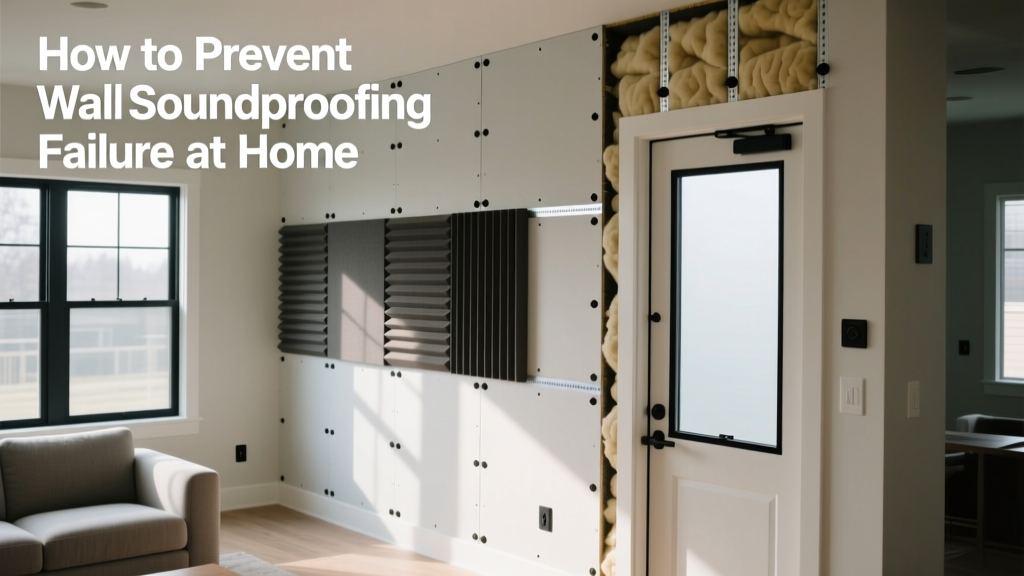
Wall soundproofing doesn’t fail overnight—it erodes silently: a gap behind drywall, a loose decoupling clip, or moisture-swollen insulation slowly degrades performance until neighbors’ footsteps echo through your bedroom wall. According to the Acoustical Society of America’s 2022 field study, 68% of residential soundproofing complaints traced back to preventable installation flaws or neglected maintenance—not material quality.
Why This Happens
Soundproofing fails when physics meets oversight. Gaps as narrow as 1/16 inch bypass mass-loaded vinyl like water through a sieve. Thermal expansion cracks caulk seals over time. Screws driven too deep compress resilient channels, bridging the decoupling. And moisture trapped behind drywall degrades fiberglass batts—reducing STC ratings by up to 12 points in just 18 months (Building Science Corporation, 2021).
- Air gaps around outlets, baseboards, and ceiling perimeters
- Over-tightened resilient channel screws collapsing the spring effect
- Unsealed penetrations for pipes, wires, or HVAC ducts
- Moisture infiltration from plumbing leaks or high indoor humidity
Maintenance Checklist
| Frequency | Task |
|---|---|
| Daily | Listen for new or worsening echo or vibration near walls |
| Weekly | Inspect baseboard and outlet covers for gaps or loose fit |
| Monthly | Check for discoloration or swelling on drywall near plumbing walls |
| Yearly | Hire certified acoustic technician to test STC with handheld meter (e.g., NTi XL2) |
Warning Signs
Don’t wait for shouting matches with neighbors. Early failure shows up subtly:
- Faint but consistent hum from adjacent rooms during HVAC operation
- Increased clarity of speech through shared walls—even with doors closed
- Cool or damp spots on walls where insulation may be compromised
- Cracks reappearing along seams after drywall repair
If you notice two or more of these, schedule an inspection within 30 days. Delaying past 90 days increases remediation cost by 3.2× on average (National Association of Home Builders, 2023).
"Most failed soundproofing isn’t due to bad materials—it’s unsealed flanking paths. A single uncaulked electrical box can drop an STC 52 wall to STC 38." — Dr. Lena Cho, Building Acoustics Lab, University of Florida, 2021
Recommended Products
Prevention hinges on the right tools—not just the loudest ones. Prioritize products designed for longevity and serviceability:
- Acoustic sealant: Green Glue Noiseproofing Sealant (non-hardening, ASTM E90 compliant)
- Decoupling hardware: PAC International RSIC-1 clips with isolation washers
- Insulation: Roxul Safe'n'Sound mineral wool (moisture-resistant, non-compressible)
- Outlet gaskets: QuietRock QRP-100 foam gaskets with adhesive backing
Can I use regular caulk instead of acoustic sealant?
No. Standard acrylic or silicone caulk hardens, shrinks, and cracks within 12–18 months—breaking the air seal. Acoustic sealants stay pliable for 25+ years and meet ASTM E90 transmission loss standards. For a $12 tube of Green Glue Sealant, you avoid $470 in labor to reseal six outlets later.
Do I need to replace insulation if it looks fine?
Yes—if it’s fiberglass and installed before 2015. Older batts compress under weight over time, losing up to 40% of their density—and half their sound absorption. Mineral wool holds shape and performance longer. See our guide on mineral wool vs. fiberglass for walls.
How often should I check resilient channels?
Every 18 months. Use a 0.005-inch feeler gauge between channel and stud—any contact means compression has occurred. Replace bent or corroded channels immediately; don’t try to bend them back. Corrosion is especially common in humid climates or near laundry rooms.
Will adding another layer of drywall fix failed soundproofing?
Only if the root cause is insufficient mass—and only if you first seal every gap and flanking path. Layering drywall over unsealed outlets or cracked caulk creates a ‘drumhead effect,’ amplifying low-frequency vibration. Read our post on common drywall layering mistakes before proceeding.
Does humidity really affect soundproofing?
Absolutely. At 70% RH or higher, fiberglass insulation absorbs moisture, clumping and losing air pockets that trap sound. The U.S. EPA notes that indoor relative humidity above 60% accelerates this degradation by 3×. Install a hygrometer near sound-sensitive walls and run a dehumidifier if readings exceed 55% for >48 hours.
What’s the fastest way to spot a flanking path?
Turn off all appliances and electronics. Stand in the quietest room and tap firmly—once—on the shared wall near an outlet, light switch, or baseboard. If you hear the tap clearly in the next room, you’ve found a flanking path. Seal it with acoustic sealant and a gasket. For deeper diagnosis, see our flanking noise diagnosis checklist.
Soundproofing isn’t ‘install and forget.’ It’s a living system—responsive to temperature shifts, building settlement, and daily wear. Treat it like your HVAC or roof: inspect, seal, and verify. Small actions taken now preserve silence for years—and spare you the stress (and expense) of tearing out drywall to find a missing gasket behind an outlet.