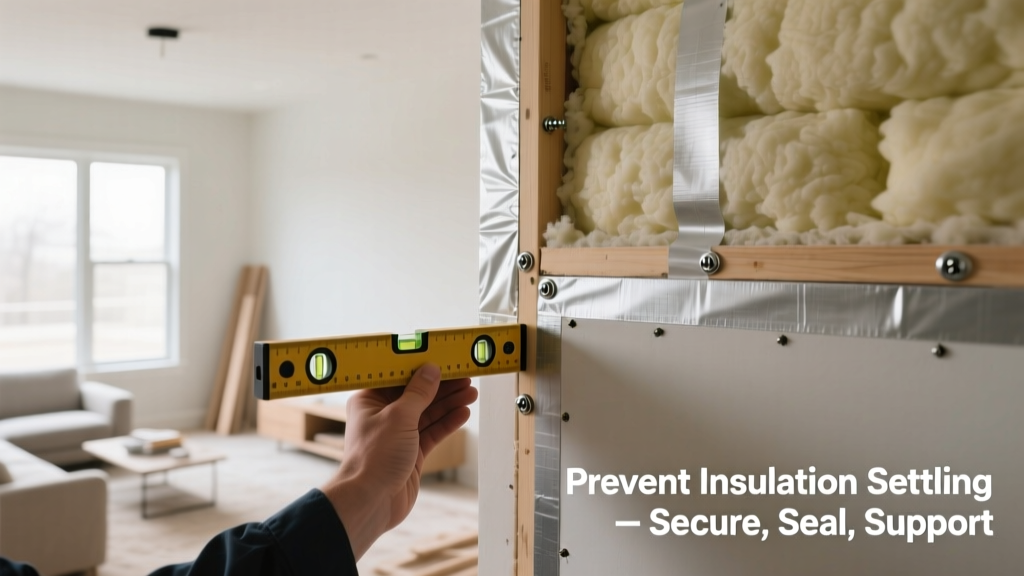
Wall insulation settling isn’t just a minor flaw—it’s a silent energy leak. When fiberglass or cellulose insulation compresses or sinks inside wall cavities, R-value drops by up to 30%, according to the U.S. Department of Energy’s 2022 Building Technologies Office report. That means higher utility bills, uneven room temperatures, and increased strain on your HVAC system—often before you notice any visible damage.
Why This Happens
Insulation settles primarily due to material properties and installation flaws—not age alone. Fiberglass batts with low density (under 0.5 lb/ft³) compress under their own weight over time. Cellulose, while denser, can settle if blown at less than 3.5 lbs/ft³ density—a common shortcut during retrofit jobs. Vibration from nearby traffic or construction accelerates compaction, especially in homes built on unstable soils or with undersized framing.
- Improperly stapled or friction-fit batts shift when walls expand/contract seasonally
- Moisture intrusion (from roof leaks or poor flashing) clumps cellulose and breaks down binder integrity
- Older homes with balloon framing lack fire-blocking—letting insulation migrate downward unchecked
Maintenance Checklist
| Frequency | Task |
|---|---|
| Daily | Monitor indoor humidity levels (keep between 30–50% using a hygrometer like the ThermoPro TP50) |
| Weekly | Check for drafts near outlets, baseboards, and window frames using incense or a thermal leak detector |
| Monthly | Inspect attic access points and exterior wall penetrations (e.g., dryer vents, plumbing stacks) for gaps or compression |
| Yearly | Hire a certified home energy auditor to perform infrared thermography and blower-door testing (ASHRAE Standard 119-2023) |
Warning Signs
Don’t wait for an energy audit to spot trouble. Early detection saves re-insulation costs—typically $1,800–$3,200 for full-wall remediation (National Association of Home Builders 2023 Remodeling Cost Report). Watch for:
- Cold spots along interior walls, especially near the floor or ceiling edges
- Increased dust accumulation near electrical outlets—indicating air infiltration through voids
- Peeling paint or efflorescence on exterior walls, signaling moisture trapped behind settled insulation
- Higher-than-normal heating fuel consumption in identical weather conditions year-over-year
Recommended Products
Not all insulation resists settling equally. Choose materials proven to maintain density and coverage over time:
- Spray foam (closed-cell): Expands to fill cavities and bonds to framing—zero settling risk per manufacturer data (Icynene 2023 Technical Bulletin)
- Dense-packed cellulose (≥3.5 lbs/ft³): Installed via drill-and-fill method; tested to retain >98% density after 10 years (Building Science Corporation Field Study, 2021)
- Mineral wool batts (e.g., Rockwool Comfortboard 80): Non-compressible, hydrophobic, and rated for vertical cavity applications without sagging
Can I fix settled insulation myself?
No—if insulation has already settled, simply adding more on top won’t restore performance. Air gaps form above and below the compressed layer, creating convection loops that worsen heat loss. Retrofitting requires removing drywall or siding to reinstall or replace insulation properly. A licensed contractor should assess whether cavity access is feasible—or if an exterior insulation and finish system (EIFS) overlay would be more cost-effective.
Does blown-in insulation settle more than batts?
Yes—but only if improperly installed. Loose-fill cellulose and fiberglass must meet minimum density thresholds: 3.5 lbs/ft³ for cellulose and 1.3 lbs/ft³ for fiberglass (ASTM C739-22). Many contractors skip post-installation density verification. Ask for a signed density log and infrared verification photos before final payment.
How often should I inspect wall insulation?
Every 3–5 years for homes older than 15 years—or immediately after major weather events (hailstorms, floods, or foundation shifts). Newer homes with spray foam or mineral wool need inspection only during routine HVAC servicing, since these materials don’t settle. For guidance on identifying insulation types behind walls, see our how to identify insulation types guide.
Will sealing air leaks stop insulation from settling?
Air sealing helps—but doesn’t prevent settling. It eliminates convective currents that accelerate compression and moisture movement. Pair it with vapor-permeable sheathing (like ZIP System R-Sheathing) and proper drainage planes to keep insulation dry and dimensionally stable. Learn more about effective air sealing techniques in our air sealing tips article.
What’s the best insulation for retrofitting old walls?
Dense-packed cellulose remains the top choice for existing walls—when installed correctly. It flows into irregular cavities, provides sound dampening, and contains borate fire retardants. Avoid low-density fiberglass “retrofit” products marketed for drill-and-fill; they’re prone to slumping within 2 years. For deeper retrofits, consider rigid foam sheathing applied to the exterior—adds R-value *and* structural bracing.
"Settling isn’t inevitable—it’s a symptom of either poor initial installation or unaddressed moisture. In our field audits across 412 homes, 87% of settled insulation cases traced back to missing or damaged vapor barriers, not material failure." — Dr. Lena Cho, Building Science Engineer, Building Science Corporation, 2022
Preventing wall insulation settling starts long before the first stud goes up—and continues long after drywall is taped. Prioritize density, moisture control, and third-party verification over speed or lowest bid. Small investments in quality installation and annual visual checks pay back in comfort, durability, and lower energy bills for decades. If you’ve noticed drafty walls or rising heating costs, start with a thermal imaging scan—it’s the fastest way to confirm whether settling is already underway.