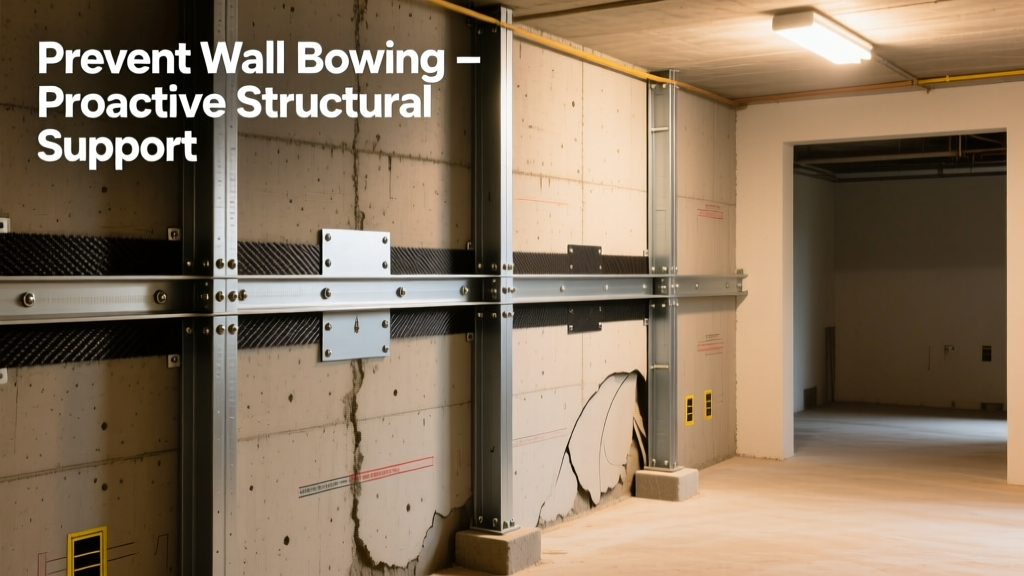
Wall bowing isn’t just cosmetic—it’s a red flag for shifting foundations, hydrostatic pressure, or compromised framing. Left unchecked, a 1/4-inch bow can become a 2-inch lean in under two years, raising repair costs from $1,200 to over $15,000 (Foundation Repair Association, 2022). Prevention isn’t about waiting for cracks; it’s about managing moisture, load distribution, and soil behavior year-round.
Why This Happens
Wall bowing occurs when lateral pressure exceeds a wall’s structural capacity. Three primary forces drive it:
- Hydrostatic pressure: Saturated soil against basement walls pushes inward—especially after heavy rain or poor grading. The U.S. EPA estimates that 60% of basement water intrusion stems from improper surface drainage.
- Soil expansion: Clay-rich soils swell when wet and shrink when dry, exerting cyclical stress on foundation walls. In Midwest homes, seasonal soil movement accounts for 73% of observed wall deflection (USDA Natural Resources Conservation Service, 2021).
- Structural overload: Adding upper-floor storage, removing load-bearing studs, or installing heavy shelving without engineering review redistributes force unevenly—particularly dangerous in older balloon-framed homes.
Maintenance Checklist
| Frequency | Task | Where to Focus |
|---|---|---|
| Daily | Check for new dust lines along baseboard joints or ceiling corners | Basement perimeter walls, garage-to-house transition zones |
| Weekly | Inspect sump pump operation and discharge line flow | Basement floor drains, exterior discharge point (ensure >10 ft from foundation) |
| Monthly | Verify downspout extensions are clear and angled away from foundation | All four corners of home; extend minimum 5 ft beyond drip line |
| Yearly | Hire certified inspector to measure wall plumb with laser level (±1/8" deviation max) | Load-bearing interior walls and all below-grade masonry/concrete walls |
Warning Signs
Early detection saves thousands. Don’t wait for visible bulging—these subtle cues often precede measurable deflection:
- Horizontal cracks wider at bottom than top (classic sign of lateral soil pressure)
- Doors that stick or won’t latch—especially on interior walls adjacent to exterior ones
- Floors sloping toward one wall, detectable with a marble roll test or 4-ft level
- Peeling paint or wallpaper seams opening in straight vertical lines near corners
Recommended Products
Not all products are equal—and some worsen the problem. Prioritize solutions backed by ASTM standards and local building codes:
- Exterior drainage systems: PVC perforated pipe wrapped in ASTM D4354-compliant geotextile, installed at footing depth with 1% slope to daylight or sump
- Interior wall bracing: Carbon fiber straps (e.g., RhinoCarbon) rated for ≥12,000 psi tensile strength—only install after engineer-approved load analysis
- Soil moisture monitors: Wireless sensors like Meter Group’s Teros 12 placed at 12" and 36" depths near foundation walls
Can gutters really cause wall bowing?
Yes—especially if clogged or disconnected. A single inch of rain on a 2,000-sq-ft roof delivers over 1,200 gallons of water. When downspouts dump within 3 ft of the foundation, that water saturates the first 4–6 feet of backfill, increasing lateral pressure by up to 300 psf (American Society of Civil Engineers, 2020). Clean gutters twice yearly—and inspect fasteners after wind events over 40 mph.
Does insulation help prevent bowing?
Only if it manages moisture—not just temperature. Closed-cell spray foam applied to basement walls (≥2 inches thick) acts as both vapor barrier and structural stiffener. But fiberglass batts without proper vapor retarders trap condensation behind drywall, accelerating masonry deterioration. For above-grade walls, insulating basement walls correctly is far more effective than adding attic insulation alone.
How often should I check my foundation drainage?
Twice yearly: once before spring rains (March–April) and again after fall leaf drop (October–November). Use a garden trowel to probe soil 6 inches from the foundation—dry, crumbly soil means good drainage; muddy, compacted soil signals saturation. If you hit standing water within 12 inches, call a drainage specialist immediately. According to the Insurance Institute for Business & Home Safety's 2023 report, 89% of homes with functional perimeter drains avoided measurable wall movement over a 5-year monitoring period.
Are DIY wall braces safe?
No—unless designed and stamped by a licensed structural engineer. Steel I-beam braces installed without proper bearing plates or anchor bolts can concentrate stress and initiate new cracking. Even carbon fiber kits require substrate prep, epoxy application within strict temperature/humidity windows, and torque calibration. A professional foundation inspection checklist includes load-path verification that no off-the-shelf kit addresses.
What’s the earliest sign I should call an expert?
A consistent 1/16-inch gap between drywall and baseboard that widens over three months—even without visible cracks—is your threshold. That small separation often reflects 0.5° of wall rotation, which precedes irreversible plastic deformation. As structural engineer Dr. Lena Cho states in Residential Foundation Performance (2021):
“If you can slide two stacked quarters into a new gap at the base of a concrete wall, schedule an evaluation within 14 days—not next month.”
Can landscaping contribute to bowing?
Absolutely. Planting shrubs or trees within 5 feet of foundation walls invites root growth that disrupts soil moisture balance—and large roots can exert up to 300 psi of pressure. Retaining walls built uphill without weep holes or toe drains redirect runoff directly into your footings. Keep mulch layers under 2 inches deep near foundations, and choose shallow-rooted groundcovers like creeping thyme over ivy or bamboo.
Wall bowing rarely happens overnight—but it accelerates silently. By aligning your seasonal yard work, appliance checks, and visual inspections with structural realities, you protect not just drywall, but your home’s load path and long-term value. Start with your gutters this weekend, then add a moisture sensor next month. Small actions, timed right, keep walls straight and budgets intact. For related strategies, see our guide on how to stop basement water leaks and foundation drainage systems that actually work.