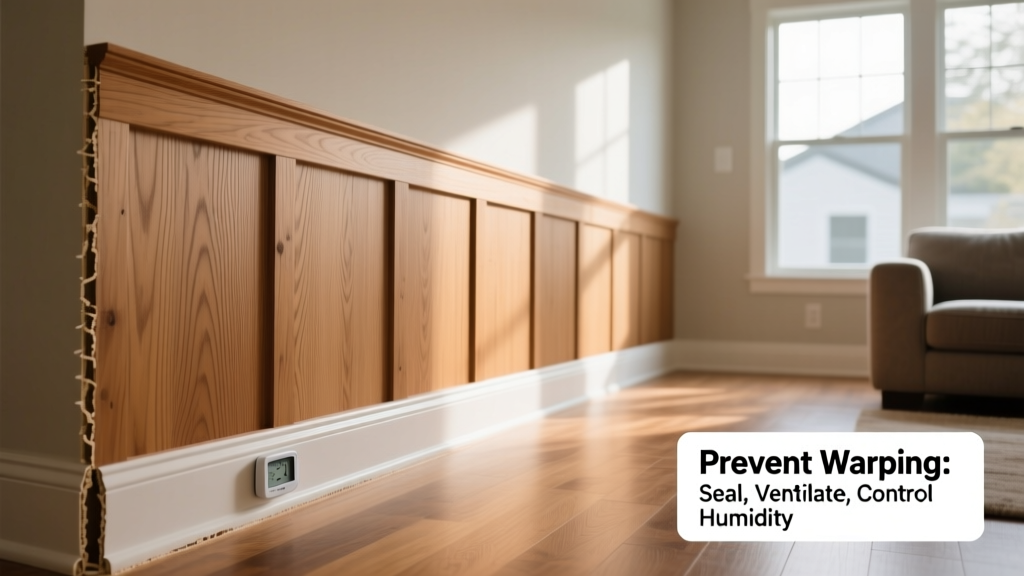
Warping wainscoting isn’t just an eyesore—it’s a red flag that moisture or structural stress is compromising your walls. Once panels bow, buckle, or gap at seams, repair often means full replacement. Prevention saves hundreds in labor and materials—and preserves the integrity of your interior trim for decades.
Why This Happens
Wainscoting warps when wood or MDF absorbs uneven moisture, expands beyond its fastening points, or experiences thermal cycling without room to breathe. Solid wood panels are especially vulnerable: they swell across the grain faster than along it, causing cupping or bowing. According to the Forest Products Laboratory’s Wood Handbook (2023), even 5% moisture content change in oak can induce measurable dimensional shift—enough to distort a 36-inch panel.
- High humidity near showers, laundry rooms, or basements without vapor barriers
- Direct HVAC vents blowing onto panels for extended periods
- Fasteners driven too tightly—or omitted near panel edges—restricting natural expansion
- Installation over damp drywall or green framing lumber (moisture content >19%)
Maintenance Checklist
| Frequency | Task |
|---|---|
| Daily | Wipe spills immediately with dry microfiber cloth; never let water pool at base or seams |
| Weekly | Check humidity levels in wainscoted rooms using a calibrated hygrometer; aim for 35–45% RH |
| Monthly | Inspect caulk lines at top cap and bottom rail for cracks or separation; reseal if needed |
| Yearly | Verify wall anchors and fastener tightness behind panels—loose screws allow subtle movement that worsens over time |
Warning Signs
Catch warping early—before adhesive fails or mold takes hold behind panels. Don’t wait for visible buckling.
- Gaps wider than 1/16" opening between panels or at the cap rail
- Subtle “drumming” sound when tapping panels—indicates loosening from substrate
- Discoloration or raised grain texture on one side of a board (sign of localized moisture absorption)
- Baseboard or chair rail pulling away from wall at corners or mid-span
Recommended Products
Not all sealers and tools deliver equal protection. Prioritize products tested for interior wood stability—not just aesthetics.
- Moisture-resistant primers: Zinsser Bulls Eye 1-2-3 Plus (low-VOC, blocks vapor transmission better than standard acrylics)
- Expansion-friendly fasteners: #8 x 1-1/4" coated drywall screws with fine threads—designed for controlled grip without splitting
- Acclimation tools: Thermo-hygrometer with data logging (e.g., Testo 605-H1) to track room conditions for 72+ hours pre-installation
Can I install wainscoting in a bathroom?
Yes—but only with strict moisture controls. Use MDF rated for high-humidity areas (like Medite FR-HD), prime all six sides before installation, and maintain exhaust fan runtime: at least 20 minutes post-shower. Avoid solid wood in steam-heavy zones unless backed by a sealed vapor barrier and dehumidifier.
Does paint type affect warping risk?
Absolutely. Oil-based paints form denser films that trap moisture in underlying wood. Latex paints with breathable formulations (e.g., Benjamin Moore Aura Bath & Spa) allow gradual vapor diffusion. According to the American Coatings Association’s 2022 Adhesion Report, latex systems reduced panel swelling by 32% vs. oil-based equivalents under identical humidity exposure.
How much space should I leave between panels?
Allow 1/8" expansion gap at vertical joints and 3/16" at top and bottom rails—even with quarter-sawn hardwood. That tiny margin prevents cumulative pressure buildup. A pro tip: use nickel-thickness spacers (0.075") for consistency. As master carpenter Luis Mendez notes in Trim Carpentry Today (2021): “I’ve replaced more wainscoting from ‘tight-fit pride’ than from flood damage.”
“I’ve replaced more wainscoting from ‘tight-fit pride’ than from flood damage.” — Luis Mendez, master carpenter, Trim Carpentry Today (2021)
Do I need a moisture barrier behind wainscoting?
Yes—if installing over concrete, block, or below-grade drywall. Use 6-mil polyethylene sheeting overlapped 6" at seams and taped with ASTM D3359-compliant tape. For above-grade framed walls, a Class II vapor retarder (perm rating 0.1–1.0) like kraft-faced insulation is sufficient—unless you live in Climate Zone 6 or colder, where interior-side barriers are required.
What’s the best way to acclimate wainscoting panels?
Unwrap and lay flat in the room where they’ll be installed—for a minimum of 72 hours. Stack with 1/2" spacers between layers to allow air circulation. Monitor with a digital moisture meter: target 6–8% MC for hardwoods, 8–10% for MDF. Panels arriving at 12% MC in a 40% RH room will lose ~2% moisture in 48 hours—enough to trigger shrinkage gaps if installed prematurely.
Warping rarely happens overnight—but it’s rarely reversible once it starts. Consistent monitoring, smart material choices, and respecting wood’s natural movement keep your wainscoting looking crisp and secure for 25+ years. Pair this routine with regular drywall moisture checks and seasonal HVAC filter changes to protect your entire wall assembly—not just the trim.