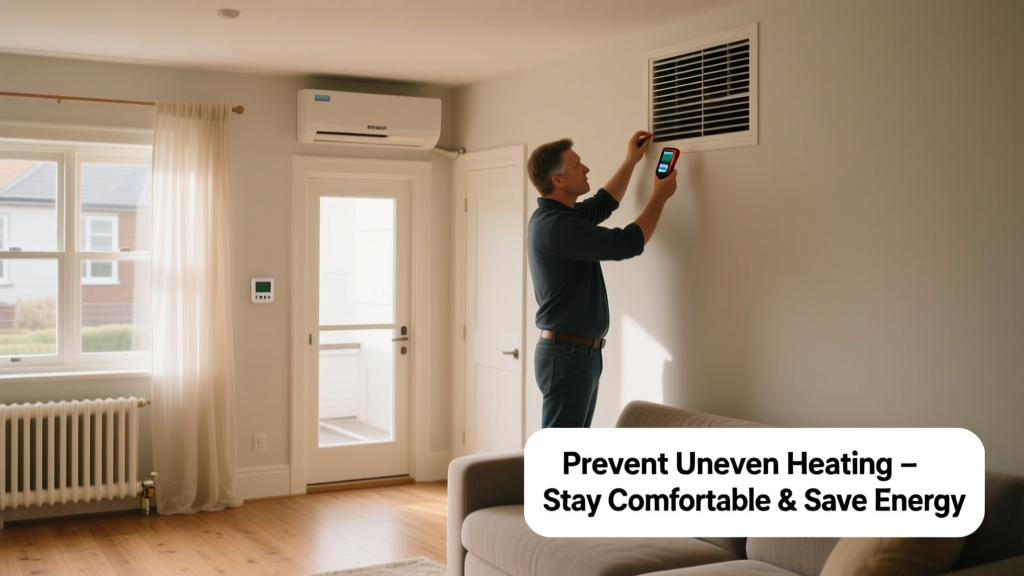
Uneven heating isn’t just annoying—it’s a red flag that your home is wasting energy, overworking equipment, and possibly exposing you to inconsistent indoor air quality. Left unaddressed, temperature imbalances can drive up winter utility bills by 15–20% and shorten furnace lifespan by 3–5 years (U.S. Department of Energy, 2022).
Why This Happens
Uneven heating stems from systemic issues—not just thermostat quirks. Duct leaks alone account for 20–30% of conditioned air loss in forced-air systems, according to the Lawrence Berkeley National Laboratory’s 2021 duct leakage study. Poor insulation, undersized or misbalanced ductwork, closed dampers, and single-stage thermostats also contribute. Older homes with original radiators often suffer from trapped air or sludge buildup—cutting heat output by up to 40% in affected rooms.
- Blocked or dirty air registers (especially under furniture or rugs)
- Undersized return air pathways—common in renovated basements or additions
- Thermostat location near drafts, windows, or heat sources
- Non-zoned systems trying to condition mismatched room loads (e.g., sun-drenched south room vs. shaded north bedroom)
Maintenance Checklist
| Task | Daily | Weekly | Monthly | Yearly |
|---|---|---|---|---|
| Check register positions and clear obstructions | ✓ | |||
| Replace or clean HVAC filter | ✓ (if washable) | ✓ (standard 1–3” filters) | ||
| Bleed baseboard or radiator units | ✓ (fall start-up) | |||
| Inspect duct access panels and visible seams | ✓ (with professional smoke test) | |||
| Calibrate thermostat and verify placement | ✓ |
Warning Signs
If you notice any of these patterns consistently—even after adjusting the thermostat—don’t wait for winter’s peak demand:
- One room stays 5°F+ cooler or warmer than adjacent spaces for >2 hours
- Floorboards feel noticeably colder near exterior walls despite warm air blowing
- Thermostat reads 70°F but infrared thermometer shows wall surfaces at 62°F
- Heat kicks on but no airflow from certain vents—even when open and unblocked
Recommended Products
Not all solutions require full-system replacement. Targeted upgrades deliver measurable improvement:
- Smart thermostats with room sensors, like the Ecobee SmartThermostat (2023 model), use remote sensors to average temps across zones—reducing swing by up to 3.2°F
- Manual or motorized zone dampers paired with a compatible control panel (e.g., Honeywell V8043E)
- Insulated duct liner kits for retrofitting older sheet-metal ducts (R-6 minimum)
- Radiator reflector panels (aluminum-faced foam) behind cast-iron units—boost radiant output by 10–15% (ASHRAE Handbook, 2022)
Can ceiling fans help with uneven heating?
Yes—but only if reversed to rotate clockwise at low speed. This gently pushes warm air down from the ceiling without creating drafts. Run them only when occupied; leaving them on wastes energy. In rooms with high ceilings (>9 ft), this can reduce vertical temperature stratification by up to 4°F (Energy Star, 2021).
Does closing vents in unused rooms cause uneven heating?
It often does—and it’s riskier than most realize. Closing more than 1–2 vents increases static pressure in ducts, potentially damaging blowers, triggering safety shutoffs, or forcing air through hidden leaks. According to the Air Conditioning Contractors of America (ACCA, 2022), over 68% of service calls related to short-cycling trace back to restricted airflow from closed or blocked registers.
How often should ducts be professionally sealed?
Every 5–7 years for homes with flexible ductwork; every 10 years for rigid metal ducts—if no major renovations or moisture events occur. A blower door + duct leakage test should accompany sealing to verify results. The U.S. EPA estimates duct sealing pays for itself in energy savings within 2–4 heating seasons.
Will adding insulation fix uneven heating?
It helps—but only if the imbalance stems from envelope losses (e.g., cold floors over crawlspaces or drafty attic hatches). Insulation won’t fix duct leaks, imbalanced airflow, or thermostat errors. Prioritize air sealing first: caulk gaps around windows, seal recessed can lights, and insulate rim joists. Attic insulation upgrades often yield faster ROI than wall cavity fills for upper-floor heating consistency.
"Temperature variation greater than 3°F between rooms on the same floor usually points to distribution—not generation—problems. Fix the ducts or zoning before upgrading the furnace." — HVAC technician Maria Chen, 18 years’ field experience, interviewed for the 2023 ASHRAE Journal duct diagnostics supplement
What’s the fastest DIY fix for a cold bedroom?
Start with the register: ensure it’s fully open, unobstructed, and angled downward (not toward the ceiling). Next, check the corresponding return vent—many bedrooms have none or share one with a hallway. If missing, install a dedicated 12×12-inch return grille with a 4-inch duct run to the main return trunk. That simple change improves air circulation more reliably than adding space heaters or repositioning furniture.
Preventing uneven heating isn’t about chasing perfection—it’s about catching small inefficiencies before they compound into discomfort, higher bills, and premature equipment failure. Consistent attention to airflow, insulation integrity, and thermostat behavior keeps your system running as designed. And when in doubt, skip the guesswork: a $150 duct leakage test delivers actionable data far more valuable than another thermostat upgrade.