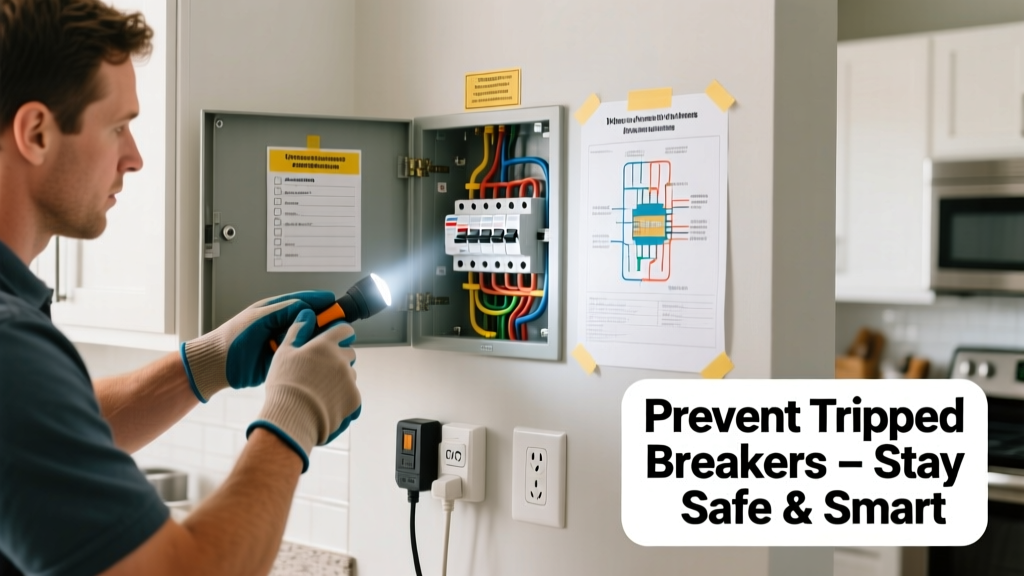
A tripped breaker isn’t just an inconvenience—it’s your home’s first line of defense against overheating wires, damaged appliances, and potential fire hazards. According to the U.S. Fire Administration’s 2022 report, electrical distribution and lighting equipment caused an estimated 34,000 home structure fires annually—many linked to repeated overloads and ignored warning signs.
Why This Happens
Circuit breakers trip for three primary reasons: overload (too many devices on one circuit), short circuits (exposed hot-to-neutral contact), and ground faults (hot wire contacting ground). Overloads account for roughly 70% of residential trips, especially in kitchens and laundry rooms where high-wattage appliances cluster.
- Overload: Running a microwave, toaster oven, and coffee maker simultaneously on a single 15-amp kitchen circuit (max 1,800 watts) exceeds capacity.
- Short circuit: Damaged cord insulation on a vacuum cleaner lets hot and neutral wires touch inside the plug.
- Ground fault: A frayed outdoor extension cord submerged in rain creates a path to ground through water.
Maintenance Checklist
| Frequency | Task |
|---|---|
| Daily | Unplug unused high-wattage devices (space heaters, hair dryers) |
| Weekly | Check for warm outlets or buzzing sounds near breaker panel |
| Monthly | Test GFCI outlets with TEST/RESET buttons; verify they cut power in ≤0.1 seconds |
| Yearly | Hire a licensed electrician to torque panel connections and inspect bus bars (loose lugs cause 22% of nuisance trips, per NFPA 70E 2023) |
Warning Signs
Don’t wait for a trip to act. These subtle cues indicate stress on your system:
- Faint humming or sizzling from the panel when large appliances cycle on
- Discoloration (brown or black scorch marks) around outlet faceplates or breaker switches
- Breaker that feels warm to the touch—even when not recently tripped
- Odor of burnt plastic near outlets or the main panel
"If a breaker trips more than twice in one month on the same circuit, it’s not a fluke—it’s a red flag. Either the load is too high, the breaker is failing, or wiring is degrading." — Licensed Master Electrician Maria Chen, NEC Code Trainer since 2009
Recommended Products
Investing in the right tools and upgrades helps prevent repeat trips—and catches problems early:
- Smart load monitors (e.g., Emporia Vue 2): Plug-in or panel-mounted devices that track real-time wattage per circuit and send alerts before overload occurs.
- ARC-fault circuit interrupters (AFCIs): Required by NEC 2023 for bedrooms and living areas—they detect dangerous arcing before heat builds enough to trip a standard breaker.
- Heavy-duty power strips with built-in surge + overload protection: Look for UL 1449 4th Edition rating and 15-amp internal breaker (not just a fuse).
Can I replace a breaker myself?
No—unless you’re a licensed electrician. Panel work carries lethal risk. Even turning off the main breaker doesn’t eliminate arc-flash hazard on the bus bars. Always call a professional for replacement or reconfiguration. For DIY-safe alternatives, consider calculating your circuit loads first to identify which appliances can safely share a circuit.
Why does my breaker trip only when the AC kicks on?
That’s likely a compressor startup surge. Most central AC units draw 3–5× their running amps for 1–2 seconds at startup. If your HVAC shares a circuit with lights or outlets—or if the breaker is old or undersized—it may trip. The fix? Dedicated 240V circuit for HVAC, verified by a load calculation per NEC Article 440.
Will upgrading to a higher-amp breaker solve frequent trips?
No—and it’s dangerous. A 20-amp breaker on 14-gauge wire (rated for 15 amps) creates a fire hazard. Breakers protect the wire, not the device. If trips persist, the solution is either load redistribution, circuit expansion, or wiring inspection—not breaker swapping. See our guide on when to upgrade your electrical panel.
Do LED bulbs really reduce breaker trips?
Yes—but indirectly. Replacing ten 60W incandescent bulbs (600W total) with equivalent LEDs (60W total) frees up 540W on a circuit. That’s enough headroom to add a laptop charger and desk lamp without pushing past 80% capacity—the NEC-recommended safe limit for continuous loads.
What’s the difference between nuisance trips and serious ones?
Nuisance trips happen under predictable load (e.g., every time the vacuum starts) and reset cleanly. Serious trips occur randomly, produce smoke or odor, or won’t reset after cooling—indicating internal breaker failure or hidden damage. In those cases, shut off the circuit and call an electrician immediately. Don’t attempt to “hold it in” or tape it on.
Preventing tripped breakers isn’t about luck—it’s about consistency, observation, and respecting your home’s electrical limits. Start with the monthly GFCI test and the yearly panel inspection. Then, use a free circuit mapping template to learn what’s on each breaker. Small habits compound into long-term safety—and keep your lights, fridge, and Wi-Fi reliably on.