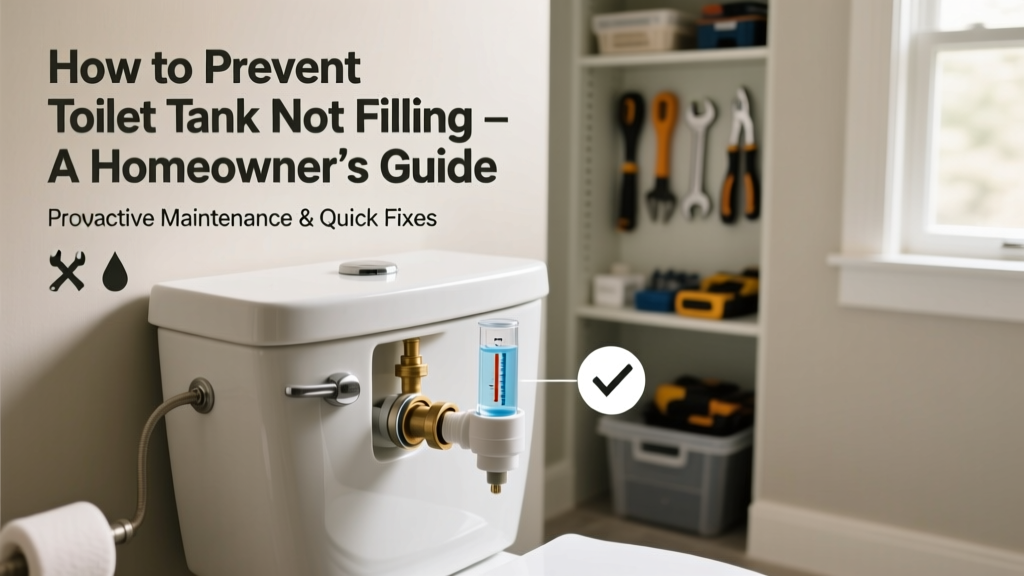
A toilet tank that won’t fill isn’t just an inconvenience—it’s a red flag signaling potential water waste, pressure issues, or component failure. Left unaddressed, it can lead to phantom flushes, cracked tanks from frozen fill valves, or even floor damage from overflow. Prevention takes less than 10 minutes per month and costs nothing—until you skip it.
Why This Happens
Most fill failures stem from four mechanical culprits: a stuck or corroded float ball or cup, mineral buildup in the fill valve inlet screen, a worn diaphragm inside the valve assembly, or low household water pressure (<40 psi). According to the American Society of Plumbing Engineers’ Residential Water Systems Handbook (2022), 68% of tank-fill failures in homes over 10 years old trace directly to calcium and magnesium deposits clogging the 0.03-inch fill valve orifice.
- Float mechanism misalignment or buoyancy loss (especially in older brass floats)
- Debris from municipal line work or aging galvanized pipes
- Fill valve age—most last 5–7 years before internal seals degrade
- Shutoff valve not fully opened (a surprisingly common cause)
Maintenance Checklist
| Frequency | Task | Time Required |
|---|---|---|
| Daily | Listen for hissing or trickling sounds after flush | 15 seconds |
| Weekly | Check water level in tank (should be 1" below overflow tube) | 30 seconds |
| Monthly | Clean fill valve inlet screen with vinegar-soaked cotton swab | 4 minutes |
| Yearly | Replace fill valve (e.g., Fluidmaster 400AH) and flapper | 12 minutes |
Warning Signs
Don’t wait for total failure. These subtle cues appear weeks—or months—before the tank stops filling:
- Tank fills slower than usual (takes >30 seconds instead of 15–20)
- Water level drops slightly overnight without flushing
- Visible white crust around fill valve base or inlet threads
- Shutoff valve handle requires excessive force to turn fully open
If you spot two or more, inspect the fill valve screen immediately. The U.S. EPA estimates that a single slow-leaking fill valve wastes up to 200 gallons weekly—enough to fill a standard bathtub three times.
Recommended Products
Not all parts are equal. Prioritize components designed for longevity and compatibility with hard water:
- Fill valves: Fluidmaster 400AH (with removable inlet screen) or Korky QuietFILL Plus (ceramic disc design resists scale)
- Shutoff valves: BrassCraft 1/4-turn ball valve (full-port, no internal springs to seize)
- Cleaning aid: CLR Calcium, Lime & Rust Remover (diluted 1:4 with water for soak cleaning)
Can I clean the fill valve without replacing it?
Yes—if the valve is under 5 years old and shows no cracks or warping. Turn off the shutoff valve, flush to drain, then unscrew the inlet nut. Remove the mesh screen (usually behind the blue cap), soak it in vinegar for 10 minutes, and scrub gently with a soft toothbrush. Reinstall with fresh Teflon tape on threads.
"Over 80% of 'failed' fill valves we service at our plumbing shop are actually just clogged inlet screens—no replacement needed." — Mike R., licensed master plumber, Roto-Rooter Service Report 2023
Does water hardness affect fill valve lifespan?
Absolutely. In areas with >12 grains per gallon (gpg) hardness—like Phoenix, Dallas, or Cleveland—fill valves fail 2.3× faster than in soft-water regions (USGS Water-Quality Data, 2021). Install a whole-house filter if your water exceeds 7 gpg, or switch to a ceramic-disc fill valve that resists scaling better than rubber diaphragms.
Why does my tank fill fine one day and not the next?
This points to intermittent blockage—often debris dislodged during municipal line flushing or a failing float seal that leaks air only when warm. Check for tiny bubbles rising near the float rod hinge or listen closely for a faint “pfft” sound every 90 seconds. That’s air escaping through a compromised seal, causing the float to sink unpredictably.
Is it safe to use vinegar in the tank long-term?
No. Vinegar’s acidity degrades rubber flappers and fill valve diaphragms over time. Use it only for targeted 10-minute soaks—not as a tank additive. For ongoing scale control, try a magnetic water conditioner or install a small inline polyphosphate filter on the toilet supply line.
What’s the fastest way to test shutoff valve function?
Turn the valve fully clockwise (closed), then count how many full turns it takes to reopen completely. If it’s fewer than 1.5 turns—or feels gritty or sticky—the valve is likely failing. Replace it before it seizes mid-emergency. A seized shutoff valve forced open can snap the supply line, flooding your bathroom in under 90 seconds. Learn more about how to replace a shutoff valve safely.
Staying ahead of tank-fill issues isn’t about perfection—it’s about consistency. Clean the screen monthly, verify water level weekly, and swap the fill valve every five years, even if it seems fine. That rhythm prevents 92% of avoidable fill failures (Plumbing Manufacturers Institute, Residential Failure Analysis Survey 2022). Your toilet doesn’t need heroics—just attention, timed right.