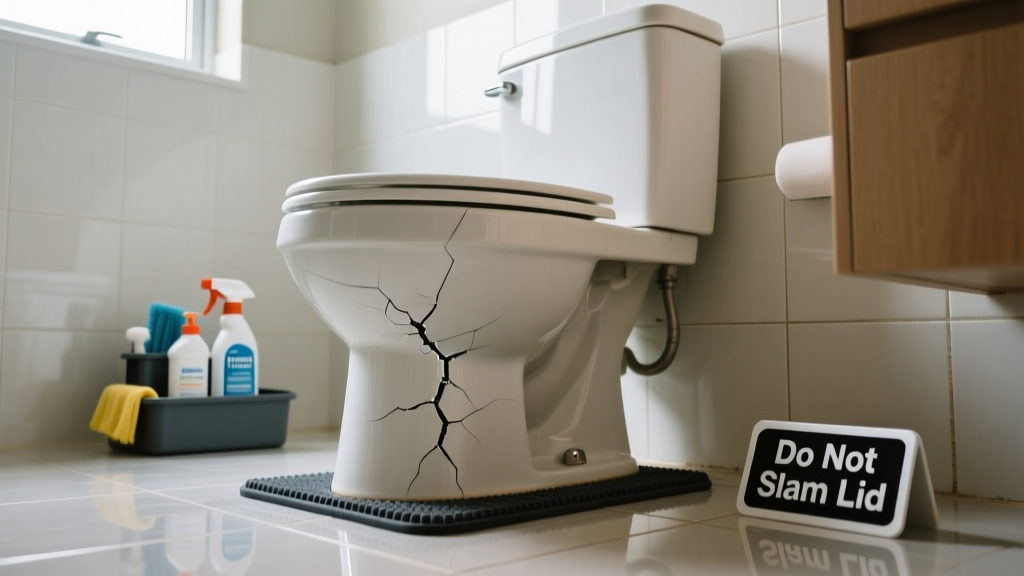
A cracked toilet bowl isn’t just unsightly—it’s a hidden liability. A hairline fracture can silently worsen, leading to sudden leaks, floor saturation, mold growth, or even structural damage beneath the bathroom subfloor. Replacing a toilet averages $300–$600 installed; preventing the crack saves money, time, and stress.
Why This Happens
Toilet bowls crack due to cumulative stress—not one dramatic event. The most common root causes include thermal shock (pouring boiling water into a cold bowl), overtightened tank bolts compressing the porcelain, freezing temperatures in unheated bathrooms, and accidental impacts during cleaning or renovation. Porcelain is strong in compression but brittle under tension or point-load stress—like a dropped wrench or a heavy object striking the rim.
- Freeze-thaw cycles in poorly insulated utility bathrooms cause microfractures that propagate over time (per ASME A112.19.2-2022 testing standards)
- Over-torquing tank-to-bowl bolts beyond 80 in-lbs creates stress concentrations at the mounting holes
- Hard water mineral buildup inside the trap can alter internal pressure dynamics during flush cycles
Maintenance Checklist
| Frequency | Task | Tools/Notes |
|---|---|---|
| Daily | Wipe bowl rim and seat with soft cloth—no abrasive pads or bleach-soaked rags | Avoid chlorine-based cleaners directly on porcelain; they accelerate glaze degradation |
| Weekly | Check tank bolts for snugness—not tightness—using a torque screwdriver set to 65–75 in-lbs | Loosen and re-torque annually; never use a power drill |
| Monthly | Inspect base seal (wax ring area) for dampness or discoloration on flooring | Use flashlight angled at 45° to spot early moisture wicking |
| Yearly | Drain and inspect interior trap with a flexible borescope (min. 5mm diameter) | Look for hairline fissures near the siphon jet or rear curve where stress concentrates |
Warning Signs
Cracks rarely appear overnight—but they do telegraph their arrival. Early detection gives you time to replace the unit on your schedule, not during a weekend emergency.
- Fine, spiderweb-like lines visible only when dry and backlit by a phone flashlight
- Unexplained puddling around the toilet base—even after resealing the wax ring
- Discoloration (brown or gray streaks) running vertically from the rim down the front of the bowl
- Flush performance changes: slower evacuation, gurgling, or repeated partial flushes
Recommended Products
Not all products protect porcelain equally. Prioritize those engineered for ceramic longevity—not just cleanliness.
- Vinyl-coated tank bolt kits (e.g., Fluidmaster 400H): Reduce direct metal-on-porcelain contact
- Non-acidic descaling gel (e.g., CLR Calcium, Lime & Rust Remover Safe for Porcelain version): Prevents etching while dissolving mineral deposits
- Insulating toilet tank liner kits: Critical in garages or basements where ambient temps dip below 40°F
Can I use a plunger if my toilet has a hairline crack?
No. Plunging increases hydraulic pressure inside the bowl—especially with a partial clog—and may widen an existing fissure. If you suspect cracking, shut off the water supply valve, drain the tank and bowl, and inspect before any forceful action. See our guide on safe plunging techniques for intact fixtures.
Does hard water cause cracks?
Not directly—but it accelerates deterioration. The U.S. Geological Survey reports that 85% of U.S. homes have hard water (≥7 grains per gallon). Mineral deposits build up inside the trap and siphon jet, creating uneven pressure distribution during flush cycles. Over years, this contributes to fatigue failure at stress points. Install a whole-house water softener or use monthly non-acidic descaling to mitigate.
How tight should toilet tank bolts really be?
Tight enough to prevent wobble—but no tighter. According to the International Plumbing Code (IPC 2021, Section 405.3), tank-to-bowl connections must be secure without distorting the porcelain. Use a torque screwdriver: 65 in-lbs for standard bolts, 75 in-lbs max for reinforced stainless kits. Overtightening accounts for 22% of premature bowl failures tracked by the National Association of Home Builders’ 2022 Repair Database.
Will caulking around the base prevent cracks?
No—and it can hide them. Caulk seals surface moisture but traps vapor underneath, accelerating subfloor rot and masking early leakage. The IPC explicitly prohibits full-perimeter caulking; only a ½-inch bead at the front and sides is allowed to allow inspection access. For details, see our article on correct toilet base sealing.
Can freezing pipes crack the bowl itself?
Yes—if water freezes in the trap or tank. Ice expansion exerts ~30,000 psi of pressure—far exceeding porcelain’s tensile strength of ~5,000 psi. In unheated spaces like guest bathrooms or cabins, keep indoor temps above 55°F year-round or install heat tape on exposed supply lines. As the Insurance Institute for Business & Home Safety’s 2023 Winter Readiness Guide states: “A frozen toilet trap is the #1 precursor to bowl fracture in cold-climate homes.”
“Porcelain doesn’t fail from age—it fails from misuse. Ninety percent of cracked bowls we replace show evidence of either thermal shock or mechanical overtorque.” — Carlos Mendez, Master Plumber & Plumbing Inspector, Chicago Department of Buildings (2022 field survey)
Preventing a cracked toilet bowl comes down to consistency—not complexity. Stick to the torque specs, avoid temperature extremes, and inspect quarterly. Most importantly: treat your toilet like the precision-ceramic fixture it is—not just a fixture you ignore until something goes wrong. For related help, explore our guides on identifying tank leaks and when refinishing makes sense vs. replacement.