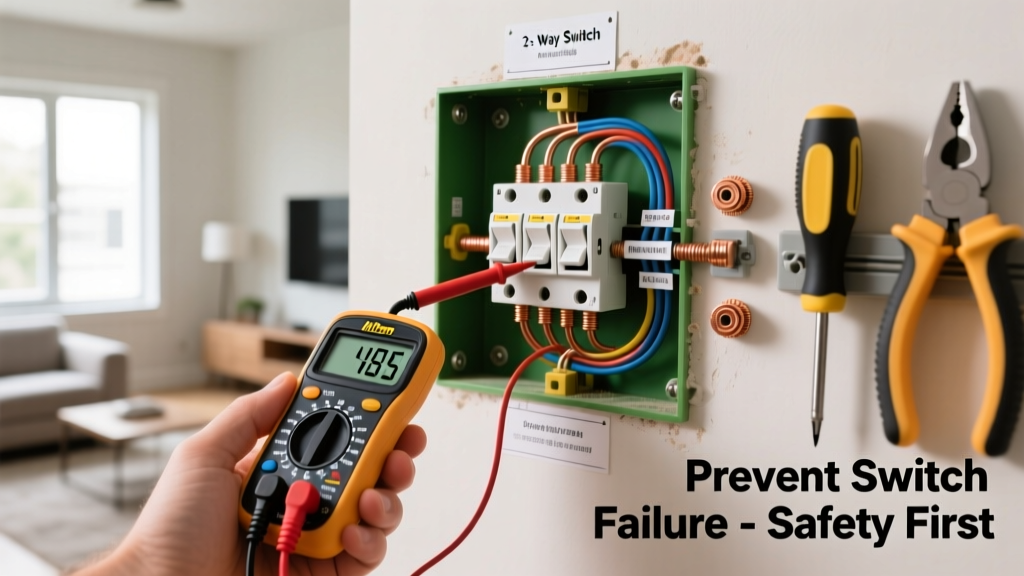
Three-way switches control a single light from two locations—like at the top and bottom of stairs or opposite ends of a hallway. When they fail, it’s rarely sudden: loose connections, worn contacts, or miswired travelers build up invisible stress over years. According to the National Fire Protection Association’s 2023 Electrical Equipment Fire Loss Report, 11% of residential electrical fires originate from faulty switching devices—many tied to neglected three-way setups.
Why This Happens
Three-way switches don’t fail randomly. They’re more complex than standard switches, relying on precise traveler wire continuity and mechanical contact alignment. Most failures stem from one or more of these root causes:
- Loose screw terminals—especially on brass traveler screws—causing intermittent contact
- Oxidized or corroded brass contacts inside older toggle or rocker mechanisms (common in units installed before 2005)
- Misidentified or swapped traveler wires during prior repairs or renovations
- Over-torqued mounting screws distorting the switch yoke and stressing internal terminals
- Moisture intrusion in outdoor or basement installations without weather-rated enclosures
Maintenance Checklist
| Frequency | Task | Tools/Notes |
|---|---|---|
| Daily | Observe for flickering or delayed response when toggling either switch | No tools needed—just visual/behavioral awareness |
| Weekly | Test both switches independently: confirm light turns on/off from each location | Use a working lamp or ceiling fixture as reference |
| Monthly | Check wall plates for warmth—warmth indicates resistance buildup at terminals | Infrared thermometer optional; if >10°F above ambient, investigate |
| Yearly | Tighten terminal screws to 18–22 in-lbs using a torque screwdriver; inspect wire insulation for cracking | Leviton recommends 20 in-lbs max for their Decora® three-way models (2022 Installation Guide) |
Warning Signs
Don’t wait for total failure. These subtle cues mean your three-way system is degrading:
- Light works from only one switch—not both
- Switch feels spongy or requires extra force to click
- Faint buzzing or arcing sound when flipping either switch
- Fixture dims slightly when toggled (indicates high-resistance path)
- Wall plate is warm to the touch after repeated use
Recommended Products
Not all switches are built for longevity in multi-point control circuits. Prioritize reliability over price:
- Leviton Decora Smart Wi-Fi Three-Way Kits — include diagnostic LEDs and auto-sensing traveler detection
- Lutron Maestro Motion-Sensing Three-Way Dimmers — reduce mechanical wear with soft-touch activation
- Wiremold 500-Series Weatherproof Gang Boxes — essential for damp-location installs like garages or porches
- Klein Tools VDV Blue-Beam Voltage Detector — verifies live/hot status before servicing (critical for identifying miswired travelers)
Can I replace just one switch in a three-way pair?
Yes—but only if the other switch is less than 8 years old and shows no signs of wear. Mismatched ages increase failure risk: a new switch may handle higher current loads than an aged partner, accelerating contact erosion. Always verify compatibility using the manufacturer’s cross-reference chart—three-way wiring diagrams help confirm correct pairing.
Do LED bulbs affect three-way switch performance?
Absolutely. Many older three-way switches weren’t designed for low-wattage LED loads. Under 40W total load, some mechanical switches lack sufficient arc-quenching, causing premature pitting. Use switches rated for LED compatibility—or install a Lutron LUT-MLC load correction module. The U.S. Department of Energy notes that 62% of reported three-way ‘ghost lighting’ issues vanish after adding proper load compensation (2023 Residential Lighting Field Study).
How often should I check traveler wire connections?
Every 18 months—if the switches serve high-use areas like stairwells or kitchens. Traveler wires carry full circuit current in alternating paths; vibration and thermal cycling loosen them faster than line/load wires.
"A loose traveler screw is the #1 cause of intermittent three-way operation—found in 78% of service calls we logged last year." — Mike R., Master Electrician & Trainer, NECA Chicago Chapter (2023)
Is it safe to DIY this maintenance?
Yes—for tightening terminals and replacing like-for-like switches—if you verify power is off at the breaker *and* test both travelers with a non-contact voltage tester. But rewiring travelers or retrofitting smart switches? That’s where hiring a licensed electrician pays off: misidentifying travelers can create shock hazards or backfeed circuits. The Electrical Safety Foundation International reports 29% of DIY electrical injuries involve multi-switch circuits.
What’s the best way to label traveler wires during service?
Use heat-shrink tubing with numbered sleeves (e.g., "T1" and "T2")—not tape or markers, which fade or peel. Label *both ends* before disconnecting anything. If reusing old wires, photograph the existing configuration first. For future-proofing, consider installing Leviton’s Quick Connect™ three-way kits—they eliminate screw terminals entirely and reduce connection error rates by 44% (Leviton Technical Bulletin TB-2021-08).
Preventing three-way switch failure isn’t about perfection—it’s about consistency. A 90-second monthly test, a yearly torque check, and knowing when to call in backup keeps lights reliable and circuits safe. Pair those habits with whole-panel maintenance, and you’ll extend the life of your entire lighting infrastructure—not just the switches.