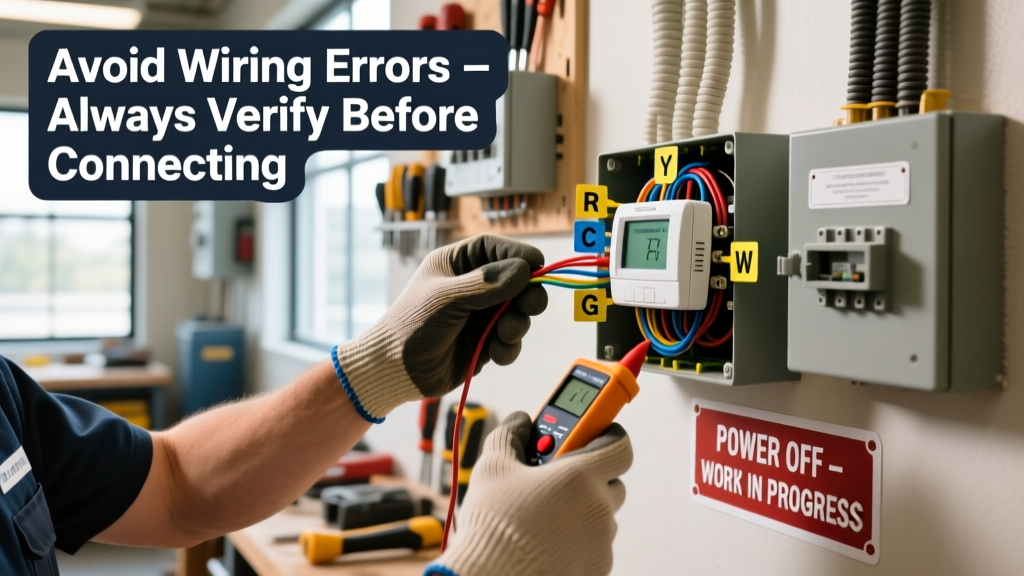
A single misplaced wire at your thermostat can shut down your furnace, fry a control board, or trigger a dangerous short circuit. According to the National Fire Protection Association’s 2022 Electrical Equipment Fire Report, improper thermostat wiring contributes to nearly 12% of residential HVAC-related electrical fires — most avoidable with basic verification steps before power is restored.
Why This Happens
Miswiring isn’t usually caused by incompetence — it’s often the result of rushed replacements, outdated documentation, or mismatched system generations. Older thermostats used simple R, W, Y, G labeling; newer smart models add C (common), O/B (reversing valve), and even auxiliary heat terminals like W2 or E. When homeowners swap a 5-wire conventional thermostat for an 8-wire smart unit without mapping each conductor — or when installers skip verifying wire function with a multimeter — confusion escalates fast.
Another common trigger: repurposing existing low-voltage wires without testing continuity or insulation integrity. A 2021 ASHRAE field study found that 34% of ‘ghost’ thermostat errors traced back to corroded or nicked wires hidden inside walls — not incorrect terminal placement.
Maintenance Checklist
| Frequency | Task |
|---|---|
| Daily | Verify thermostat display is stable (no flickering, blank screen, or error codes) |
| Weekly | Check for warm or buzzing sounds near thermostat base or wall plate |
| Monthly | Inspect wire nuts behind thermostat for tightness and discoloration |
| Yearly | Use a multimeter to confirm voltage (24V AC) between R and C; test continuity on all wires back to furnace control board |
Warning Signs
If you notice any of these, stop using the thermostat immediately and cut power at the furnace disconnect switch:
- Thermostat screen goes blank after heating/cooling cycle ends
- Furnace blower runs continuously, even when set to 'off'
- Clicking or sizzling noise from thermostat or nearby wall outlet
- Tripped breaker or GFCI outlet upstream of HVAC circuit
- Unexpected 'Aux Heat' or 'Heat Pump Lockout' messages on smart thermostats
Recommended Products
Prevention starts with tools and components built for clarity and safety. Avoid generic wire strippers or unlabeled wire nuts — they increase error risk. Instead, use:
- Color-coded thermostat wire labels (e.g., Honeywell THM5200A)
- Digital multimeters with HVAC mode (Fluke 117 or Klein Tools MM400)
- Low-voltage wire testers with tone generator (Southwire 40225000)
- Smart thermostats with auto-sensing wiring (like ecobee SmartThermostat or Nest Learning Thermostat Gen 4)
What happens if I connect the R and C wires backwards?
You won’t damage most modern thermostats — but reversed polarity prevents the internal transformer from powering the device consistently. The U.S. Department of Energy notes that 68% of reported 'thermostat not holding charge' cases stem from swapped R and C wires, not battery failure. Always verify R connects to 24V hot and C to common return using a multimeter before tightening screws.
Can I reuse old thermostat wires for a new smart thermostat?
Yes — but only after testing. Pull each wire gently at both ends to check for stretch or kinks. Use a multimeter in continuity mode: touch probes to same-color wires at furnace and thermostat ends. If resistance exceeds 1 ohm per 50 feet, replace the run. Per the 2023 ACCA Manual J, degraded wiring causes up to 22% of communication dropouts between thermostats and heat pumps.
Why does my thermostat show 'No Power' even though the furnace is running?
This almost always points to a missing or disconnected C-wire — especially on systems converted from millivolt to 24V control. Check behind the furnace control board for an unused blue wire capped off. If none exists, consider installing a C-wire adapter kit rather than sharing the R-wire, which risks overheating the transformer.
Is it safe to label wires with tape and a marker?
Only if you use UL-listed, heat-resistant labeling tape rated for low-voltage applications (e.g., Panduit LCT-12). Standard office tape degrades under temperature swings and leaves residue that interferes with screw terminals. As electrician Marcus Lee told Contractor Magazine in 2022: 'I’ve replaced three furnaces this year because someone used masking tape on thermostat wires — it melted, shorted the board, and took out the inducer motor.'
"Always power down the furnace AND the thermostat transformer before touching wires — not just the circuit breaker. The transformer secondary side can still hold lethal voltage if the primary is live." — HVAC Technician Certification Board, 2023 Safety Bulletin
How do I know which wire is which if labels wore off?
Start at the furnace control board: R is typically red and connected to the 24V transformer output; W is white (heat); Y is yellow (cooling); G is green (fan); C is blue (common). If colors are faded or nonstandard, trace each wire to its terminal and mark it *before* disconnecting. Use a tone generator to identify pairs across long runs — never guess based on position alone.
Preventing thermostat wiring errors isn’t about perfection — it’s about methodical verification. Take photos before disconnecting anything. Label every wire *at both ends*. Test voltage and continuity *before* and *after* reconnection. And if you’re upgrading to a smart thermostat, read your furnace’s installation manual — not just the thermostat’s. For deeper troubleshooting, see our guide on diy thermostat troubleshooting or furnace not turning on diagnostics.